
Define the compact class, lock the small-unit fields (weight and output basis, runtime, noise, outlets, parallel kit, packaging) and compare offers.
In this guide8 sections
A compact portable generator is bought on its field set, not on the word in the listing. "Smallest", "lightest" and "mini" are search terms; they tell a supplier nothing about what to quote. Write the class you are sourcing as six fields, then make every supplier answer the same small-unit questions with the basis of each figure: which weight, which output, which load point, which distance, which outlet set, which carton. That is the whole method of this guide, and it applies to roughly 0.7–2 kW inverter units and the smallest open-frame gasoline sets bought for retail, rental and outdoor channels. The exception is capacity: if you do not yet know what the units must run, size the load first with the load-list method; this guide starts once the target class is known.
It is written for importers, distributors, rental fleets and private-label buyers who write a request for quotation (RFQ). It does not rank models, review products, quote prices or give installation, connection or siting advice. Battery power stations are a different product class, with stored energy and charging inputs instead of a fuel tank; they belong on the portable power stations page, not here.
Define the compact class before you ask for quotes
Six fields define the class. Write them before the RFQ goes out, because every later comparison depends on them, and a supplier who receives them answers against one target instead of guessing which of its variants you mean.
| Field | What to write | Why it matters at the small end |
|---|---|---|
| Rated AC output | The continuous output band you are sourcing (this guide works in roughly 0.7–2 kW) and the one figure the comparison will use | Small units are often sold on maximum watts; the class must be defined on rated output |
| Voltage, frequency, phase | Destination values and the outlet standard | The same model name ships as different market variants |
| Fuel | Gasoline, and whether LPG or dual-fuel variants are in scope | Fuel decides the engine, tank, runtime and transport fields |
| Form | Enclosed inverter case, or a small open-frame set | Form drives weight, noise behaviour and handling |
| Output stage | Inverter required, or conventional capacitor- or AVR-regulated output acceptable | Decides whether waveform and economy-mode fields apply |
| Channel | Retail boxed unit, rental fleet, outdoor or camping bundle, private label | Decides the packaging, accessory and document fields |
Two boundaries keep the class honest. Inverter against conventional output is a technology decision covered in the inverter generator buying guide; here you only record which configuration is offered and ask for the evidence that goes with it. Form factor, noise and runtime as selection criteria for one buyer are covered in the portable inverter generator selection guide; this page turns those criteria into RFQ fields a supplier must answer with a stated basis. The question "what is the smallest generator made" has no useful answer for procurement: the smallest unit that meets your six fields is the one that matters, and it changes with the market variant.
Lock what "compact" means in numbers
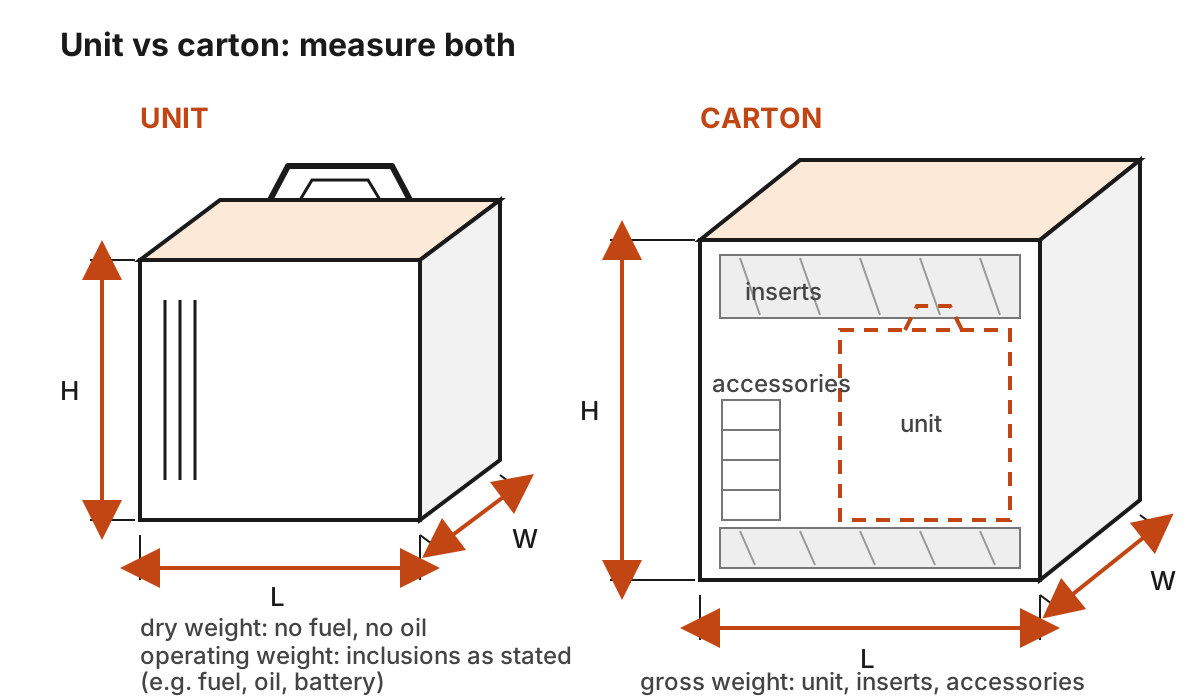
A compact unit is not defined by one weight. Ask for four separate figures and the inclusions behind each: dry weight, operating weight, unit dimensions, and carton dimensions with gross weight.
Dry weight and operating weight are different measurements, and "operating weight" is not a universal convention. One supplier includes fuel and oil, another includes the battery of an electric-start variant, a third quotes the unit with its accessory bag. The RFQ therefore asks for both figures with the inclusions written out: fuel (full tank or none), oil, battery, accessories. A single weight figure with no inclusions is returned for clarification, not entered in the comparison.
Unit dimensions and carton dimensions are also two fields. The product's length, width and height tell you about shelf space, vehicle space and handling; the carton's length, width, height and gross weight tell you about parcel and pallet planning, storage racks and the loading plan, which is why they go into the container loading data together with the packing configuration. A product size passed off as a carton size is one of the most common gaps in small-unit offers.
Handling is the fourth record. Note the handle arrangement (top carry handle, side grips, wheels) and the supplier's stated handling or lift information from the manual. Do not infer a one-person lift from a photograph or from a dry-weight figure: your channel's handling requirement and the maker's statement are two separate fields, and only the maker's document fills the second one.
Specify fuel, runtime and operating mode
Ask for tank capacity and runtime at named load points, with the economy-mode state stated for each figure. A runtime figure without a load point is not a figure; "up to" hours with no load, mode or model identity is returned.
Runtime changes with load, and on inverter units it also changes with the economy mode, which lets engine speed follow the load. Two offers are comparable only when both quote the same load point in the same mode: for example a quarter-load figure and a half-load figure, if the maker publishes both, each marked economy on or off, with the fuel and the test basis named. The runtime guide explains how to read consumption and test conditions; the RFQ field is simply tank capacity, runtime at each named load point, mode state, fuel and the document the figures come from.
Output basis belongs in the same section because it decides which load point you are talking about. Rated output is the continuous comparison figure; maximum output is a separate, time-bounded claim with its own duration and basis, and many small-unit listings foreground it. The rated versus peak guide covers the terminology; the RFQ requires both figures, their basis and the document that states them. The "80 percent rule" that appears in search results is a loading rule of thumb, not a specification: the rated figure and the maker's duty statement already carry the continuous basis, so the RFQ asks for those rather than for a percentage.
Record the engine identity as well: maker and model, displacement, two- or four-stroke cycle, cooling, and the fuel and oil arrangement from the maker's specification. Do not assume the cycle from the size of the unit. The oil arrangement decides what a rental customer must check before each use and which consumables a fleet stocks, and it belongs in the offer, not in an assumption.
Noise: require the conditions, not the number
A sound figure is comparable only when the metric and weighting, the distance, the load, the operating mode, the measurement position and the method travel with it. A bare dB(A) number is information, not a specification.
Sound power and sound pressure are different quantities; a sound-pressure level depends on the distance and the position at which it was measured, which is why the figure changes between the sides of the unit and between the load points. ISO 8528-10:2022 is the noise test code for engine-driven generating sets, and the useful RFQ question is which method and which descriptor the supplier's figure follows, not whether a standard number appears on the datasheet. Caterpillar's white paper on generator sound-pressure calculations is a readable explanation of why distance and averaging change the reported level. The procedure for checking a quiet claim is in the noise check guide; the field for this RFQ is the full set of conditions tied to the model.
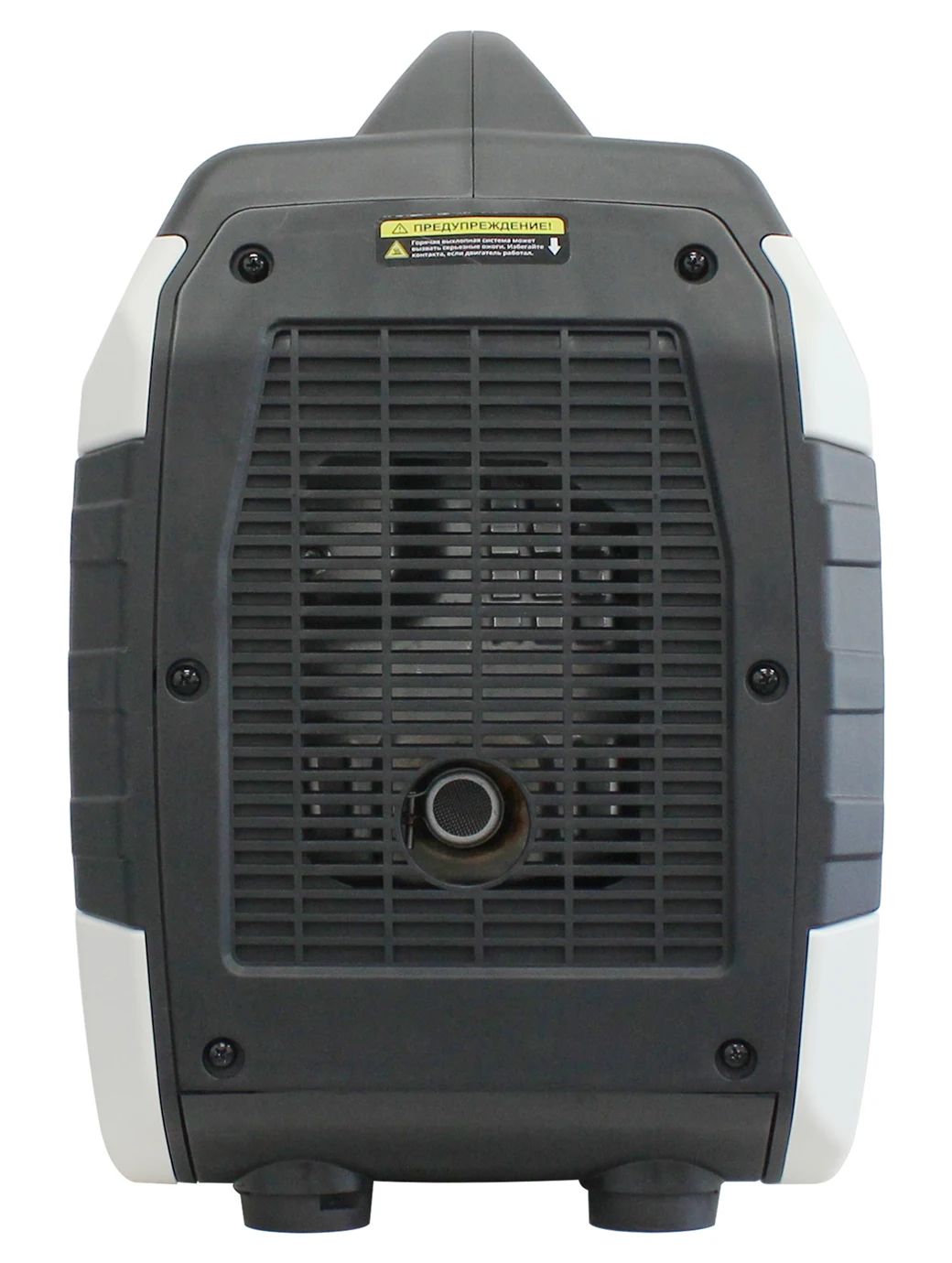
Between offers, hold the conditions constant before you compare. Two figures taken at different loads, distances or modes are two different measurements, not a ranking, and a rental or retail channel that promises "quiet" to its own customers needs the conditions in writing before it repeats the word.
Outlets, DC/USB and parallel capability
List every AC outlet with its type, voltage, frequency and rating, list the DC and USB outputs with their own ratings, and record parallel capability as a separate line with the compatible model and the kit identity. "Multiple outlets" is not an answer.
The outlet schedule is tied to the market variant, because the same model carries different receptacles for different destinations; the outlets and receptacles guide covers the SKU side. Ask for the panel photograph of the offered variant together with the specification. The E-H-M-3500-A product page shows the level of description to ask for on a compact inverter panel: the AC socket, the DC output, the USB port, the parallel terminals and the economy switch are each named separately, which is what the RFQ needs for every offered variant.
DC and USB outputs are separate rows with connector, voltage, current or power rating, and a statement of whether they operate concurrently with the AC load as claimed. They do not establish the AC rating. The related search "mini generator 12 V" describes a different product need: a DC socket on a small inverter unit is a convenience output, not the reason to buy the class.
"Parallel ready" without the compatible model list, the kit part number and the meaning of the combined figure is a marketing phrase. The parallel kit guide covers compatibility proof before a listing; the RFQ line is parallel yes or no, the approved pairing, the kit identity, and the basis of any combined output figure.
Tie every claim to the unit that will ship
Every figure, document and certificate in an offer must name the exact model, the variant or market code, the configuration and the document revision. A family datasheet, an unidentified revision or a certificate for another variant is returned, not filed.
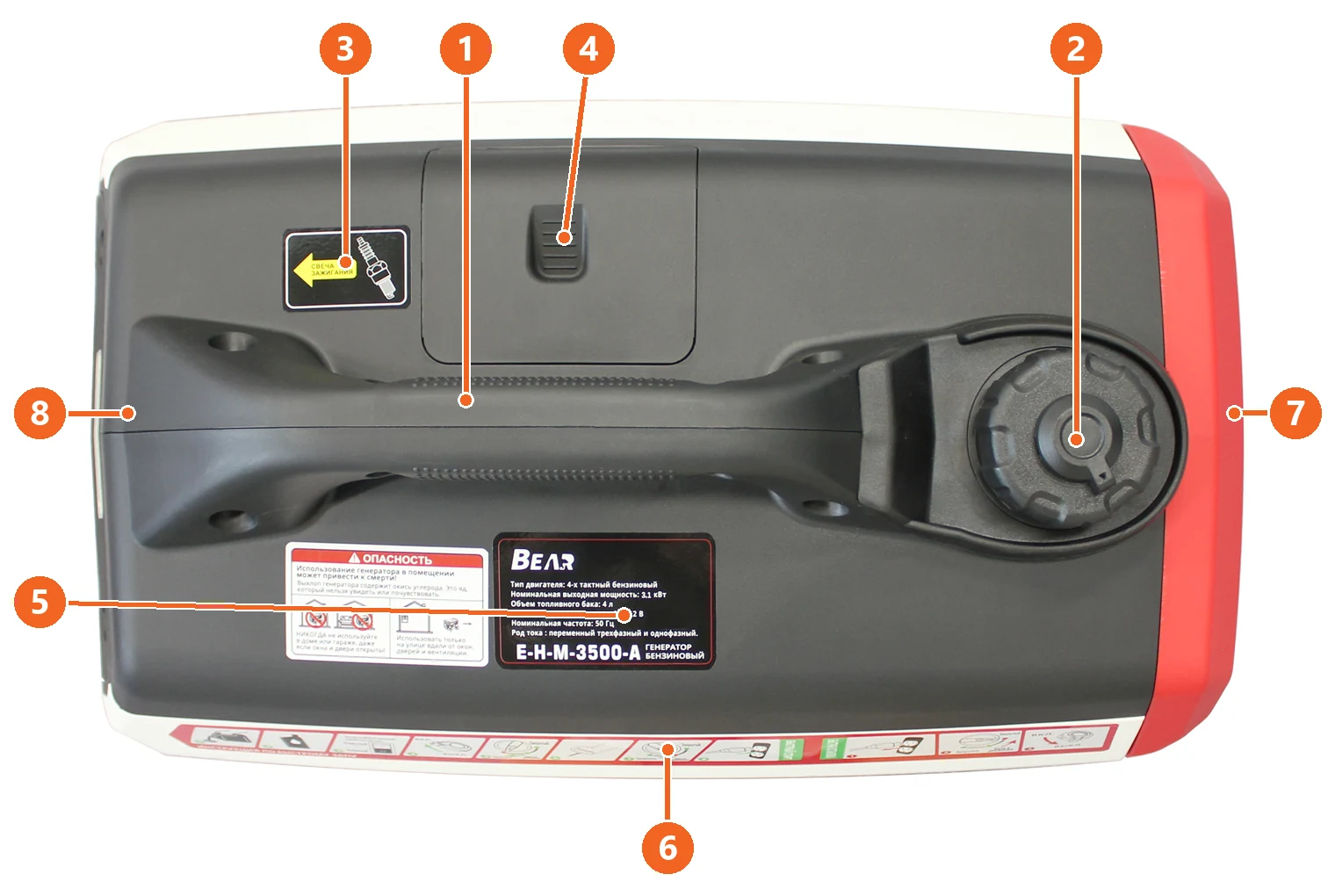
Four identity fields carry this: model code, variant or market code, configuration or order code, and the revision or date of the datasheet and manual. The model code on the unit's own label must match the datasheet, the manual, the certificate and the carton of the offered variant; the nameplate checklist lists what the label itself should show for import and resale. The photograph below shows where several of the RFQ fields live on a compact inverter unit, and which one is not visible from above.
| Callout | Visible part | RFQ field it belongs to |
|---|---|---|
| 1 | Carry handle | Handling: handle arrangement and the maker's handling statement; not a one-person-lift claim |
| 2 | Fuel filler cap | Fuel and weight basis: tank capacity, and whether the quoted weight includes fuel |
| 3 | Spark plug access cover | Service access and consumables: the spark plug type in the parts list |
| 4 | Service hatch latch | Maintenance access: what the manual lists as user-serviceable |
| 5 | Model and warning labels | Identity: the model code and the label language must match the datasheet, manual and carton of the offered variant |
| 6 | Quick-start pictogram strip | Market variant: label language and the documents included for the destination |
| 7 | Control-panel end | Outlet schedule, DC/USB ratings, economy switch and parallel terminals, recorded from the panel photograph and the manual |
| 8 | Exhaust end | Noise measurement side; the maker's manual carries the operating statements for this side, and this guide gives no siting advice |
Documents and packaging by destination
Ask the responsible manufacturer or importer which conformity route, emissions certification and safety standard edition apply to the exact model in the destination market, and file the document that names that model. A logo on a listing, a "global certificate" or a certificate for another model is not a document.
| Document or reference | Scope as published | What the RFQ asks for |
|---|---|---|
| ANSI/PGMA G300-2023, Safety and Performance of Portable Generators | US voluntary consensus standard for portable generators within its stated scope | Edition, scope match to the model and evidence of conformity; not implied for other destinations |
| ANSI/UL 2201 and carbon-monoxide features, listed on the CPSC portable generator page | US standard relevant to portable-generator safety and CO mitigation; CPSC lists it together with G300 | The exact feature name as documented (sensor, shutoff), its scope and the listing or certificate; a feature name is not a compliance claim |
| US EPA small engine emissions rules, 40 CFR Parts 1054 and 1060 | Federal exhaust and evaporative emissions rules for small spark-ignition engines and equipment, applicability by category | Engine and equipment emissions certification and label information from the responsible party |
| California small off-road engine requirements | California rules for covered new spark-ignition engines and equipment | Model year, engine category and sales channel confirmed by the responsible manufacturer or importer |
| ISO 8528-8:2016 | Design requirements, minimum performance and type tests for low-power generating sets | Which parts and edition were applied; a technical reference, not a market approval |
| Regulation (EU) 2023/1230 on machinery and the EMC Directive 2014/30/EU | EU machinery framework, whose application date must be checked against the placing-on-market date, and EU electromagnetic compatibility legislation | The EU responsible economic operator confirms the applicable legislation, the conformity route and the model-matched declaration |
Do not transfer household wiring rules, vehicle standards, marine standards or battery power-station standards onto a portable engine generator; identify the scope and the local adoption first, and leave legal interpretation for a market to the responsible importer or the local authority. The import compliance evidence matrix holds the general evidence fields by market; this section only adds the small-unit specifics.
Packaging has its own fields because the carton is the product in a retail or rental channel: carton configuration, dimensions and gross weight, protection, the accessories included (and excluded), the marks and labels on the carton, and the private-label artwork version where one applies. An electric-start variant adds the battery: chemistry or type, voltage and capacity, whether it is included, its shipping state, and the transport documentation the freight forwarder needs to classify the consignment. The forwarder confirms transport classification and shipment conditions for the actual configuration; the supplier confirms what is in the box.
Compare the offers and close
Put the offers side by side on one field list, mark each cell Pass, Gap or Exception with the document that supports it, and close only when every required field is a Pass or an Exception assigned to a named party. "Return" below means send back for clarification, not reject the product.
| Field | Complete supplier answer and evidence | Return when |
|---|---|---|
| Identity | Exact model, variant or market code, configuration and revision; datasheet and manual bearing the same identifiers | Family name only, unidentified revision, or documents for another variant |
| Rated and maximum output | Each value separately, with voltage, frequency, phase and the fuel or configuration it applies to; duration or definition of the maximum; the rating basis and its document | One headline watt figure, maximum presented as continuous, or no basis |
| Engine | Maker and model, displacement, two- or four-stroke, cooling, fuel and oil arrangement; engine document | "Standard engine" with no identity |
| Weight and dimensions | Dry and operating weight with inclusions defined; unit dimensions; carton dimensions and gross weight; drawing or spec sheet and packing record | One unlabelled weight or size set, or product size given as carton size |
| Fuel and runtime | Fuel, tank capacity, runtime at named load points, economy-mode state and test basis; maker's data or test record | "Up to" runtime without load, mode, fuel or model identity |
| Outlet schedule | Every AC outlet's type, voltage, frequency and rating; panel photograph of the variant plus specification | "Multiple outlets", or a list not tied to the offered variant |
| DC and USB | Connector, voltage, current or power rating, concurrent operation statement; manual or specification | Connector photo alone, or an output claim without a rating |
| Parallel | Yes or no; compatible model(s); kit identity; meaning of the combined figure; maker's compatibility statement | "Parallel ready" without pairing or kit, or an unsupported combined figure |
| Noise | Metric and weighting, distance, load, mode, measurement position, method or standard, tied to the model; test report or maker's documented data | Bare dB figure, or conditions that differ between offers |
| Certification by destination | Destination market, applicable requirement, certificate or declaration number, holder, model scope and revision; underlying document and label evidence | Logo-only claim, certificate for a different model, or "global certificate" |
| Packaging | Carton configuration, dimensions, gross weight, protection, included accessories, marks and labels, artwork version; packing specification and artwork proof | Dimensions without gross weight, unclear contents, or unapproved artwork |
| Battery, if electric start | Type, voltage and capacity, included or not, shipping state, transport documentation | "Electric start" without battery inclusion, state or shipping details |
| Documents | Exact file title, revision or date and language of the manual, datasheet, parts list, declarations, certificates, test reports and labels required for the destination | Undated generic files, missing revision, or a mismatch to model or market |
For the comparison itself, place the offers in columns beside the same list and cite the supplier document in an evidence column. The rows below are a hypothetical example of how the format reads; replace them with your own offers.
| Field (hypothetical example) | Offer A | Offer B | Offer C | Evidence cited |
|---|---|---|---|---|
| Rated and maximum output | Pass | Gap: maximum figure only | Pass | A: datasheet rev. 3; C: datasheet rev. 2 |
| Weight and dimensions | Exception: operating weight to be confirmed by the maker | Pass | Gap: product size given as carton size | A: spec sheet rev. 1; B: packing list |
| Noise | Pass | Pass, but at a different load point than A | Gap: bare dB figure | A and B: test records named in the quotation |
| Parallel | Pass: pairing and kit named | Gap: "parallel ready" | Not offered | A: maker compatibility statement |
The comparison is complete when every required row has a comparable answer, named evidence and a match to the offered model, variant and revision, and every remaining exception has an owner and a due date before order approval. When an offer is incomplete, return one sentence rather than a long email: "Please complete the missing fields for model ___, variant ___, revision ___; state the basis and conditions for each figure and attach the document that names this model; mark fields that do not apply as N/A with a reason."
For a BEAR quotation, send the six class fields, the destination market, the channel and the quantity through the contact page. The written quotation confirms the model, configuration, accessories and documents for that build, so the field set comes back answered against one exact unit rather than a family. BEAR's listed inverter configurations start above this band under gasoline inverter generators; whether a build in your class can be quoted is confirmed in the written quotation, and a sample unit or a factory visit can be arranged before a production order.