

Record placement and CO protection for one exact portable generator: manual wording, exhaust side, openings, weather, cord run, CO shutoff, local confirmations.
In this guide10 sections
Where to place a generator is settled by the manual of the exact model and by the site it will stand on, not by a distance copied from a forum thread or from another product's installation sheet. Before the order, and again at delivery, three things go into one record for that unit: the manufacturer's clearance and orientation wording from the manual revision that ships with it, the site facts (which way the exhaust faces, which openings are nearby, the ground, the weather exposure, the cord route), and the local rules that the installer or the authority having jurisdiction confirms. No distance in this guide is a rule, and every figure the record contains must carry the document it came from and the scope that document gives it.
The largest exception is not a field but an exclusion: indoors, garages, basements, crawl spaces, sheds and partly enclosed structures are not placements to evaluate for any fuel-burning generator, whatever carbon monoxide (CO) feature it carries. The record names them as excluded and stops there.
The record is written for importers, distributors, rental fleets, private-label buyers and prepared end buyers who need comparable supplier answers and evidence they can match to the delivered unit. It covers open-frame gasoline sets, inverter generators and enclosed canopy diesel sets that are moved to a site rather than installed permanently. It does not teach operation, does not summarise any code, and does not explain how an excluded location could be made acceptable; it says what to write down, who supplies each entry, and what to send back.
Connection to a building is the licensed electrician's work and stays outside this record; the generator-side fields that connection needs are in the neutral configuration record and the outlets, receptacles and plugs guide. Noise has its own measurement check, and the documents a destination market asks for sit in the import compliance matrix.
Lock the unit and the document the record describes
One record describes one model, one configuration and one manual revision; an answer that cannot be tied to that set is returned, however reasonable it sounds. Write the manufacturer and model code, the variant or configuration code, the fuel, the destination market with its voltage and frequency version, the manual's title, revision or date and language, the page or section that holds the placement wording, the serial or production identifier once it exists, and the quotation or order reference.
The identity matters because placement wording changes between revisions and between market versions of the same family, and because a standby set's installation manual carries figures written for a permanently installed, permanently connected product. Copying those figures into the record for a movable set stores a number with the wrong scope, and nobody will notice until the delivered unit is compared with it. The pre-order document checklist shows how the manual revision is tied to the order file, and the nameplate checklist covers the identity fields the nameplate must repeat.
Quote the manufacturer's clearance and orientation wording; do not convert it
Copy the wording as printed, with its page or section and the revision, and keep three sources in separate fields: the manufacturer's statement, the confirmation from the local authority or the installer, and any condition set by an insurer or a landlord. None of the three replaces another, and a figure from one does not become a rule for the others.
| Record entry | A complete answer | Return for completion |
|---|---|---|
| Manufacturer clearance and orientation wording | The text as printed, page or section, revision; any figure together with the document and the condition it applies to | A paraphrase, a figure without document and scope, or "see manual" without the exact manual and passage |
| Local-authority or installer confirmation | The named rule or authority, the jurisdiction, the confirmation status and who resolves any open point | "Compliant everywhere", or an uncited rule presented as universal |
| Insurer or landlord requirement | The written condition, or "not applicable" or "not confirmed" | Private conditions blended into the manufacturer's statement |
| Document identity | The manual revision used for every quoted passage | An undated extract, or another model's manual |
A supplier may answer "see manual" only when the answer names the exact manual revision and the passage. Enclosed canopy sets add one more item to quote: the manual's wording on the unit's own intake and discharge openings and on door swing, which describes the clearance the set needs for itself before any building is considered. The open-frame versus enclosed matrix lists what else changes between the two builds.
Where to place a generator: record the site as found
The site part of the record is a sketch and a list of observed conditions, not an approval. Mark the proposed position of the unit, every opening on the nearby building faces (windows, doors, vents, air intakes, soffit vents), the exhaust direction as an arrow, the ground surface with its slope or drainage, the cord route from the outlet panel to the point where it enters the building, and the exposure to rain, snow and wind. Leave each distance blank until it is measured at the site by the buyer or the installer; a distance written from memory, or from a different site, is not a record.
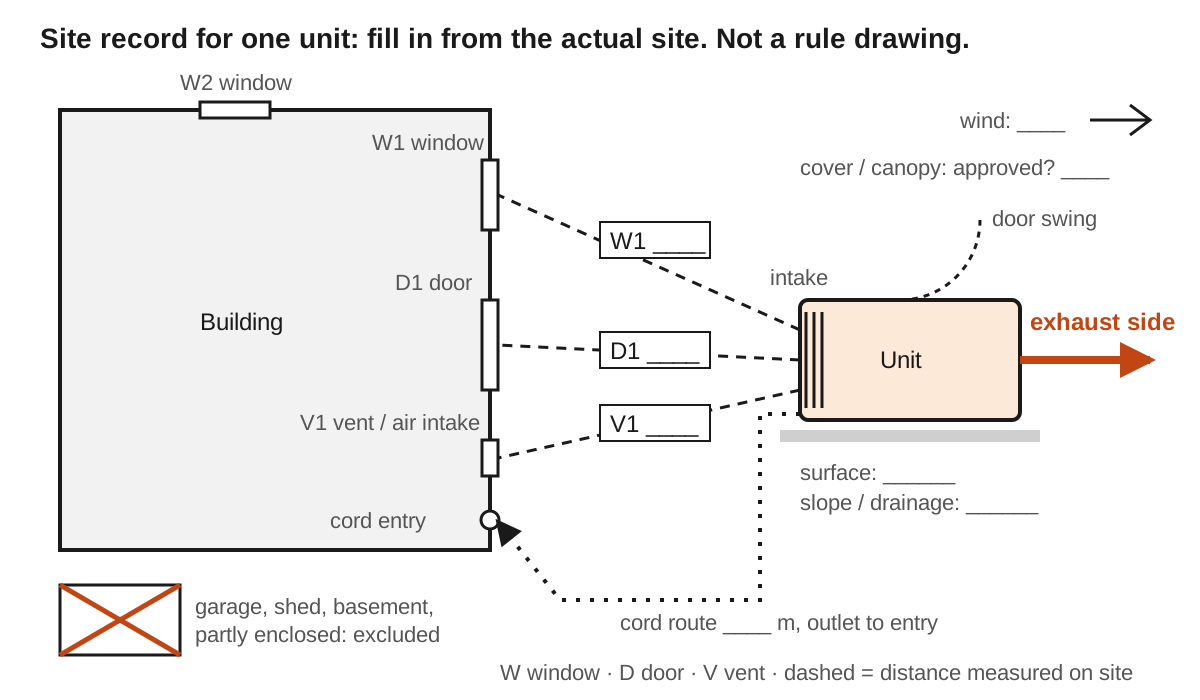
Two entries need words rather than numbers. The first is the list of openings by type and position, because the exhaust arrow is only meaningful when it is read against the openings it points towards or away from. The second is the cord route, because its length and its entry point are site facts the electrician will ask for before anything is connected, and the outlets and cords guide explains which cord facts belong with the generator record. If the only positions available are inside a structure or under a partly open one, the record closes with "no acceptable location identified".
The record does not try to compensate with open doors, a fan or a favourable wind. The U.S. Consumer Product Safety Commission states that portable generators are not to be used inside homes, garages, basements, crawl spaces or sheds even with doors and windows open; a shed with the doors open is an excluded location, not a placement option. Any engine-driven generator produces carbon monoxide (CDC/NIOSH); the brand on the canopy changes nothing about that.
Identify the exhaust side, intakes, doors, weather and ground on the quoted build
Ask the supplier for a photograph or drawing of the quoted build with the exhaust outlet identified. The end-and-side photograph that usually accompanies a quotation shows the outlet panel and the control window and may not show the exhaust face at all, so the exhaust arrow on the sketch cannot be drawn from it. On an enclosed set, the parts that the manual's clearance wording refers to are visible from outside once you know what to look for.
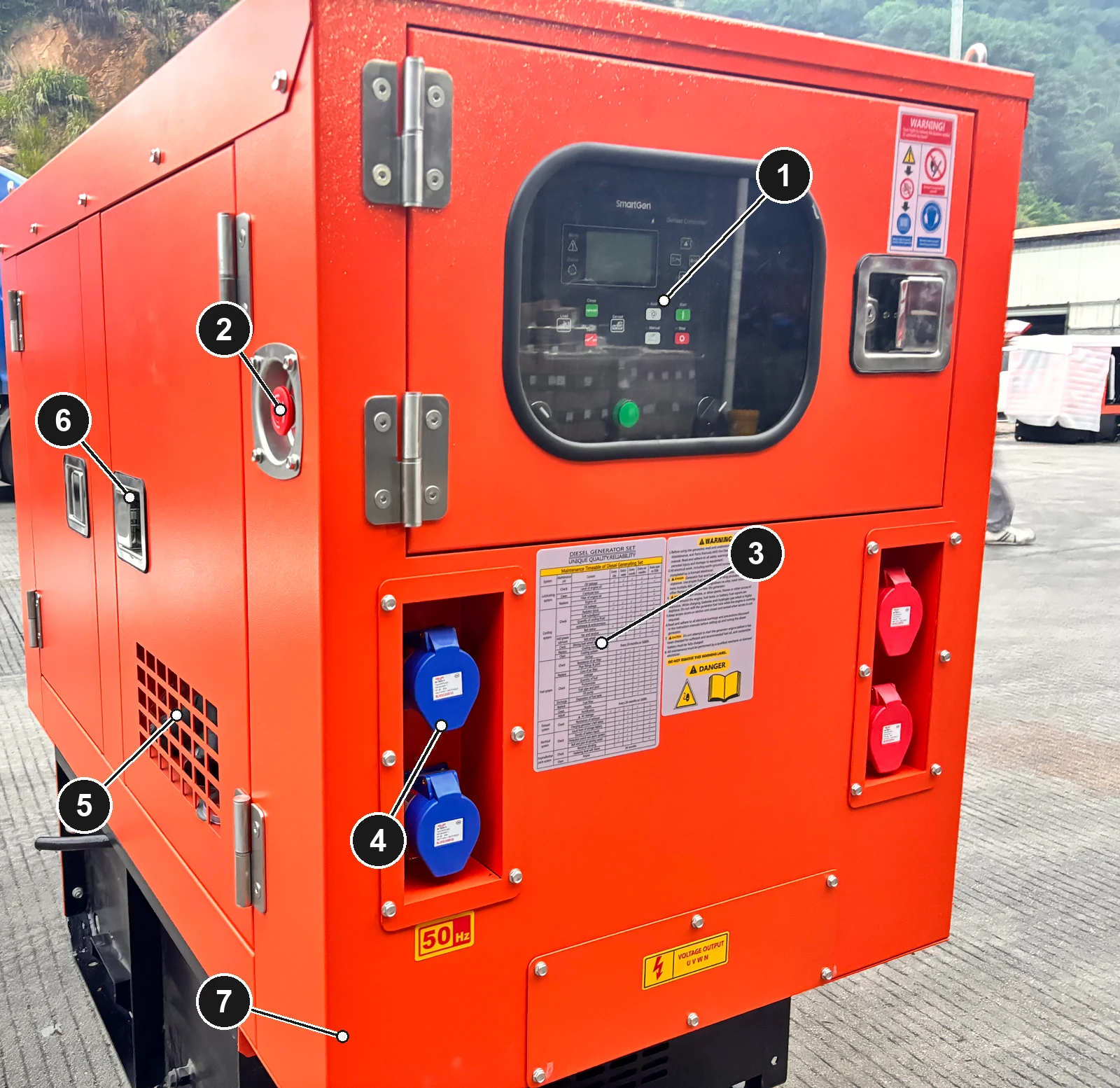
| Callout | Visible part | What it means for the record |
|---|---|---|
| 1 | Controller window | The side the operator stands at; the installer's access clearance refers to it |
| 2 | Emergency stop button | Must stay reachable from the operator's side; note which face it is on |
| 3 | Instruction and warning label area | The label artwork the record asks for; photograph it on the delivered unit and compare it with the market version named in the manual |
| 4 | Output socket panel | Where the cord run starts; its position fixes the cord route on the sketch |
| 5 | Intake louvre on the service door | An opening of the unit itself; the manual's intake clearance wording applies here |
| 6 | Service door latch | Door swing needs its own clearance; record which doors open and to which side |
| 7 | Base frame | The contact with the ground; forklift pockets or a skid decide how the set is positioned on the surface |
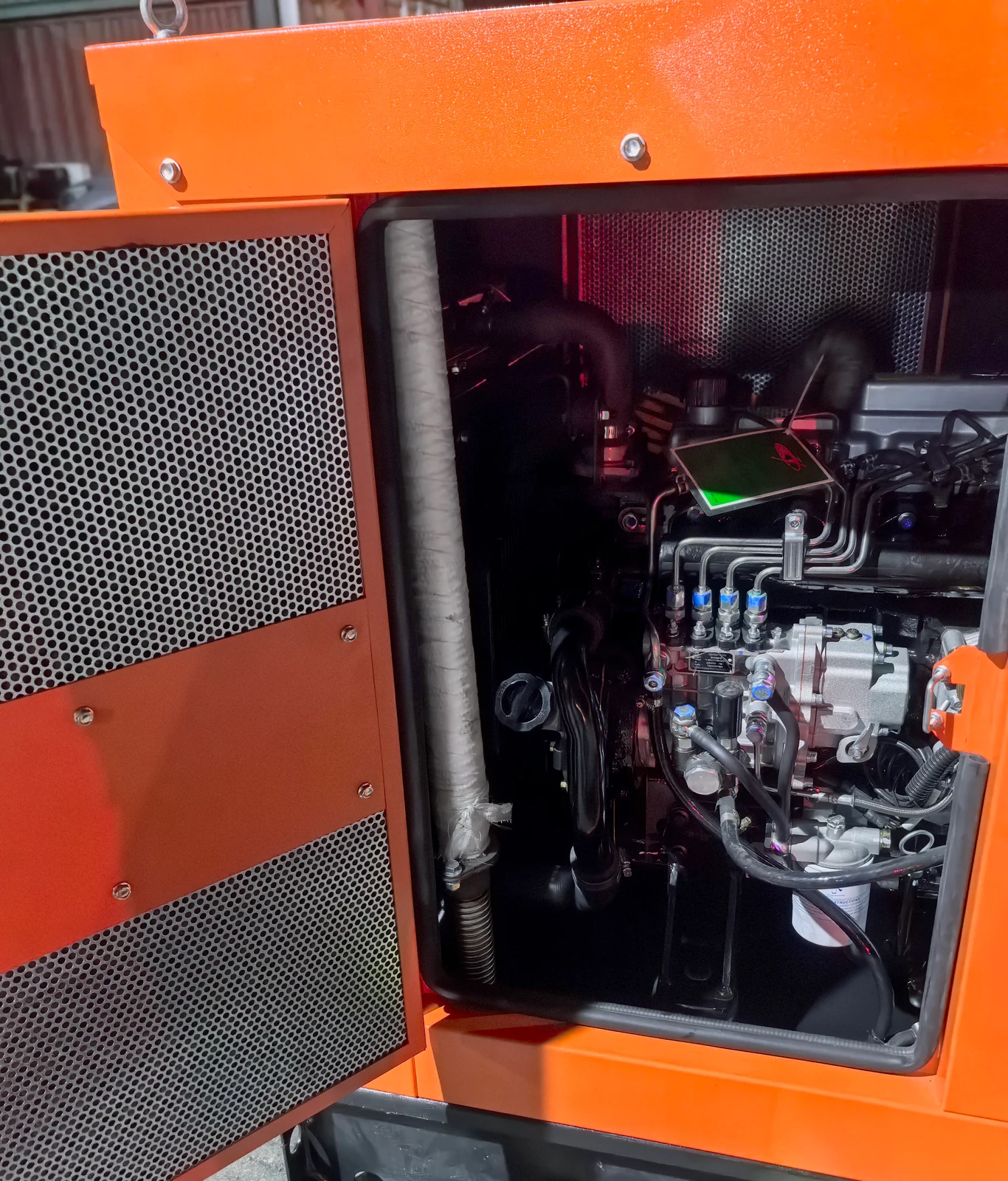
Weather goes into the record as the manual's operating-weather wording, quoted like the clearance wording, plus the status of any cover. A manufacturer-approved operating cover or canopy, a storage cover and an improvised shelter are three different things: only the first may be used while the set runs, and only when the accessory's identity and the model-specific evidence for it are on file. "Weatherproof" on a listing is not that evidence.
Ground conditions are observed and written down (surface, level, drainage, anything that could collect water or fuel), and the installer confirms suitability where the manual or the local rules require it. Enclosed sets of the kind shown are listed under silent diesel generators; for the movement, kit and wet-area rules that apply when a set is issued to a crew for a shift, use the job-site guide.
CO shutoff: record the feature identity, not the marketing word
Record yes, no or unknown for the exact unit, the feature's name as the manufacturer prints it, the manual page or the label that shows it, and, if the supplier claims compliance with a named standard, the document that supports the claim for this model and configuration. "CO safe", "CO protected" or a feature name on its own is not evidence. Not every set carries such a feature; where it is absent, the record states "not fitted", confirmed by the supplier, rather than leaving the field blank.
The boundary is more important than the field. A sensor that shuts the engine down is a risk-reduction feature. The CPSC voluntary-standards page for portable generators describes the standards that contain such provisions, and the same agency's guidance still places the generator outdoors and away from the building. The feature does not make an enclosed or partly enclosed location acceptable, and the record must not treat it as if it did.
The two standards the agency names in this context are UL 2201 and ANSI/PGMA G300; the PGMA publishes the G300-2023 text, whose scope statement and exclusions are the first thing to read, because a configuration built for another market can sit outside it. For either standard, ask whether compliance is claimed for the exact unit, which edition, and for the supporting document. The standard's name on a listing proves nothing about the unit quoted.
Market rules and standards: use each for its scope
Record the named rule or authority, the jurisdiction and the confirmation status, and let the installer or the authority identify who resolves a site-specific question. The table lists the documents that appear most often in supplier answers and what each can and cannot do in the record; confirm the edition and the scope before any of them is cited.
| Document | What it is | How the record uses it |
|---|---|---|
| Manual of the exact model (manufacturer) | The product-side requirement for that model, configuration and revision | Quoted verbatim; it governs the unit's own clearances, orientation and weather limits |
| ANSI/PGMA G300-2023 (PGMA) | A voluntary US industry standard for portable generators with its own scope statement and exclusions | Ask whether compliance is claimed for the exact unit, with edition and evidence; confirm that the configuration falls within the scope |
| UL 2201 (UL) | A voluntary US product-safety standard for portable engine-generator assemblies that CPSC describes in connection with CO hazard mitigation | Same treatment; the name alone is not a certification of the quoted unit |
| NFPA 37 (NFPA) | A US standard for stationary combustion engines; its application text also reaches portable engines that stay connected in one place for an extended period | Applicability is a question for the authority having jurisdiction; do not copy its separation provisions into a portable record |
| OSHA 3286 and CPSC safety guidance | Agency guidance with its own figures and its own audience | If quoted, name the document and the audience; never present it as a universal manufacturer or legal requirement |
| Standby-set installation manuals | Written for permanently installed, permanently connected sets | Do not transfer their figures to a movable set |
| Local fire, building and noise rules | Vary by jurisdiction and by site | The installer or the authority confirms; noise belongs in the noise check and market documents in the import compliance matrix |
Do not present any numeric distance as a universal fact. If a number must appear in the record, state the document, the edition, the scope and the condition behind it, or leave the field with the name of the person who will confirm it.
Labels and the delivery check
Ask for a clear image, or the artwork, of the CO and placement warning labels for the exact unit and market version, with the language identified. At delivery, photograph the labels, the exhaust face and the CO feature (or its absence) and compare them with the record before the unit is accepted:
- the label artwork matches the market version and language named in the manual;
- the exhaust outlet sits where the drawing used for the sketch shows it;
- the CO feature is present or absent exactly as recorded, with the same name;
- the manual revision supplied matches the revision quoted in the record;
- a cover or canopy delivered as an operating accessory is the one for which evidence is on file.
A mismatch holds the acceptance and returns the record to the supplier with the photograph attached. The incoming inspection fields cover the rest of the receiving check, and the nameplate checklist the identity marks the labels must agree with.
The placement and CO-protection record
The record has thirteen fields. The supplier answers the product-side fields for the exact quoted build; the buyer or the site party supplies the site facts; the installer, the local authority and the insurer or landlord confirm their own entries. Each field closes with evidence attached or with an open item assigned to a named person.
| Field | Supplied by | Acceptable evidence | Status |
|---|---|---|---|
| Product identity: manufacturer, model, variant, fuel, destination market and version | Supplier | Matches the quotation, the nameplate and the supplied manual | |
| Manual identity: title, revision or date, language, page or section | Supplier | The full manual for that model and configuration, kept with the order file | |
| Manufacturer clearance and orientation wording | Supplier | Verbatim text with page or section and revision; any figure with document and scope | |
| Exhaust side and direction | Supplier (product) and buyer (sketch) | Photograph or drawing of the quoted build with the outlet identified; arrow drawn on the sketch | |
| Site sketch | Buyer or site party | Unit position, openings by type, exhaust arrow, blank distance fields | |
| Surface and ground conditions | Buyer or site party; installer confirms where needed | Observed surface, level and drainage written down | |
| Nearby openings | Buyer or site party | Windows, doors, vents, air intakes and soffits listed by position | |
| Cord route and length | Buyer or site party; electrician confirms suitability separately | Route drawn and length measured, or "not yet measured" | |
| Weather exposure and cover | Supplier (manual wording, accessory evidence) and buyer (exposure) | Operating-weather wording quoted; cover identity and model-specific evidence, or "no operating cover" | |
| CO sensor and shutoff | Supplier | Yes, no or unknown; feature name; manual or label evidence; standards claim with document, if claimed | |
| Labels | Supplier | Image or artwork for the exact unit and market version, language identified | |
| Destination-market rules | Installer or local authority | Named rule or authority, jurisdiction, confirmation status | |
| Insurer or landlord requirements | Buyer | Written requirement, or "not applicable" or "not confirmed", kept separate from the two rows above |
The record is complete when one document ties the exact model, configuration and manual revision to the site facts, the quoted wording, the CO-feature evidence, the labels and the named confirmations, and when every numeric distance in it carries a document and a scope or is explicitly left to the manual and the confirmer. An incomplete answer goes back to the party named in the row, with the missing document, site fact or confirmation spelled out; nothing is filled in with a figure from elsewhere.
Hypothetical example of a returned row: a supplier answers the clearance field with "keep the usual clearance around the set". The buyer quotes that sentence in the status column, marks the row open, and asks for the manual passage with page and revision for the quoted configuration. No figure is written until it arrives.
Errors that make a record unusable
- A distance copied from a search result, a forum, another model, a standby manual or another market, without the document and the scope.
- A CO shutoff treated as a substitute for an outdoor location, or a feature label treated as proof of compliance with a standard.
- Open doors, windows, a fan or the wind direction used to argue that an excluded location is acceptable.
- A storage cover accepted as an operating cover, or an improvised shelter accepted as weather protection.
- The supplier asked to judge the site, or insurer and landlord conditions written into the manufacturer's row.
- Model, configuration or manual revision left out, so that delivery evidence cannot be matched to the record.
- The exhaust side recorded from a photograph of a different variant.
A unit that stands idle between outages has fields of its own for fuel, oil, battery and the storage site; they are in the off-season storage guide, not here.
Send the record with the inquiry
For a BEAR quotation, send the record with the rows you can already fill: the model of interest, the destination market and version, the openings and exposure of the intended site, and whether a CO feature is required, through the contact page. The written quotation confirms the model, configuration, accessories and documents, so the manual revision, the exhaust-side view and the label artwork of the quoted build can be requested as part of it, and a sample unit or a factory visit can be arranged before a production order. Portable gasoline sets are listed under gasoline generators, and enclosed sets like the one photographed under silent diesel generators.