
Turn a generator warranty offer into order fields: start event, hour cap, covered parts, dead-on-arrival handling, parts and freight, claim evidence.
In this guide9 sections
A generator warranty is worth exactly what the order says in writing, and most quotations say very little. Before you accept "12 months warranty" or "one year or 1,000 hours" from a factory or brand in China, write eight things into the order: the start event and how it is proved, the hour cap and how hours are read, the covered failures and the named exclusions, dead-on-arrival handling, who repairs the unit in your country, who pays for parts, labour, freight and customs, what evidence a claim needs, and what you must pass on if you resell. The one exception is a sample or trial unit bought to test a supplier: there you can accept the standard document, but record the same fields, so the first container is not negotiated from zero.
This guide is for importers, distributors, dealers, rental fleets and small businesses buying portable gasoline or inverter generators, small air-cooled diesel sets or larger diesel generator sets. It does not compare brands' warranty lengths and it is not legal advice. Screening the supplier itself belongs to the supplier checklist, and the pre-order paperwork belongs to the document pack guide; this page only turns the warranty promise into checkable order terms.
Start with the clock: period, hour cap and the start event
"12 months" is not a term until the order says when the twelve months begin. Shipment, delivery at your warehouse, commissioning and first start are four different dates, and on a container that waits in a port they can be two months apart. Pick one event, name the document that proves it, and write both into the clause.
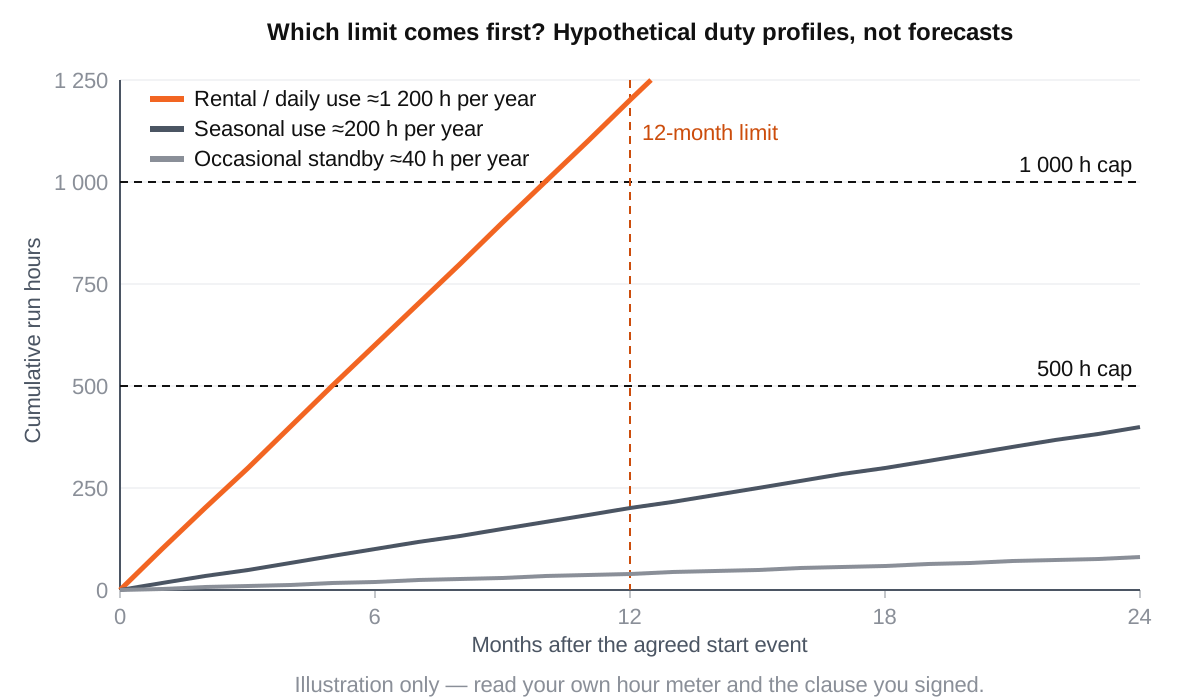
Hour caps need the same treatment. A warranty that reads "12 months or 1,000 hours" should say which limit ends coverage first, how hours are read, and what counts if the unit has no hour meter. The chart below shows why the two limits are not interchangeable: a rental fleet can use up an hour cap long before the calendar runs out, while a standby unit will never reach it.
| Clock field | A complete supplier answer | Proof to keep | Who confirms |
|---|---|---|---|
| Period | Number of months and the rule when both a time limit and an hour limit exist ("whichever occurs first" or another stated rule) | Signed order clause or warranty statement attached to the order | Supplier |
| Start event | One named event: bill-of-lading date, delivery record at your warehouse, commissioning record or first-start record | The document named in the clause | Supplier; your receiving staff for delivery |
| Hour cap | The number and how hours are read: hour meter, controller log, or a stated alternative when no meter is fitted | Photo of the meter at delivery and at the claim | Supplier; your staff keep the readings |
| Backstop | What happens if delivery or commissioning is delayed beyond a stated date after shipment | Order clause | Supplier and buyer |
If a quotation only says "12 months", send it back with one sentence: "Please state the start event, the proof document, the hour cap and which limit expires first." A supplier who can answer this in writing has a warranty process; one who cannot has a slogan.
Who repairs what: set, engine and alternator warranties
A generator set is often sold with more than one warranty inside it. The set builder covers assembly and its own parts, the engine maker may cover the engine under separate terms, and the alternator, controller or inverter module may carry a third document. Each can have a different period, a different claim channel and a different list of exclusions.
Ask for every applicable document before the deposit and ask one more question: who coordinates a claim that touches two of them? The useful answer names one party, usually the set supplier, who takes the claim and deals with the component makers behind the scenes. "Contact the engine manufacturer directly" is a real answer too, but then you need that manufacturer's claim route in your country before you order, not after the failure.
Repair location is the second half of this section. Three arrangements are common and all three can work: a named service partner in your market, a parts-and-labour model where the factory ships parts and your own workshop fits them at an agreed labour allowance, or a return-to-seller model for small units. What does not work is "worldwide support" with no party and no route; treat it as a blank field. The supplier checklist covers how to assign after-sales ownership across the whole relationship; here you only need the warranty routing written down.
Which failures and parts are covered, and which are named
"Defects in material and workmanship" is the standard formula, and it tells you nothing about the parts you actually worry about. The way to make it useful is to list components and ask for a status against each one: covered, excluded, or covered under a stated condition. The same list later becomes your claim form.
| Component or item | Typical status to request | Condition to pin down |
|---|---|---|
| Alternator windings, rotor, stator | Covered | Period and hours as in the clock clause |
| AVR, inverter board, controller | Covered or conditional | Whether a failure attributed to overload or to a connected load is excluded, and what evidence decides it |
| Carburettor, injection pump, fuel lines | Conditional | Fuel-related exclusions: stale or contaminated fuel, wrong fuel grade, and the evidence the supplier would use |
| Recoil starter, starter motor, battery | Conditional or shorter period | Batteries often carry their own shorter term; recoil rope may be treated as wear |
| Filters, spark plugs, belts, brushes, oil, coolant | Excluded as consumables | Whether a consumable needed for a covered repair is supplied with the part |
| Paint, canopy panels, wheels, handles | Excluded or cosmetic-only | Transit damage belongs to the shipment claim, not the warranty |
Two exclusion families deserve their own sentences in the clause. Fuel-related exclusions are the most common reason a carburettor claim is refused, so the order should say how the supplier would establish a fuel cause, rather than leaving "improper fuel" as a free-standing phrase. Maintenance-related exclusions should point to the actual service schedule of the engine, which is why the maintenance schedule guide and the first-order spare-parts kit belong next to this clause: a missing service record should trigger a question, not an automatic denial, unless the contract says otherwise.
Dead on arrival is a separate clause
A unit that does not start on the day it is unpacked is not the same case as a unit that fails in month seven, and a general warranty clause usually does not say what happens in the first case. Write a short dead-on-arrival clause of its own. It needs four fields: the reporting window after receipt, the evidence you will send, who decides, and the remedy with its freight allocation.
Evidence is cheap to agree in advance and expensive to argue about later. An unboxing video that shows the serial number, the shipping marks and the first start attempt settles most disputes about transit damage versus factory fault. The pre-shipment inspection checklist reduces how often you need the clause, and a witnessed test in the factory acceptance test scope reduces it further, but neither replaces it: a passed inspection proves the unit ran at the factory, not that it survived the voyage.
Parts, labour, freight and customs: who pays what
"Free replacement parts" is where most warranty promises quietly break. The part may be free; the courier from China, the import duty, the VAT at your border, the broker, the labour to fit it and the return of the failed part are not, and the Incoterms® rule on your original shipment does not decide them. The International Chamber of Commerce's Incoterms® 2020 allocate delivery cost and risk for the goods you bought; warranty parts need their own allocation.
| Cost line | Question to settle | Common answers to compare |
|---|---|---|
| Replacement part | Free within the period, or at a stated price | Free for covered failures; consumables at list price |
| Outbound freight | Who books and pays the courier or the next container slot | Supplier pays courier for small parts; large parts ride the next order |
| Duties and taxes on parts | Who pays at your border | Buyer, unless the supplier ships with duties paid |
| Labour | Who performs it and at what allowance | Your workshop at an agreed hourly allowance; a named partner; or none |
| Failed-part return | Whether the old part must go back, and who pays | Return on request at supplier cost, or photo evidence and local scrapping |
| Response time | Days to acknowledge, days to decide, days to dispatch | Stated milestones with an escalation contact |
Write the table into the order with one answer per line. A supplier who prefers to leave a line open is telling you where the first dispute will be.
Claim evidence you can keep from day one
Most refused claims are refused for paperwork, not for engineering: a missing hour reading, a serial that does not match the invoice, a service record that was never kept. Agree the evidence list before shipment and start the records when the unit arrives, not when it fails.
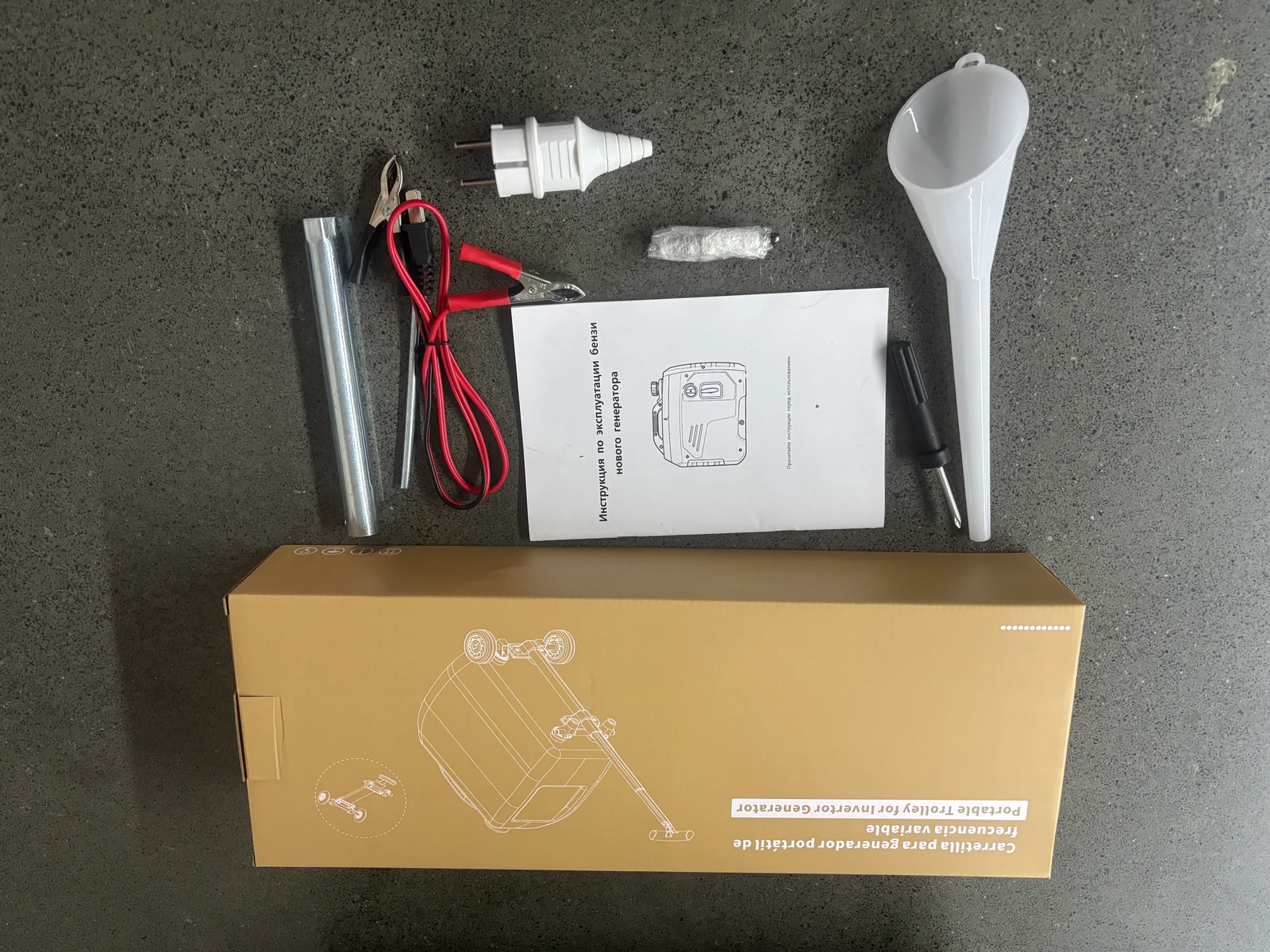
The evidence list a buyer can realistically keep has six items:
- serial and model plate photographed at delivery;
- the delivery record that starts the clock;
- hour-meter readings at delivery, at each service and at the claim;
- a service log with dates, oil grade and filters used;
- photos or a short video of the failure and of the fuel in the tank;
- the claim channel named in the order, with the response milestones from the cost table above.
The test-report red flags guide explains why a factory test report is not claim evidence: it proves a state at the factory, not a defect later. The first-article approval guide covers the approved sample that a later claim is measured against.
If you resell, decide what passes to your customers
A factory warranty is a contract between you and the factory. Your customers have a contract with you, and in most countries a consumer who buys from a dealer has rights that do not depend on what the factory promised.
The United States Federal Trade Commission's business guide to federal warranty law explains that its consumer-warranty rules cover consumer products rather than goods bought for resale or commercial use; the European Union's consumer contracts and guarantees page sets out the seller's duties toward consumers in EU countries. Russia and the EAEU have their own consumer-protection law with the same structure. None of these pages tells you a universal period; they tell you to check the law of the country where you sell.
For the order, three fields follow. What warranty text and records you must hand to each reseller or end user. How an end-user claim reaches the factory, and whether the factory accepts it directly or only through you. Whether the factory's period is long enough to cover what local law and your own sales terms oblige you to give; if it is not, the gap is your cost and should be priced into the margin.
Compare the clause, not the slogan
"Fully tested", "lifetime support" and "extended warranty available" are not fields. The warranty schedule below is. Ask every supplier to fill it against the same model list, mark each row agreed, missing or disputed, and do not treat two offers as comparable while a material row is blank. The same sheet goes into the order as an attachment, and it tells your receiving staff what to record on day one.
| # | Field | Agreed / missing / disputed | What to send back when missing |
|---|---|---|---|
| 1 | Covered product: models, configurations, serial ranges; set, engine and alternator covered together or separately | "Identify the covered product and attach each applicable warranty document." | |
| 2 | Period and hour cap, and which limit expires first | "State the time limit, the hour limit and the end rule." | |
| 3 | Start event and its proof document | "Name the start event and the record that proves it." | |
| 4 | Covered failures and the status of each named component | Send the component table for completion. | |
| 5 | Wear items, consumables and maintenance exclusions, with the schedule they refer to | "List the excluded items and attach the service schedule." | |
| 6 | Fuel, misuse, storage and alteration exclusions, and the evidence used to decide them | "Define each exclusion and the evidence that establishes it." | |
| 7 | Dead-on-arrival clause: window, evidence, decision, remedy, freight | Propose the four fields as a clause. | |
| 8 | Remedy and repair location per assembly: repair, replacement, credit; named party and route | "Name the claim owner and repair route for each assembly." | |
| 9 | Parts, labour and failed-part return | "State who supplies parts, who pays labour and whether failed parts return." | |
| 10 | Freight, duties, taxes and local charges on warranty parts | Send the cost table and ask for a payer per line. | |
| 11 | Claim evidence list and submission channel | "Confirm the evidence list and acceptable alternatives." | |
| 12 | Response and decision milestones with an escalation contact | "Replace 'prompt' with dates and a named contact." | |
| 13 | Reseller handover and end-user claim routing | "State what I pass to resellers and how their claims reach you." | |
| 14 | Governing law, language and which document controls if the quotation and the warranty text conflict | Send the list of conflicts for resolution. |
When you ask BEAR for a quotation on gasoline generators or diesel generator sets, attach this schedule with the model list and the destination country. The written quotation that comes back is the document that fixes model, configuration, accessories and papers for your order, and it is the place where the warranty fields should appear as text rather than as a brochure line. Send the completed schedule to Miya together with the quantity, the destination voltage and frequency, and how you intend to resell or operate the units.
Frequently asked questions
Does "every unit is fully tested" shorten the warranty discussion?
No. A factory test proves that the unit ran before packing; it does not define a period, a remedy or a cost allocation, and it does not settle a dead-on-arrival case. Keep the test record for your file and negotiate the clause as if the sentence were not there.
What if the generator has no hour meter?
Agree an alternative before shipment: fuel purchased, a maintenance log signed at each service, or a stated assumption of hours per month for the duty you described. A missing meter should lead to an agreed rule, not to an automatic refusal at claim time.
Is a longer warranty a sign of a better generator?
Not by itself. A 24-month promise with undefined exclusions, no named repairer and freight at your cost can be worth less than a 12-month clause with every field filled. Compare the fourteen rows, then the months.