
Specify a genset base frame before ordering: construction, mounts, lifting and forklift points, battery tray, finish, and the drawings to inspect it against.
In this guide8 sections
A skid-mounted generator is only as well specified as the drawing behind its base frame. Before you order, get a frame drawing and a lifting drawing that carry the exact model, configuration and revision, and check the delivered frame against them: construction (welded or bent), cross members and mount pads, the mounts between engine, alternator and frame, lifting points, locating holes, forklift slots, the battery tray, drain points and the finish. Phrases such as "heavy-duty skid" settle none of these. The main exception is everything below the frame: the foundation, the anchoring and any isolation between the set and the floor belong to the installer or site designer, and the wooden skid a set ships on is packaging, not part of the generator.
This guide is for importers, distributors, rental fleets and EPC contractors buying diesel generator sets from a factory. It turns the frame into RFQ fields with a completion test and a short inspection record. It does not size frames, design foundations or describe lifting procedures. If you are still choosing between an open set and a canopy, start with the open-frame versus enclosed comparison; if the frame is settled and you are planning the shipment, the container loading plan lists the data a forwarder needs.
What the base frame carries, and what it does not decide
The base frame, or skid, is the steel structure the engine, alternator, radiator and control panel sit on; on many diesel sets it also contains or carries the fuel tank. It holds that assembly in alignment, takes the shake when the set starts and runs under load, and gives the set defined points for lifting, locating and handling.
All of that is the genset supplier's design for a particular model and configuration. The buyer's job is to obtain the arrangement in writing and check it, not to calculate it.
Four terms get mixed up in quotations. Keep them apart in the RFQ:
| Term in a quotation | What it is | What to ask for |
|---|---|---|
| Base frame / skid | The genset's own steel frame under engine and alternator | Frame drawing with model, configuration and revision |
| Sub-base tank / tank in base | A fuel tank built into or under the frame | Whether it is fitted, and its interface on the same drawing; the tank itself has its own specification |
| Wooden shipping skid | Timber packaging under the set for transport | Packing specification; it comes off before installation |
| Trailer or vehicle mount | A different product with its own chassis and road rules | A separate quotation, outside this guide |
The product name does not tell you which frame you are buying. A set sold as "skid-mounted" can come with or without a sub-base tank, with or without isolators under the frame, and with different lifting arrangements for the open and the canopied version. The configuration line on the quotation is what you hold the supplier to.
Welded or one-piece bent frame: which is acceptable for your order?
Either construction can be acceptable when the supplier states it on the drawing for your exact set and stands behind it for the handling and duty you described. The label alone proves nothing: a welded frame can be badly made, and a frame bent from plate can be adequate for a small set. Two offers become comparable when the same facts are written down for both.
A welded (fabricated) frame is built from steel sections or plates joined by welding, typically longitudinal rails with cross members between them. A bent-plate frame is cut from steel sheet and folded into a channel or tray shape, sometimes in one piece, with fewer welded joints. Channel section and thickened plate are construction choices, not quality grades.
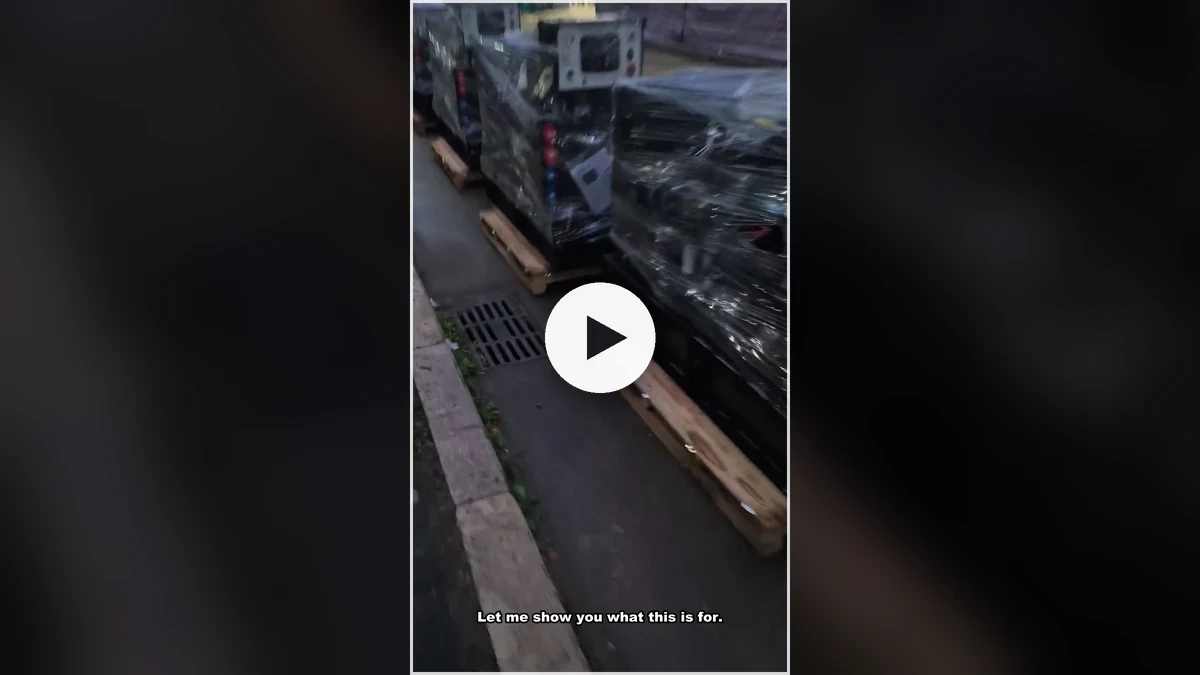
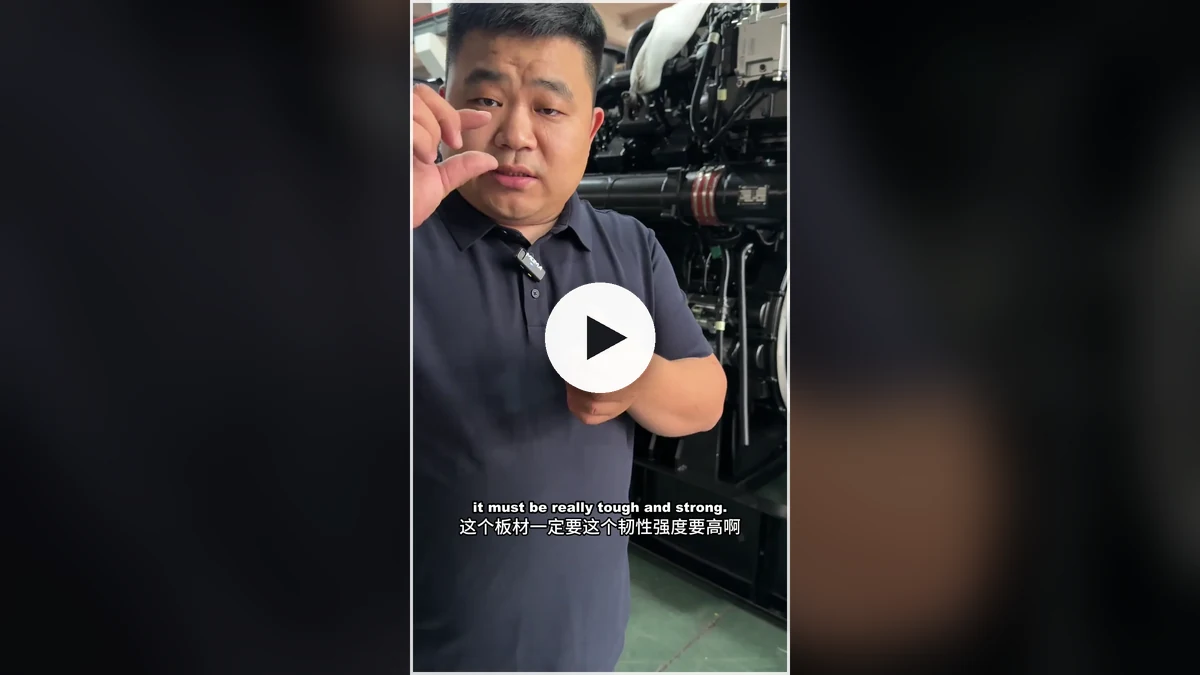
In a factory video, Sange shows a large set on a fully welded frame, points to the cross beams and the end plate added to it, and says that on a machine of that size he would not use a bent frame unless the plate were very strong and thick. That is his view on one unit, not a rule for every set. What he points at is the useful part for a buyer: cross members, end plates and the frame section are exactly what a frame drawing should show.
Record the construction in four fields:
- Construction: welded fabrication, bent plate, or a combination, with the drawing number and revision.
- Material and section: steel grade and section or plate thickness as the supplier's drawing or material specification states them. "Heavy-duty" or "thick steel" without values does not complete the field.
- Joining and inspection basis: for a welded frame, the welding procedure or quality system the supplier works to and the inspection applied to the welds; for a bent frame, the forming method and how the bent geometry is checked.
- Design basis: the set model and configuration (with or without sub-base tank and canopy) and the handling you declared, such as crane lift, forklift, or road transport on rough roads.
Welding standards help only when they are named with their scope. ISO 5817:2023 defines quality levels for imperfections in fusion-welded joints; it does not design a frame or tell you which level your order needs.
ISO 3834-2:2021 sets comprehensive quality requirements for fusion welding in a workshop; a supplier working to it has a welding quality system, which is neither a strength calculation for your frame nor a product certificate. If you want either in the contract, write the standard, the edition, the quality level or part, the joints it covers and the record you expect back.
Cross members, mounts and vibration isolation: two interfaces, two owners
A skid-mounted set has two vibration interfaces, and an RFQ that says only "anti-vibration mounts" leaves both open. The first sits between the engine and alternator and the frame. The second, where it exists, sits between the frame and whatever the set stands on.
Mounts between the engine, alternator and frame are part of the generator set. The supplier should identify the mount type or the maker's part number, the number of mounts and their positions on the frame drawing, and which cross members or welded pads carry them. If the engine and alternator are bolted rigidly to the frame, the drawing should say so and show where isolation is intended instead.
Isolation under the frame, meaning spring or rubber isolators or anti-vibration pads between the skid and the floor, may or may not be in the scope of supply. Genset application manuals typically distinguish isolation built into the set from isolators installed below the skid, and tie the choice to the specific set and site.
Whether your installation needs isolators under the frame, and of what kind, is the installer's or site designer's decision. The supplier's part is to state what is supplied and where the fixing holes are.
If vibration will be measured at acceptance, agree the method before production. ISO 8528-9:2017, listed here by the Swedish Institute for Standards, covers the measurement and evaluation of external mechanical vibration of reciprocating-engine generating sets on rigid and resilient mountings. It is a measurement standard, not a frame drawing standard, and the evaluation basis has to be agreed for your set.
Cross members and mount pads are features to locate and inspect, not to count against a general rule. Their positions belong on the drawing; at inspection, each one should be where the drawing puts it, with the mounts sitting on it.
Lifting points, locating holes and forklift slots are not interchangeable
A hole in a frame does not tell you what it is for. Lifting points, locating or tie-down holes and forklift slots do different jobs, and only the supplier can say which is which on your frame. Ask for a lifting drawing for the exact set and configuration, and for the locating holes and forklift slots to be marked separately on the frame drawing.
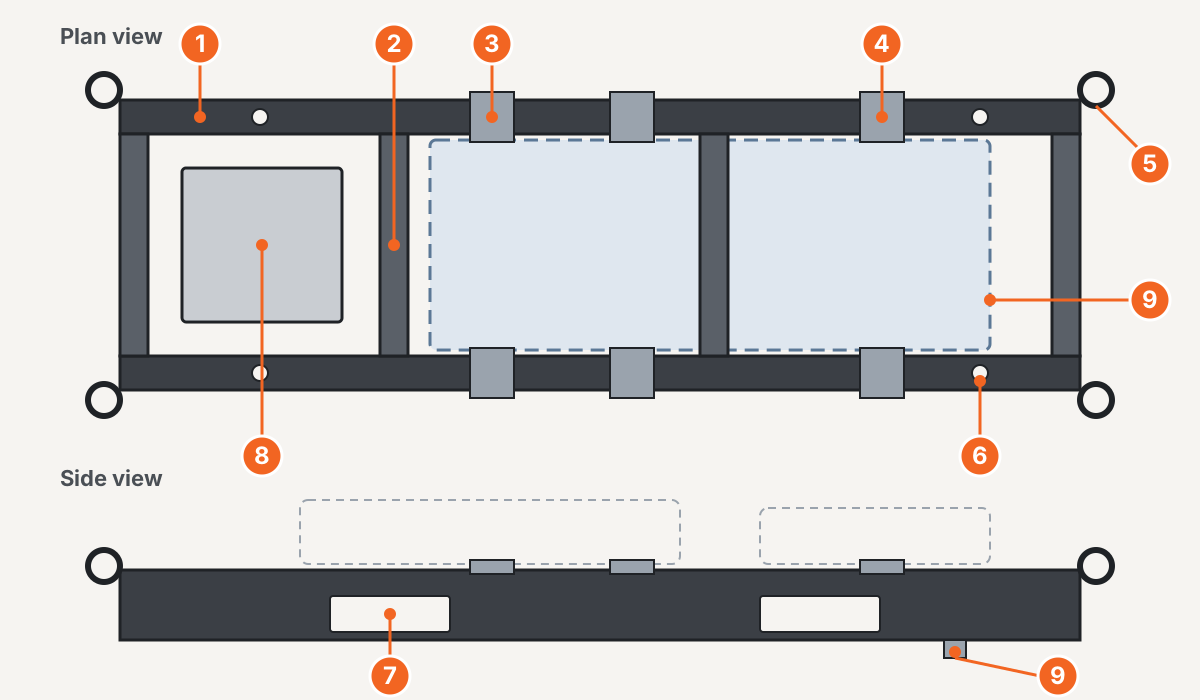
| No. | Feature | Defined by | Confirmed by | Do not infer |
|---|---|---|---|---|
| 1 | Longitudinal rails | Frame drawing (section, material) | Genset supplier | Section or thickness from a photo |
| 2 | Cross members | Frame drawing | Genset supplier | Load capacity from their number |
| 3 | Engine mount pads | Frame and assembly drawing; mount part numbers | Genset supplier; mount maker for its part | Isolation type from appearance |
| 4 | Alternator mount pads | Frame and assembly drawing | Genset supplier | That they match another alternator |
| 5 | Lifting points | Lifting drawing for the exact configuration | Genset supplier | That any corner hole is a lifting point |
| 6 | Locating and tie-down holes | Frame drawing; transport securing plan | Genset supplier; forwarder for securing | That a tie-down hole can take a lift |
| 7 | Forklift slots | Frame drawing | Genset supplier; forwarder for handling | That the set can be forklifted with canopy or full tank |
| 8 | Battery tray | Assembly drawing | Genset supplier | That a tray in a photo is in your configuration |
| 9 | Sub-base tank outline and drain | Tank specification | Genset supplier | Tank capacity from the frame size |
Lifting points. The lifting drawing should show the points, the configuration it applies to (open or canopied, with or without fuel), and any notes the supplier attaches, such as the required lifting arrangement. A drawing for another model or revision does not count, and neither does a photograph or a sales sheet.
This guide gives no lifting method and no load figure; those come from the supplier's drawing and from the rules that apply where the set is lifted. For equipment placed on the EU market, the EUR-Lex summary of Regulation (EU) 2023/1230 shows that the machinery regulation also covers lifting accessories and applies from 20 January 2027; what that means for a given order is a question for your compliance adviser.
Locating and tie-down holes. These hold the set in place on a truck or in a container, or locate it on its foundation. The supplier should mark which holes serve transport securing and which serve fixing on site, and the forwarder confirms the securing arrangement. The IMO overview of the CTU Code, a non-mandatory code of practice for packing and securing cargo in transport units, belongs to that shipping conversation, not to the frame design.
Forklift slots. Find out whether slots are provided, on which sides, and for which shipping condition: open frame, canopy fitted, tank empty. A slot is not a statement that your forklift can carry the set; the forwarder or the receiving warehouse checks that against the weight and dimensions on the supplier's outline drawing.
Large sets add one more question: whether the canopy, the radiator or other parts travel separately. In the welded-frame video, Sange also shows a large set whose canopy and radiator are built in sections so that it fits into a container. If your set will be split, the frame drawing, the lifting drawing and the container loading plan must describe the same shipping configuration.
Battery tray, cable routing and drain points belong on the same drawing
Small features on the frame cause the most arguments at delivery because nobody wrote them down. Put them on the frame or assembly drawing, or in a controlled specification that the quotation references.
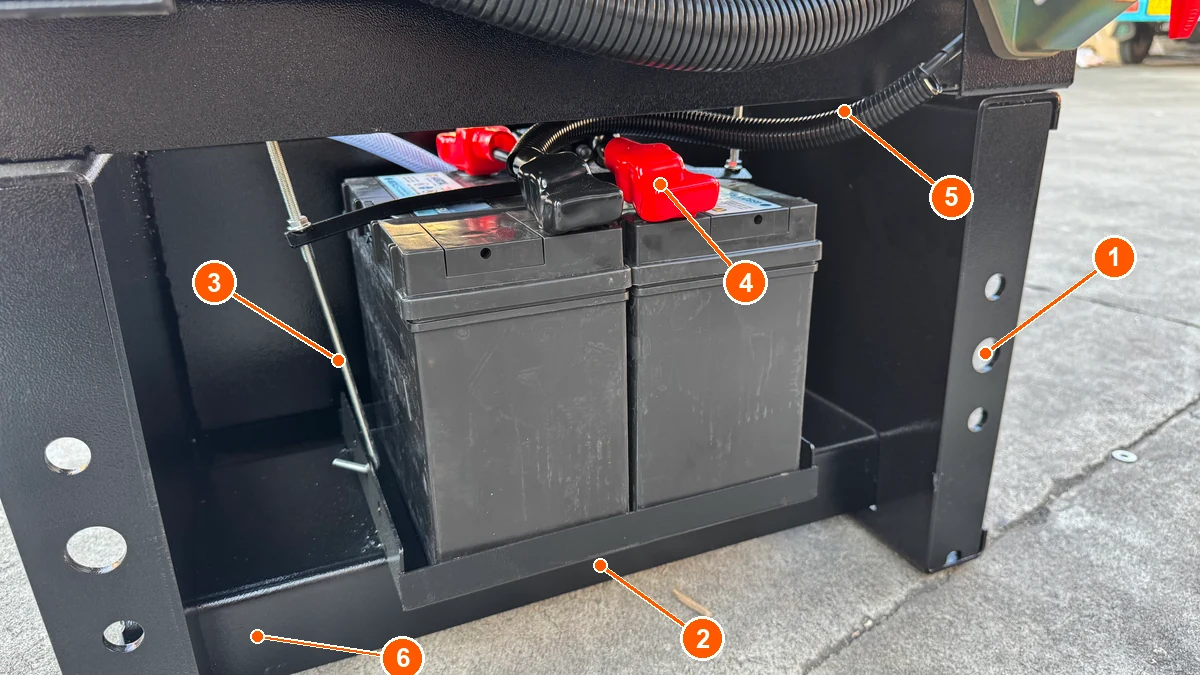
| No. | What is visible | What to put in the RFQ |
|---|---|---|
| 1 | Frame upright with a row of holes | The function of each hole (lifting, locating, bolting) marked on the drawing |
| 2 | Battery tray in the base frame | Tray position and size for the battery type and number ordered |
| 3 | Clamp bar on threaded rods across the batteries | Hold-down method and parts included |
| 4 | Terminal covers and battery cables | Covers included; cable sizes belong to the electrical specification |
| 5 | Cable in corrugated conduit fixed along the frame | Route and support points shown on the assembly drawing |
| 6 | Lower frame member under the tray | Section and finish as on the frame drawing |
Battery tray and hold-down. The supplier should state where the starter batteries sit, how they are held, and whether the batteries themselves are in the scope of supply. A tray in a catalogue photo does not prove that the tray or the clamp is in your configuration.
Cable routing. The assembly drawing should show how the cables between battery, starter, control panel and alternator run along the frame and where they are supported. This is a check of presence and location; cable specifications and any site wiring belong to the electrical documents and the installer.
Drain points. List the fuel tank drain (if a sub-base tank is fitted), the engine oil drain access and any drain for water that collects in the frame, and whether each can be reached with the set on its foundation. Any plugs or extension hoses supplied with the set should appear in the packing list. The tank's capacity and fittings are a separate specification.
Surface preparation and finish. "Painted black" is a colour, not a specification. The supplier should name the surface preparation and the coating system for the frame, and the record it will provide if your order requires one; compare the delivered frame with that statement rather than with its appearance.
Base frame RFQ fields and the acceptance record
Use this table as the frame section of an RFQ. A field is complete when the answer is tied to the model, configuration and drawing revision on the quotation, and the evidence column names a document you can hold against the physical frame.
| Field | Complete answer | Evidence and who confirms | Return it when |
|---|---|---|---|
| Frame identity | Drawing number and revision for the quoted model and configuration | Frame drawing; genset supplier | The drawing is generic or belongs to another model |
| Construction | Welded, bent or combined | Frame drawing; genset supplier | Only an adjective is given |
| Material and section | Steel grade and section or plate thickness | Drawing or material specification; genset supplier, mill certificate if contracted | "Heavy-duty" or "thick" without values |
| Fabrication and inspection | Welding or forming method and the inspection applied | Supplier's procedure and inspection record; third-party inspector only if contracted | "Fully tested" without a record |
| Cross members and mount pads | Positions shown | Frame drawing, inspection photos; genset supplier | Not on the drawing |
| Engine and alternator mounts | Type or part number, quantity, positions | Assembly drawing or parts list; genset supplier, mount maker for its part | "Anti-vibration" with no identification |
| Isolation under the frame | Supplied or not; if supplied, type and positions | Scope of supply; genset supplier states it, site designer decides the need | Scope not stated |
| Lifting points | Locations and the configuration they apply to | Lifting drawing for the exact set; genset supplier | Another model's drawing, or no drawing |
| Locating and tie-down holes | Locations and purpose | Frame drawing; genset supplier, forwarder for securing | Purpose unclear |
| Forklift slots | Present or not, sides, shipping condition | Frame drawing and photos; genset supplier, forwarder | "Forkliftable" without visible slots |
| Battery tray and hold-down | Position, hold-down parts, batteries in or out of scope | Assembly drawing and photo; genset supplier | Location assumed |
| Cable routing on the frame | Route and support points | Assembly drawing and photo; genset supplier | Not shown |
| Drain points | Locations, access, plugs or hoses included | Drawing and photo; genset supplier | Location assumed |
| Surface preparation and coating | Preparation and coating system named | Coating specification and record if required; genset supplier, coating supplier | Colour only |
| Dimensions and weight | Outline dimensions and weight with the configuration stated | Outline drawing; genset supplier, forwarder for transport | Figures not tied to a configuration |
When a field comes back incomplete, return it with three items: the field name, the document or value you need, and the model, configuration and revision it must refer to. A hypothetical example: "Lifting points: the drawing you sent is revision B for the open version; our order is the canopied version with a sub-base tank. Please send the lifting drawing for that configuration."
The frame is ready to release for production when every applicable field is answered, every document carries the quoted model, configuration and revision, and the open questions are closed in writing. The wider set of papers to collect before an order is in the documents-before-order guide.
Inspect the first frame before it is packed
Inspect the frame while it is still visible. Once the set is wrapped and standing on a wooden skid, cross members, pads and drain points are hard to see, and the photos you receive will show packaging rather than steel.
A dated photo set of the actual unit, taken before packing, lets you match each feature on the drawing:
- the unit's serial or nameplate reference in the same shot as the frame;
- the full frame from both long sides and both ends;
- each lifting point, with the lifting drawing reference;
- locating holes and forklift slots;
- engine and alternator mounts on their pads;
- the battery tray with the hold-down fitted;
- drain points, and any isolators supplied;
- the finish at a weld, an edge and a corner.
Compare each photo with the drawing and keep an exception list: feature, what the drawing says, what the photo shows, and the agreed correction. A third-party inspector checks only the scope you contracted, and an inspection report does not replace an approved drawing. On a first order, the frame record fits into the first article approval and the pre-shipment inspection checklist; if the frame is part of a factory test, the FAT scope guide shows how to write down what is tested and who witnesses it.
Send the frame questions with your RFQ
For BEAR open-frame diesel sets, send the field table above through the inquiry form together with the model, the configuration (open or canopied, with or without a sub-base tank), the destination and how the set will be handled on arrival. The written quotation confirms the model, configuration, accessories and documents, so name the frame drawing and the lifting drawing among the documents you expect, and the quotation can state which are supplied for the configuration quoted. If you want to see a frame before committing, a sample unit or a factory visit can be arranged before a production order. The current range is on the open-frame diesel generators page.