
Specify a portable power station from a load list: usable Wh, chemistry, continuous and surge output, outlets, charging, cycle life, UN 38.3 and certificates.
In this guide8 sections
A portable power station is specified from the loads it must carry and the hours it must carry them, not from the watt-hour figure printed on the case. Capacity in Wh and output in W only become a specification once the supplier states what each was measured against: the usable share of the capacity, the continuous and surge output with their conditions, the outlet and charging-input set for the destination market, the cycle-life endpoint, and the documents that identify the battery for transport and sale. Work through the fields below in order once you have decided on battery storage rather than an engine-driven set. The exception is a station that must carry a motor-driven load for days at a time or be built into a vehicle or a fixed installation: those orders start with the source decision and the installer's requirements, and this guide does not settle them.
This guide is for importers, distributors, rental fleets, private-label buyers and prepared end buyers who write requests for quotation (RFQ) for portable power stations and have to compare factory offers. It does not rank brands, design a solar array or review products. It gives you the fields, the evidence to request against each one, a format for comparing three offers and the point at which the RFQ is complete.
Start from the load list and the use scenario
Write down every device the station must run, its running watts, any starting demand, the hours per day it runs and whether it is must-run or optional. That list decides the capacity and output fields; a label such as "home backup" or "camping" decides nothing. The table shows the shape of the list with hypothetical entries.
| Load (hypothetical example) | Quantity | Running W | Starting demand | Hours per day | Must-run? |
|---|---|---|---|---|---|
| Compressor refrigerator, duty-cycled | 1 | 60 (average) | Yes, compressor start | 24 | Yes |
| Laptop charging | 2 | 65 each | No | 4 | Yes |
| LED lighting | 4 | 10 each | No | 6 | Yes |
| Router and modem | 1 | 15 | No | 24 | Yes |
| Electric kettle | 1 | 1,500 | No | 0.3 | No |
Three scenario fields sit next to the list. First, the use case: emergency backup, mobile work, rental fleet or retail resale, because each changes which fields are critical. Second, whether charging is available during use, from the grid, a vehicle or solar panels, because a station that recharges every day is sized differently from one that must last the outage on one charge. Third, which loads may be shed, because the must-run subset is the one the capacity calculation has to cover.
Motor-driven loads are the usual source of error. A compressor, a pump or a power tool draws more at start-up than while running, and the station's surge output has to cover that moment. Take the starting demand from the equipment's own data, not from a multiplier; the starting versus running watts guide explains how to read it and the refrigerator and freezer backup guide works through a cold-chain example. If the real task is a cabin or site that must run for weeks, start with the off-grid cabin power plan and come back to this page for the station itself.
Specify energy: rated Wh, usable Wh and a runtime estimate you can defend
Request the rated battery energy in Wh and, as a separate field, the usable energy the supplier states at the AC outlet or at the DC ports under named conditions. Estimate runtime from the usable figure and your load list, and present the result as an estimate with its assumptions attached.
Rated Wh is the energy the pack is rated to store. The energy that reaches a load is smaller, because the battery management system keeps a reserve, the maker limits the depth of discharge, and the inverter converts DC to AC with losses and draws some power of its own even at low load. How much smaller varies by model, by output path and by test conditions, so treat any universal "usable percentage" as a guess and ask for the supplier's own figure with its basis. Depth of discharge (DoD) describes the share of stored energy drawn in a cycle; it is not a runtime guarantee and it only compares between offers when the conditions behind it are the same.
| Energy field | Complete supplier answer | Reject |
|---|---|---|
| Rated energy | Wh with nominal pack voltage and cell configuration, from the model data sheet | mAh alone, or a cell figure presented as the pack figure |
| Usable energy | Wh or a stated usable share, the output path it applies to (AC or DC), the test conditions and the low-voltage cutoff or reserve | rated Wh presented as usable AC energy |
| Inverter idle draw | Power drawn by the inverter with no load, and whether an auto-shutoff applies | "negligible" |
The worked example below turns the load list into a daily energy figure. The numbers are hypothetical and the result is an estimate, not a promise about any product.
| Step (hypothetical example) | Calculation | Result |
|---|---|---|
| Refrigerator energy per day | 60 W × 24 h | 1,440 Wh |
| Laptops | 2 × 65 W × 4 h | 520 Wh |
| Lighting | 4 × 10 W × 6 h | 240 Wh |
| Router and modem | 15 W × 24 h | 360 Wh |
| Must-run energy per day | sum of the rows above | 2,560 Wh |
| Usable energy offered (example figure from a hypothetical offer, AC path) | supplier's stated value | 2,000 Wh |
| Hours at a steady 100 W load | 2,000 Wh ÷ 100 W | about 20 h |
The two bottom rows are the estimate the buyer can defend: hours equal usable Wh divided by the load in W. The result moves with temperature, inverter idle draw, the real duty cycle of the refrigerator and the cutoff the maker applies, so the RFQ asks the supplier for the usable figure and its conditions rather than for a runtime promise. In this example the must-run energy exceeds the usable energy, which is itself the finding: either a larger station, daily recharging or load shedding is needed before the order is placed.
Specify the inverter: continuous output, surge output and waveform
State continuous AC output and surge output as two separate fields, each with voltage, frequency, duration or overload behaviour and the operating conditions. A bare "2,000 W" is not a specification: it does not say whether the figure is continuous or peak, how long it holds, whether it applies per outlet or in total, at what temperature, or whether it applies in battery mode or when the station is passing grid power through.
| Output field | Complete supplier answer | Reject |
|---|---|---|
| Continuous output | W at the stated voltage and frequency, total and per outlet, in battery mode, with the temperature range for which it holds | one figure with no mode, duration or per-outlet limit |
| Surge or overload output | Peak W, the time it is sustained, what happens when it is exceeded (fold-back, shutdown, restart) and how the unit recovers | "peak 4,000 W" with no duration |
| Waveform | The waveform claim and, if your loads need it, a measured THD value with the load, mode and method | "pure sine wave" offered as a THD figure |
"Pure sine wave" describes the shape the inverter aims for; it is not a measured distortion value. If your customers will run electronics, chargers or equipment whose maker states a supply requirement, write the distortion line the way the THD specification guide sets out: quantity, load, measurement point, conditions and whether the figure is guaranteed or typical. If no load needs it, leave the line out rather than collect a number nobody will test.
Which outlets and charging inputs does the destination market need?
List every outlet and port by type, count and electrical rating for the market version you are buying, then list each charging input with its voltage window, current and power limits, and the recharge time the supplier states for a defined starting state of charge. The same model usually exists in several market versions, and outlets, labels and approvals change between them.
For AC outlets, the destination decides the socket type, the voltage and the frequency; the outlets, receptacles and plugs guide lists the common types by market and the voltage and frequency checklist covers the electrical side. Record the AC outlet count and the rating per outlet, then the DC side: car-socket output with its voltage and current, USB-A and USB-C ports with the power per port and any shared limit when several ports are used at once. A port count without ratings is not an answer.
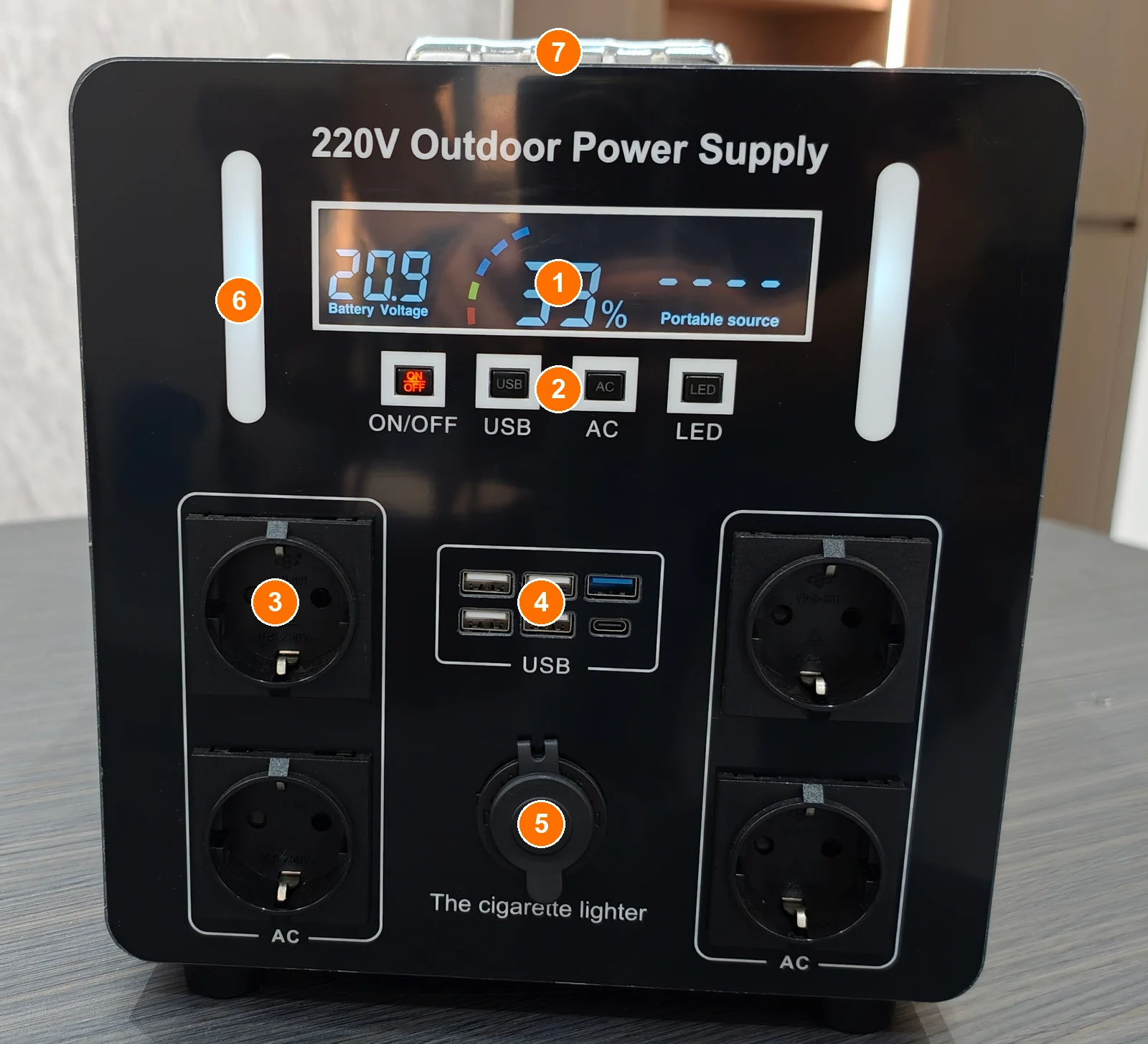
| Callout | Visible part | What the RFQ asks the supplier to state |
|---|---|---|
| 1 | Display | Which quantities the display reports and whether they are indicative or measured |
| 2 | Control buttons for the power, USB, AC and light functions | Which outputs can be switched separately, and the standby or auto-shutoff behaviour |
| 3 | Four AC sockets, two on each side of the panel | Socket type for the destination market, voltage, frequency, rating per socket and the total limit across all four |
| 4 | USB port block | Port types and count, power per port and the shared limit when several ports are used together |
| 5 | Car-socket outlet | Output voltage and current, and whether it shares a limit with the USB block |
| 6 | Light bars beside the display | Whether the light is switchable and what it draws, so it is not left out of the load list |
| 7 | Top carry handle | Net and gross weight and the carton dimensions for the offered configuration |
The charging inputs sit on the rear of this unit and are not in the photograph; they are specified in the next paragraphs.
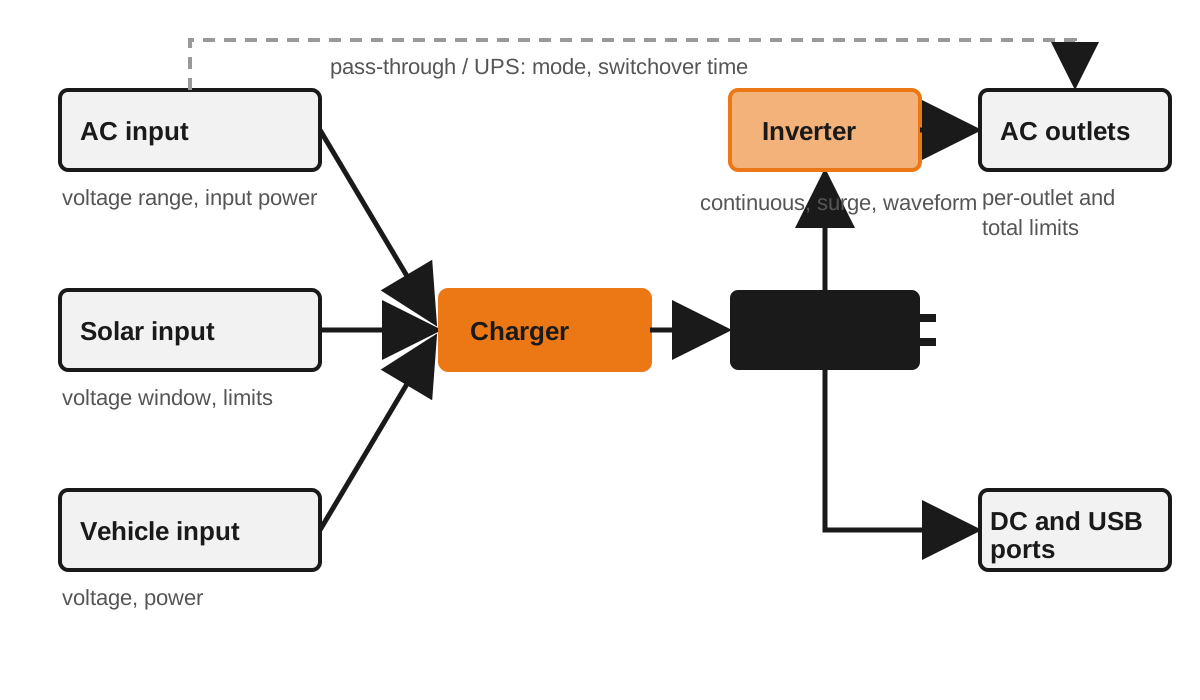
Charging inputs are described the same way. AC input: the voltage range and the input power. Solar input: the connector type, the voltage window the input accepts, the current and power limits and whether a maximum power point tracker is fitted. Vehicle input: voltage and power. For each input, the recharge time to full from a stated starting level, at a stated temperature, with and without a load connected at the same time. A phrase such as "solar compatible" or "fast recharge" is not a field; a panel wattage printed on a listing is not an input limit.
Two behaviours deserve their own lines when the station will sit between the grid and a load. First, pass-through: whether the unit can charge and supply at the same time, and with what limits. Second, UPS or bypass behaviour: whether the output is grid-fed or inverter-fed in normal operation, how long the switchover takes when grid power fails, and which loads the maker says the function suits. The labels "UPS", "EPS" and "pass-through" are used for different behaviours, so request the description and the switchover time rather than the label, and leave the question of whether a particular device tolerates that switchover to the device's own maker.
Set the battery, environment and service requirements
Request the cell chemistry by name, the cycle life with its end-of-life capacity and test basis, the charging, discharging and storage temperature ranges as three separate fields, and the warranty terms for your sales territory. Compare these only on the same stated basis.
Chemistry first. Lithium iron phosphate (LiFePO4) and nickel-based chemistries (NMC, NCA) are both used in portable stations, and each has a reputation for weight, cycle life and temperature behaviour. A reputation is not a specification: the pack design, the operating conditions and the maker's own test basis decide the figures for the offered model, so ask the maker to name the chemistry and to substantiate the cycle life, the weight and the temperature limits for that model. A statement that a pack is "lithium" is incomplete where chemistry decides the order.
Cycle life is comparable only when the endpoint and the conditions are stated: the number of cycles to a named remaining capacity (makers often quote cycles to 80 % remaining capacity; use the maker's own endpoint), at a stated depth of discharge, charge and discharge rate and temperature. "Thousands of cycles" without an endpoint is a marketing line.
Temperature limits come as three ranges, because a station may be allowed to discharge in cold that it is not allowed to charge in, and storage has its own range. Ask whether a battery heater is fitted and whether the limits change when it is active. Weight, dimensions and any ingress-protection (IP) rating are recorded with the configuration they apply to; an IP rating is not inferred from the look of the case, and "not rated" is an acceptable answer where it is the true one.
Warranty and software close the section. The warranty line needs the term, what starts it, what it covers (the unit, the battery, a capacity-retention commitment if any), the exclusions, the remedy, the territory and the claim route; a warranty written for another sales market does not transfer by itself. If the station depends on an app or on firmware updates, record the app name and platforms, the functions that need connectivity, any account or region constraint and the maker's update and support policy, because these affect resale and after-sales in your territory.
Which documents prove the battery can be shipped and sold?
Request the documents that identify the offered battery and product: the UN 38.3 test summary for the battery design type, the safety data sheet, the shipment classification confirmed by your freight forwarder, and the conformity documents for each destination market with their scope. A generic certificate, a cell-level document presented as whole-unit approval, or a document issued for another model or revision is not a match.
| Document or rule | What it covers | How the buyer uses it |
|---|---|---|
| UN Manual of Tests and Criteria, Part III, subsection 38.3 (UNECE, Rev. 5 extract of subsection 38.3; later revisions supersede it) | Transport tests for lithium cell and battery design types, used by the international transport regimes | Request the test summary whose identifiers match the pack in the offered unit. It is transport-test evidence, not proof that the whole station meets any product-safety or market rule |
| 49 CFR §173.185 (US eCFR) | US hazardous-materials transport provisions for lithium cells and batteries, including the test-summary provisions that PHMSA explains | For US shipments, have the shipper or forwarder confirm the classification, packaging, marks and documents under the rule text in force |
| IATA Lithium Battery Guidance Document (IATA) | Air-cargo guidance; what applies depends on the battery rating, whether it is contained in or packed with equipment, and the current edition | Have the air forwarder confirm the shipment pathway and documents. Passenger baggage limits are not cargo rules, and no Wh threshold is stated here as a general fact |
| IMDG Code entry for UN 3481 (IMO) | Maritime dangerous-goods provisions; UN 3481 is the entry for lithium-ion batteries contained in or packed with equipment | Have the sea forwarder determine the provisions for the shipment configuration |
| UL 2743 (UL Standards & Engagement) | Standard for portable power packs with internal batteries | Where a customer or market requires it, request the whole-unit certification or listing with the exact model scope; the standard's existence is not a certification |
| IEC 62133-2 (IEC) | Safety requirements and tests for portable sealed secondary lithium cells and batteries | Request only where it applies to the battery and the market or customer requirement; a battery document is not whole-unit conformity |
| IEC 62619 (IEC) | Safety of secondary lithium cells and batteries for industrial applications, including stationary ones | Do not assume it applies to a portable station; ask the conformity assessor to confirm product and market scope |
| Regulation (EU) 2023/1542 (EUR-Lex) | EU rules on batteries and waste batteries, including conformity and marking provisions whose application depends on the product and the provision's date | Have the EU importer or responsible economic operator verify the provisions that apply to the offered battery and station; a battery CE marking is not proof of every requirement on the complete product |
| FCC equipment authorization (FCC) | US radio-frequency equipment rules; applicability depends on the station's electronics and any wireless function | Request the authorization or declaration for the exact US version where required; it is not a battery-transport or electrical-safety approval |
For every document, record the issuing entity, the model and configuration it names, the revision or date and the market it applies to, then match those against the quotation, the label and the manual; the certificate and nameplate match guide shows the matching routine and the import compliance by market guide covers the market-side obligations. The documents before order guide and the test report red flags guide apply here unchanged: a report that does not identify the tested unit, configuration and revision is not evidence for the unit you are buying.
Responsibilities stay with the parties who hold them. The equipment maker confirms ratings, operating limits, waveform, switchover behaviour and product-safety claims; the freight forwarder confirms shipment classification, packaging, marks and documents; the conformity assessor or local authority confirms market obligations; a licensed electrician or installer confirms any interface with a building or a vehicle. The buyer records those confirmations and does not invent them.
Compare three offers on one table and close the RFQ
Put the three offers in one table with identical fields, units and conditions, mark each line accepted, clarification required or not offered, and treat the specification as ready to compare only when every required field has a model-matched answer with its evidence present or explicitly unresolved. The field list below is the RFQ; the supplier answers it for the exact offered model, configuration and destination market.
| RFQ field | Complete supplier answer | Reject |
|---|---|---|
| Identity | Manufacturer, brand or private-label name, exact model and SKU, hardware revision, battery pack identity, market version; label photo and current manual | a family name, "same as", or a manual for another variant |
| Rated and usable energy | Rated Wh with nominal voltage; usable Wh or share with path and conditions; cutoff or reserve | one Wh figure with no statement of what it describes |
| Chemistry | Cell chemistry and pack configuration from the maker's specification | "lithium" |
| Cycle life | Cycles to a named remaining capacity with DoD, rate, temperature and the test basis | a cycle count without an endpoint |
| AC continuous and surge | Both figures with voltage, frequency, per-outlet and total limits, surge duration, overload behaviour, mode and temperature | one "peak" figure or an unconditioned wattage |
| Waveform and THD | Waveform claim plus a conditioned THD figure where required, or a statement that none is available | "pure sine" as the only evidence when THD is required |
| Outlets by market | Type, count, voltage, frequency and rating per outlet for the offered market version; drawings and photos | a generic outlet image or another region's SKU |
| DC and USB ports | Type, count, voltage, current and power per port; shared limits | a port count without ratings |
| Charging inputs and times | AC, solar (connector, voltage window, current, power, tracker) and vehicle inputs; recharge time per input with starting level, temperature and simultaneous load | "solar compatible", a panel wattage, or a time without conditions |
| Pass-through and UPS behaviour | Supported mode, grid-fed or inverter-fed output, switchover time, limitations | an unqualified "UPS" label with no switchover time |
| Temperature ranges | Charge, discharge and storage ranges; heater function if any | a single "operating temperature" |
| Weight, dimensions, IP | Net and gross weight, dimensions, IP rating with its configuration, or "not rated" | an IP rating inferred from the case |
| UN 38.3 | Test summary whose identifiers match the offered pack | a generic statement of compliance |
| SDS and shipment data | Current safety data sheet; classification details confirmed by the shipping party | "SDS available" without the document |
| Conformity documents | Per market: regulation or standard, product or battery scope, model, document number, issuer, date or revision, label artwork | logo-only claims; a cell document presented as whole-unit approval |
| Warranty | Term, trigger, coverage, capacity-retention commitment, exclusions, remedy, territory, claim route | "long warranty" or terms for another market |
| Firmware and app | Firmware revision or release policy, app and platforms, connectivity-dependent functions, region or account constraints, update and support terms | undisclosed app dependence |
The comparison table repeats those fields as rows and adds one column per offer and one for evidence status. Example rows, with hypothetical entries, look like this:
| Field | Offer A | Offer B | Offer C | Evidence status |
|---|---|---|---|---|
| Usable energy, AC path, conditions stated | value and conditions supplied (hypothetical) | rated figure only | value supplied, conditions missing | A accepted; B and C clarification required |
| Surge output with duration | peak figure and seconds supplied | peak figure only | not offered as a field | A accepted; B clarification required; C not offered |
| UN 38.3 test summary identifiers match the pack | match confirmed | summary for a different pack | document promised, not received | A accepted; B rejected; C clarification required |
Accept a line only when the answer and the evidence refer to the same model, configuration and market. Otherwise mark it clarification required and send back the field number, the missing fact, the document requested and the identity or revision it must match. Three sentences cover most returns: "Field 2 gives rated Wh only; please state usable energy at the AC outlet with the test conditions and cutoff." "Field 5 gives a peak figure without duration; please state the time it is sustained and the overload behaviour." "The UN 38.3 summary names a different pack identifier; please supply the summary for the pack fitted to the offered configuration." The RFQ is ready to compare when each required field has a model-matched answer, its conditions are recorded and its evidence is present or explicitly marked unresolved; the general supplier checks in the supplier and buyer checklist sit alongside this table, not in place of it.
Send the specification with the quotation request
Send the completed field list with your load list, the destination market and socket standard, the version and quantity, the charging sources you will use and the documents your market requires through the contact page. The portable power station product page shows the configuration BEAR currently offers, and the portable power stations category is the entry point for the range. The written quotation confirms the model, configuration, accessories and documents for the offered version, so the table above comes back answered line by line, and a sample unit for your own load test or a factory visit can be arranged before a production order.