
Specify a genset's base (belly) fuel tank so offers compare: arrangement, nominal and usable capacity, drawing, baffles, openings, level sender and leak record.
In this guide11 sections
A diesel generator's base fuel tank, also called a belly or sub-base tank, should enter a quotation as one identified build: a tank drawing number and revision tied to the genset model, a nominal and a usable capacity stated on the same basis, and every opening on the tank called out so the first unit can be checked against it. That is enough for most open-frame and enclosed sets ordered for distribution or rental. The biggest exception is a site that needs a listed tank, secondary containment or separate bulk storage. Those requirements are set by the site designer and the local authority, and a factory base tank meets them only if a document for that exact tank says so.
This guide is written for importers, distributors, rental fleets and contractor procurement teams buying diesel gensets with an integral tank. It lists what to specify, what a complete supplier answer looks like and who confirms each point. It does not size a tank for a site, approve a fuel-storage design or calculate runtime; for the fuel figures that runtime depends on, use the fuel consumption quotation checklist.
Settle the fuel arrangement before comparing tanks
State in the request for quotation (RFQ) which arrangement you are buying, because two offers with the same litre figure can describe different things. An integral base tank sits inside the genset's base frame and normally feeds the engine directly. A day tank is part of a transfer arrangement fed from larger storage.
An external tank is separate storage outside the set. Which one a project needs depends on the site, the engine's fuel-system limits and local rules, not on a general preference.
| Arrangement | What the genset supplier quotes and documents | Who decides the site side |
|---|---|---|
| Integral base tank | The tank as part of the set: drawing, capacity basis, openings, sender, leak-test record | The buyer decides whether the base tank alone serves the application |
| Base tank plus external storage | The base tank and the connections offered for an external supply or return | Installer or site designer: storage, transfer and return system |
| Day tank arrangement | Only what is in the quoted scope (often the set's own connections) | Site designer and installer: day tank, transfer pump, controls |
If the RFQ only says "with fuel tank", a supplier can reasonably quote any of these. Write the arrangement in one line, for example "integral base tank, no external tank in scope", and reject offers that answer with a capacity figure but no tank type. The open-frame versus enclosed generator matrix covers the construction choice that usually comes first; the base tank sits under either type.
Capacity: two figures on one basis
Ask for two numbers, not one. Nominal capacity is the stated volume of the tank. Usable capacity is the volume the engine can actually draw for its intended operation, after the volume below the supply pickup and any expansion space or reserve are excluded. The supplier should say how each was obtained (calculated from the drawing or measured by filling) and to which levels it refers.
Runtime hours are not a capacity definition. They depend on the engine's consumption at the load you run, which is a separate set of quoted data, and they belong in the fuel-consumption request rather than in the tank line. A supplier who answers with hours of runtime has answered a different question.
A complete capacity line can look like this hypothetical example, with the brackets filled from the supplier's drawing:
Hypothetical example: Integral base tank to drawing [number], revision [letter], for [genset model and configuration]. Nominal capacity [ ] L to [filler neck shoulder]. Usable capacity [ ] L above the supply pickup inlet, excluding [expansion space / reserve]. Basis: [calculated from drawing / measured by filling]. Tank type: single wall, no listing claimed.
Between two offers, compare usable capacity with usable capacity, each on its stated basis. A nominal figure from one offer and a usable figure from another are not comparable, and neither converts to runtime on its own.
Freeze one tank build in a drawing
A brochure photograph or the words "standard base tank" do not define what will arrive. The tank definition that can be inspected is a drawing with a number and revision, tied to the exact genset model and configuration in the quotation. The schematic below shows the features that drawing should call out; the numbers match the legend table.
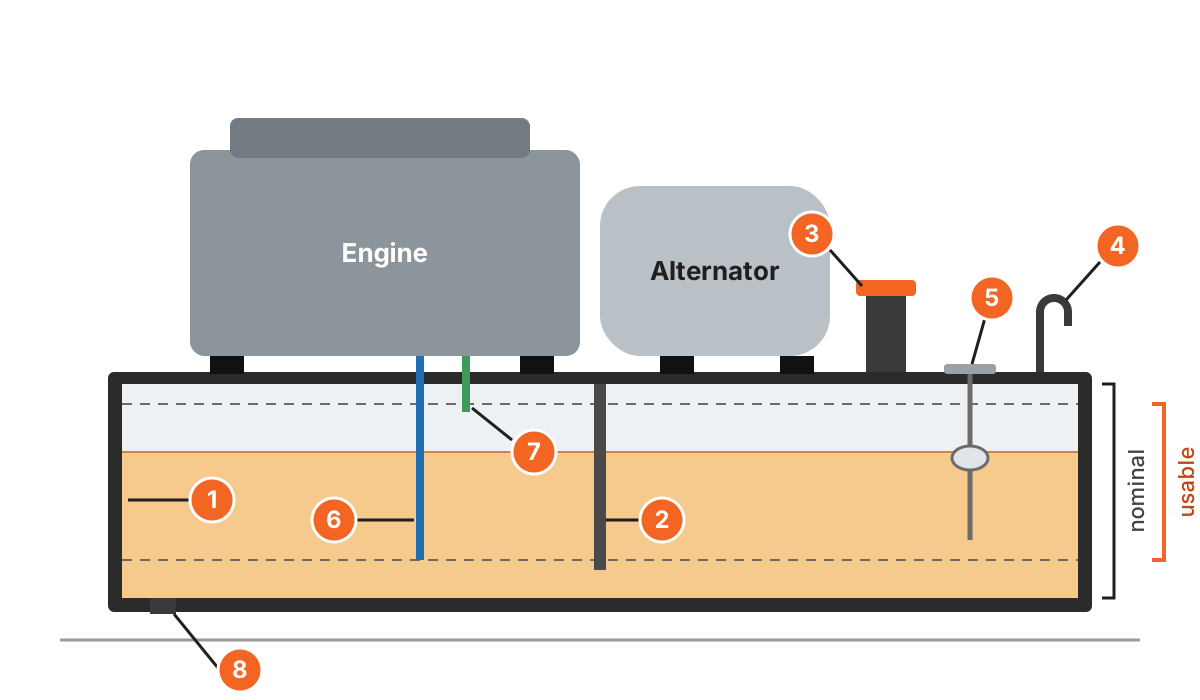
| No. | Feature | What the drawing should show | What to check on the first unit |
|---|---|---|---|
| 1 | Tank body within the base frame | Outline, drawing number, revision, material and thickness as stated by the supplier | Unit matches the approved revision; no visible damage or weld defects at the edges |
| 2 | Baffle plate(s) | Number, position and any opening between compartments | Layout matches the drawing (via inspection openings or the supplier's build photos) |
| 3 | Filler neck and cap | Position, height relative to the tank top, cap type | Position and cap match the drawing |
| 4 | Vent | Vent type and position | Vent present where drawn and unobstructed |
| 5 | Level sender or gauge | Type, position, signal or indication | Sender type matches the RFQ; reading appears where the controller documentation says it should |
| 6 | Supply connection (pickup) | Position, connection identity | Labelled and matching the drawing |
| 7 | Return connection | Position, connection identity | Labelled and matching the drawing |
| 8 | Drain at the low point | Drain type and position, any water/sediment collection | Accessible and plugged as drawn |
Hold the drawing revision as part of the order. If the factory later changes the filler, sender or chassis, the change should arrive as a revised drawing for your approval, not as a difference you discover on the first unit. The first-article approval guide describes how to lock a production reference and handle such deviations.
Baffles for sets that travel
Internal baffles divide the tank volume and reduce fuel surging when the set is moved, which matters most for rental units and sets that travel on trucks or trailers. They can also change how much of the volume is usable and how compartments drain into each other, so a baffled tank still needs its layout on the drawing. "Baffled tank" in an offer, without a drawing reference, cannot be inspected.
For a stationary set the baffle question is smaller, but the drawing should still say whether there are baffles and where. That keeps two offers on the same footing and avoids a later argument about whether a missing plate was ever promised. Transport conditions themselves, including whether tanks ship empty, are settled with the forwarder; the container loading guide lists the data to collect for that conversation.
Filler, cap, vent and spill control
The filler, cap and vent are what an operator touches every day, and they vary from one design to the next. Specify them by drawing callout: filler position and height above the tank top, cap type (plain, lockable, with or without a strainer), vent type and position, and whether any spill provision such as a collar or tray around the filler is part of the build.
A rental fleet whose sets are refuelled in the field by different people may want a raised filler neck and a lockable cap. Write them as fields, not as adjectives. Whether the site needs specific venting, overfill protection or spill containment around the installed set is a separate decision for the site designer and the local authority; the factory's job is to document what the base tank has.
Fuel level: gauge or electronic sender?
Decide where the fuel level has to be read. A mechanical gauge on the tank gives a local reading only. An electronic sender produces a signal that the genset controller can display, log or use for a low-fuel warning, which is what remote monitoring and rental telemetry need. Neither should be assumed: write the type into the RFQ, and for an electronic sender ask for its signal type and confirmation that the quoted controller accepts it and shows it.
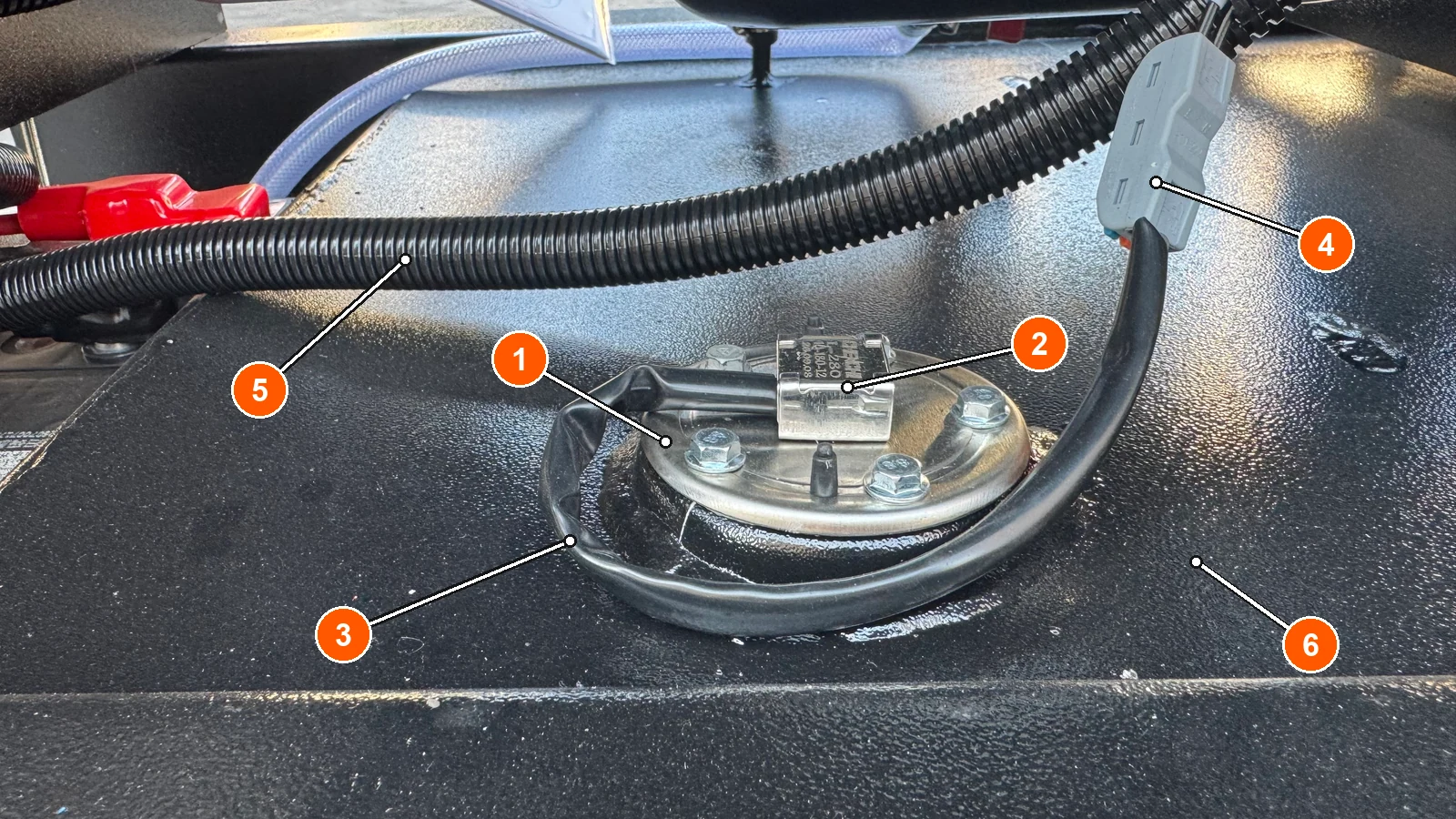
| No. | Visible part | Why it matters in the RFQ |
|---|---|---|
| 1 | Sender flange bolted to the tank top | Position and access for service belong on the drawing |
| 2 | Terminal block on the sender | Sender identity and signal type come from the component record, not the photo |
| 3 | Sender lead | Routing should be protected from heat and abrasion |
| 4 | Plug-in connector | Shows the sender is wired into the set's harness; the controller input is confirmed separately |
| 5 | Wiring loom in corrugated conduit | Part of the controller wiring; the interface drawing names the input it lands on |
| 6 | Coated top plate of the base tank | The tank surface the drawing and coating record refer to |
Drain, water and the supply and return connections
Water and sediment collect at the lowest point of a diesel tank, so the drain belongs at the low point and should be reachable once the set is installed. Ask the supplier to identify the drain type and position and to say whether there is any separate water or sediment collection point, and how it relates to the height of the supply pickup.
The supply and return connections are the tank's interface with the engine and, where one exists, with an external fuel system. Each should be labelled on the drawing with its identity and position. Return routing and the engine-side fuel-system limits are engine-model data: engine makers publish them in the application manuals for their own engines, and those values do not transfer to another maker's engine. If an external tank will be connected later, the installer needs the labelled interface drawing, and compatibility of the return arrangement should not be assumed from the base tank alone.
Wall type and listings: what the factory proves, what the local authority decides
"Double-wall", "containment" or a standard number in an offer is a claim about one specific tank, and it needs a document that names that tank. Whether an installation needs a listed tank or containment at all is decided by the site designer and the authority having jurisdiction, under the codes adopted locally. Check with the local authority before you write a listing or containment requirement into the RFQ, and before you treat any standard below as applicable.
| Document | Scope, as the publisher describes it | What it means for a base-tank quotation |
|---|---|---|
| UL 142 | Shop-fabricated steel aboveground atmospheric tanks for flammable and combustible liquids; UL's overview notes that portable and mobile-use tanks are outside it | A listing belongs to a specific tank. Ask whether the offered tank is listed and for the listing record; the standard's existence says nothing about an unlisted tank |
| UL 2085 | Protected aboveground tanks with integral secondary containment and protection features (UL comparison of UL 142, UL 2080 and UL 2085) | Not interchangeable with a "double-wall" description; only a listing record for the tank supports it |
| NFPA 30 | Storage, handling, transfer and use of flammable and combustible liquids (NFPA 30) | Applicability depends on the adopted edition and the installation; the local authority decides |
| NFPA 37 | Installation and use of stationary combustion engines, including their fuel supply (NFPA 37) | Concerns the installed set; it is not a factory certificate for a base tank |
| NFPA 110 | Emergency and standby power systems (NFPA 110) | Depends on how the system is classified on the project; not a tank product standard |
| EN 12285-2 | Workshop-fabricated horizontal cylindrical steel single- and double-skin tanks for aboveground storage (DIN Media catalogue entry) | A rectangular base tank may fall outside this scope; check the scope before accepting a conformity claim |
Where a tank listing or containment is genuinely required, it changes the product, the price and the documents, so it has to be in the RFQ from the start. Destination-market evidence beyond the tank is covered in the import compliance matrix.
Leak test and first-unit records
A leak test is only evidence when the procedure and the completed record can be matched to the tank. Ask the supplier for its test procedure, stating the method, the test pressure and the duration that apply to that tank design, and for a signed record carrying the tank or unit identity, date and result. Do not invent a generic pressure for the RFQ; the values come from the supplier's procedure or the tank's design and listing, and a reviewer can then judge whether they are reasonable. A line that only says "tested OK" is not a record, and the test report red flags guide lists the other warning signs.
Factory leak testing is also not the same as site work. Pressure tests of the installed fuel piping are part of the installation and its inspection, not of the genset order.
For the first unit, the records to collect are short:
- the drawing revision the unit was built to, with any approved deviations;
- the completed leak-test record for that tank;
- the material and coating record as stated on the drawing;
- the sender record and the controller documentation showing the fuel-level input;
- dated photographs of the filler, cap, vent, sender, drain, supply and return connections, identified to the unit.
Where these checks sit in the wider inspection plan is covered by the factory acceptance test scope guide and the pre-shipment inspection checklist.
Base tank RFQ field list
The table is the request in one place. A field is complete when it holds a specific value, a drawing reference, or an explicit "not provided" or "not applicable"; a blank or a marketing phrase sends the field back.
| Field | Complete answer | Evidence and who confirms | Send back when |
|---|---|---|---|
| Arrangement | Integral base tank, external tank or day tank, and what is in scope | Quotation; genset supplier | Only a litre figure is given |
| Tank identity | Drawing number and revision tied to the genset model and configuration | Tank or general-arrangement drawing; genset supplier | "Standard tank" without a drawing |
| Capacity | Nominal and usable litres, measurement basis, excluded volume | Drawing or capacity statement; genset supplier | One unlabelled figure, or runtime hours instead of capacity |
| Material and coating | Material, thickness and coating as stated on the drawing | Drawing and material/coating record; genset supplier | "Steel tank" with nothing else |
| Wall type and listing | Single or double wall; listing identifier and scope only if claimed | Listing record; supplier provides, site designer and authority decide applicability | "Double-wall" or a standard number without a document for this tank |
| Baffles | Number and position, openings between compartments | Drawing; genset supplier | "With baffles" without a layout |
| Filler, cap, vent, spill | Positions, filler height, cap type, vent type, spill provision or none | Drawing callouts; genset supplier | "Standard filler", vent not shown |
| Level indication | Gauge or electronic sender; for a sender, signal type and controller input | Sender record and controller documentation; supplier and component maker | "Fuel sensor" without type or interface |
| Drain and water | Drain type and position, any water or sediment collection point | Drawing; genset supplier | "Drain provided" without position |
| Supply and return | Labelled connections and positions; engine-side limits from the engine maker | Interface drawing; genset supplier and engine maker | Unlabelled connections, return assumed compatible |
| Leak test | Procedure (method, pressure, duration) and signed record per tank | Procedure and record; genset supplier, inspector if contracted | "Tested OK" or a record that cannot be matched to the tank |
| Photos | Dated photos of each listed feature on the identified unit | Inspection photos; supplier or inspector | Stock images or features hidden |
Copy the rows that apply into your RFQ and keep the same wording for every supplier. If one offer cannot fill a row, that is the answer to compare, not a gap to fill with an assumption.
Send the tank fields with the genset inquiry
Send the completed field list with the rest of the genset request: model or power range, voltage and frequency, open-frame or enclosed, and the quantity. BEAR's written quotation confirms the model, configuration, accessories and documents for the unit offered, and a sample unit or a factory visit can be arranged before a production order if you want to see the tank build first. Send the fields to Miya through the inquiry page, or start from the open-frame diesel generator range if the set type is still open.