
Turn the parts of a diesel generator set into quotation lines: engine, alternator, controller, battery, base, canopy, exhaust and mounts on one sheet.
In this guide9 sections
Two diesel generator set quotations describe the same machine only when each one names the maker and exact model of the engine, the alternator and the controller, states the battery and starting circuit, and lists the base frame, fuel tank, mounts, canopy, exhaust and cooling items as included or excluded, with a document behind every line. The kW figure comes after that, and only once both quotes state the same rating category and conditions. The biggest exception is the brand on the canopy: a genset is assembled from parts made by different companies, so the assembler's name tells you nothing about which engine or alternator is inside, and a part that is not locked by model on the quote can change before shipment.
This guide is for importers, distributors, rental fleets and EPC or contractor procurement teams buying diesel generator sets from a factory, usually from China. It turns the parts of a diesel generator into quotation lines and gives you one sheet for comparing two offers. It does not explain how a diesel engine works, rank engine brands or cover prices. Stocking spare parts belongs to the first-order spare-parts kit guide, and the open-frame against enclosed decision to the open-frame vs enclosed evidence matrix.
What a diesel generator set is made of, and who makes each part
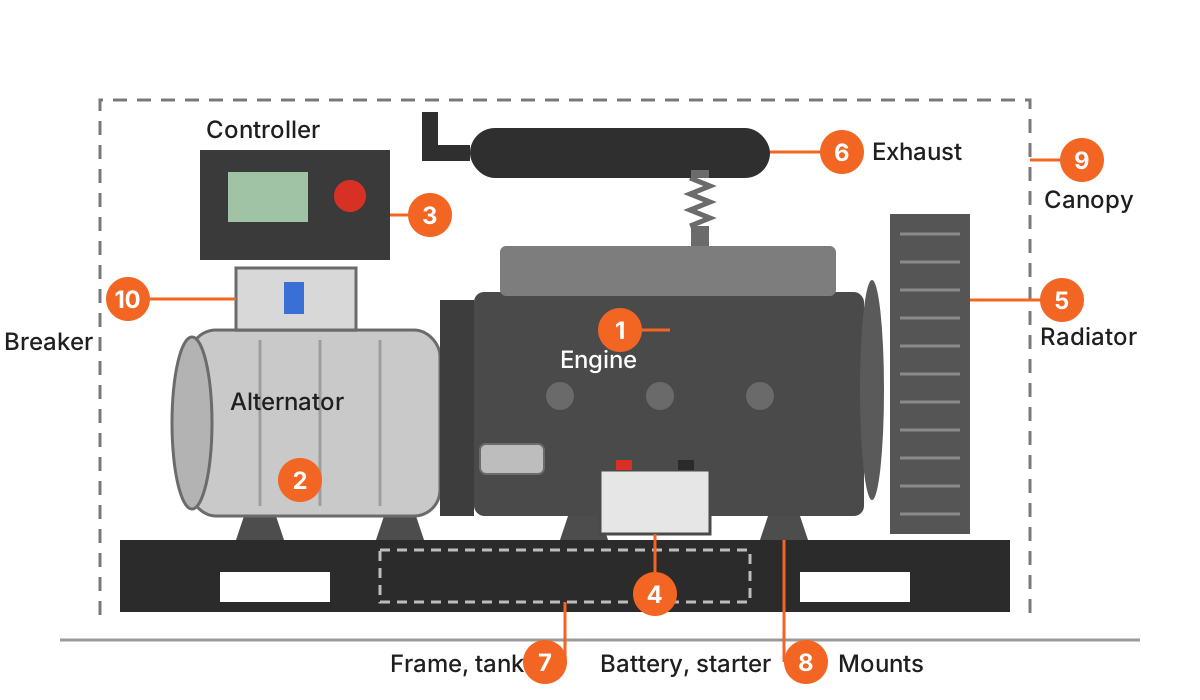
A diesel generator set has ten assemblies a buyer can name and see. The engine turns the alternator, which produces the electrical output; the controller starts, monitors and protects the set; the battery and starter crank the engine; the radiator carries away engine heat; the exhaust leaves through a flexible bellows and a silencer; the base frame carries everything on anti-vibration mounts and may hold a fuel tank; an enclosed set adds a canopy; and the output reaches the load through a breaker or sockets.
| No. | Part | What the quotation line identifies |
|---|---|---|
| 1 | Engine | Maker, exact model, speed, fuel system, governor |
| 2 | Alternator | Maker, exact model, frame designation, insulation class, IP code, voltage regulator |
| 3 | Controller and panel | Controller maker and model, the functions it is configured for, panel devices |
| 4 | Battery and starting circuit | Battery type and capacity basis, quantity, starter voltage, charger, isolator switch |
| 5 | Cooling | Radiator arrangement, fan drive, coolant fill on delivery |
| 6 | Exhaust | Flexible bellows, silencer type and position, what is supplied loose |
| 7 | Base frame and fuel tank | Frame drawing, lifting and forklift points, tank fitted or not, tank documents |
| 8 | Anti-vibration mounts | Type, number and position between the engine and alternator feet and the frame |
| 9 | Canopy (enclosed sets) | Canopy drawing, panel material and coating, acoustic lining, doors |
| 10 | Output and switchgear | Main breaker, sockets, terminals, cable entry |
The genset assembler is responsible for the combination: it chooses which engine goes with which alternator, states the package rating, builds the frame, wires the panel and coordinates the warranty route for the set. The component makers remain the source of their own data: the engine data sheet comes from the engine maker, the alternator rating sheet from the alternator maker, the controller manual from the controller maker. A quotation that names only the assembler's model gives you none of those documents.
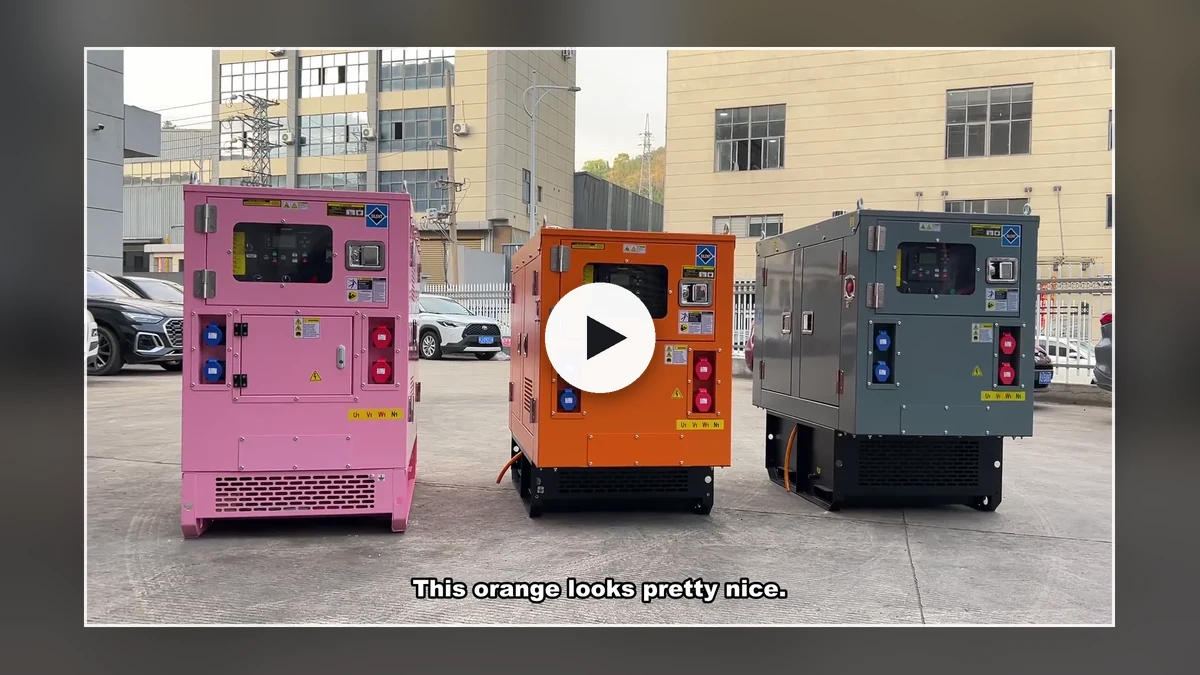
In that video Sange names Quanyi as the alternator maker and Yuchai or Weichai as the engine maker on the sets he shows. Those are his statements about the units in the video, not a description of the configuration you will be quoted. For your order, the written quotation names the exact engine, alternator and controller fitted, and a brand named on any quote is not proof that the seller is an authorised dealer of that brand; if authorisation matters to you, get it from the brand owner.
Settle the rating basis before reading any kW figure
A kW number without its rating category, the standard behind it and the operating conditions is not an offer you can compare. One quote may state prime power and the other standby power for sets that are otherwise identical, and the higher figure usually comes with tighter limits on how long and how hard the set may run. Prime, standby and continuous are separate categories with their own definitions and limits; ISO 8528-1 sets out the classifications for application, ratings and performance of engine-driven AC generating sets, and each engine and alternator maker states in its own rating documents how it applies them. The prime, standby and continuous ratings guide covers the choice itself.
For component comparison, each quote needs these fields on its first line:
- output in kW and kVA, with the power factor used to convert between them;
- rating category (prime, standby, continuous or the supplier's own term) and the standard and edition it refers to;
- voltage, frequency and number of phases;
- the ambient temperature and altitude the rating applies to;
- the data sheet or rating document, with its revision.
If the two quotes differ on category, frequency or conditions, the component lines below can still be filled in, but the offers are not yet comparable on price. The load list and starting events that decide the required rating belong to the industrial generator sizing guide.
Engine: the model line, not the badge
The engine line names the maker and the exact model, including any suffix that marks the emissions stage, the speed version or the market variant. A family name or a series name is not enough, because two engines from one family can have different ratings, fuel systems and documents. The fields that make the line checkable are:
- maker and exact model as printed on the engine's own nameplate;
- speed the set runs at for the quoted frequency, written next to the alternator's frequency and pole data so the two can be read together; if they do not obviously fit, the supplier explains;
- fuel system type (mechanical or electronic injection) and the governor type;
- starting method and starter voltage;
- the engine maker's data sheet and its revision, plus the emissions documents your destination needs.
In the factory walk-through video, Sange reads the engine model off the unit he is showing and says it has an electric fuel pump, so the fuel system does not have to be bled by hand. Whether or not that matters for your market, it is a good example of a detail that belongs on its own line: if a quote offers it, the line says which pump is fitted and whether it is part of the engine maker's build or added by the assembler. The same discipline applies to fuel consumption, which is only comparable at a stated load and rating; the fuel consumption quotation checklist covers that comparison.
Alternator: model, frame, insulation, IP code and regulator
The alternator line names its maker and exact model and points to that maker's rating sheet. "Brushless alternator" or "copper winding alternator" describes a type, not a machine. The fields that matter for comparison are:
- maker and exact model, with the frame designation the maker uses (a size code, not a universal dimension);
- rated output at the quoted voltage, frequency and power factor, from the alternator maker's sheet;
- insulation class and the temperature rise the rating is based on;
- IP code of the alternator enclosure;
- voltage regulator: an AVR with its make and model, or the regulation method the maker states.
Two standards help read these lines. IEC 60034-1 covers rating and performance of rotating electrical machines, so a supplier citing it for the alternator should say which edition. The IP code is defined by IEC 60529, and the IEC's own page on IP ratings explains what the two digits classify and that the tests behind them are set by that standard. An IP code describes the enclosure of the machine it is written on.
It does not describe the whole set, the control panel or the canopy. In the walk-through, Sange reads an IP code from the alternator he is showing; a quote should carry the code from the alternator maker's document for the alternator actually offered.
Controller, battery and starting circuit
The controller line names the controller maker and model and lists the functions it will be configured for on your order, because the same controller can be set up with or without automatic start, mains-failure detection, breaker control or communication. The panel line then lists the devices on the panel door. "Automatic control panel" without a model and a function list does not identify anything.
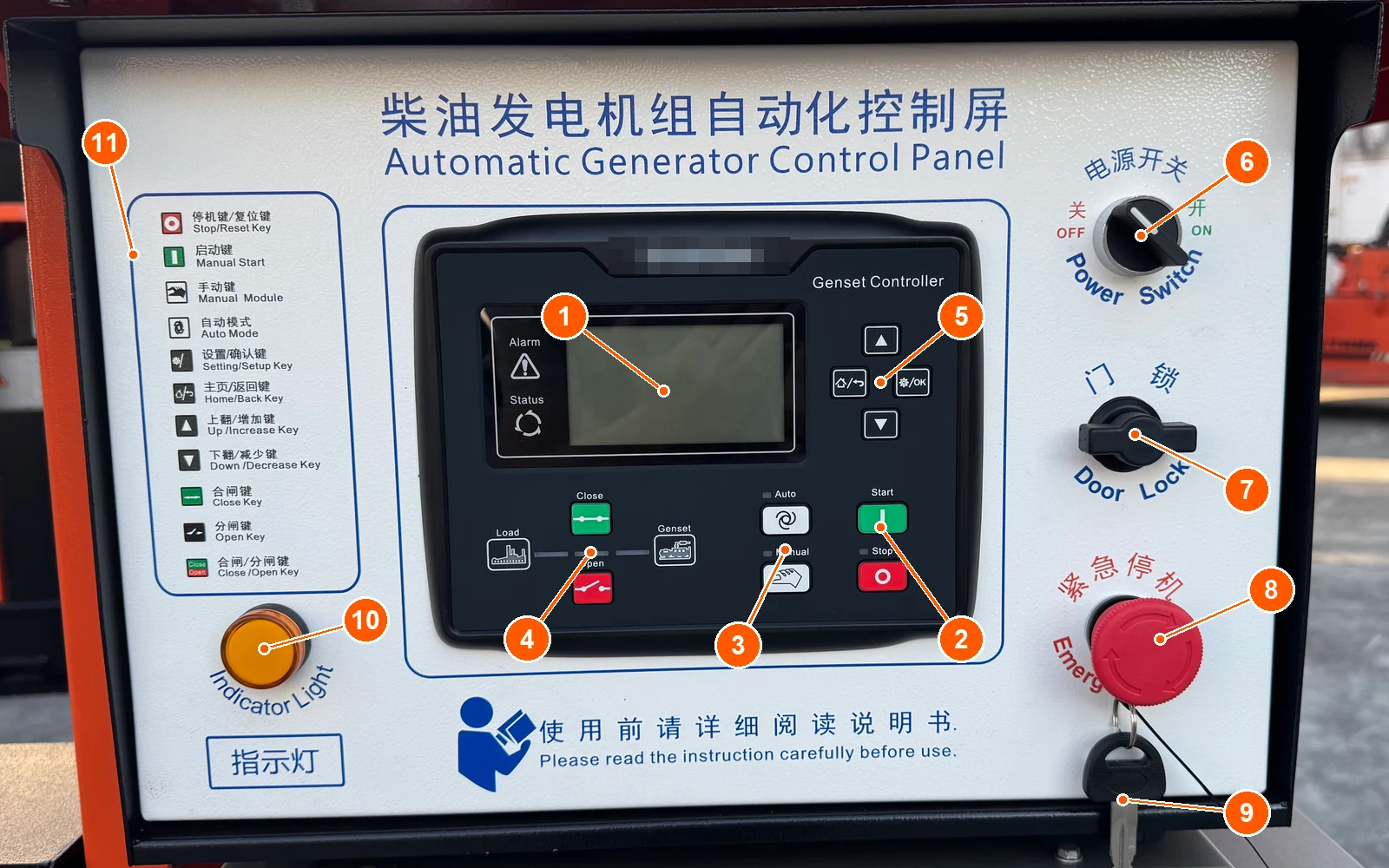
| No. | Item on the panel | Line it belongs to |
|---|---|---|
| 1 | Controller display with alarm and status indication | Controller maker, model, metering and alarm list |
| 2 | Start and stop keys | Starting functions |
| 3 | Auto and manual mode keys | Automatic start: included or not, and on which signal |
| 4 | Breaker close and open keys with the load and genset mimic | Breaker control: whether the controller operates a motorised breaker on this order |
| 5 | Menu and setting keys | Settings: who sets them, and whether the setting file is supplied |
| 6 | Power switch | Panel supply arrangement |
| 7 | Door lock | Panel access |
| 8 | Emergency stop | Emergency stop device and where it is wired |
| 9 | Key | Key switch arrangement |
| 10 | Indicator light | Indicator list |
| 11 | Key legend | Panel labelling language |
The battery and starting circuit is a separate line made of several items, each marked included, excluded or not applicable: battery type and chemistry, the capacity and the basis it is stated on, number of batteries and the system voltage, starter motor voltage, the engine-driven charging alternator, any mains battery charger, battery cables and the battery isolator switch. A supplier that writes "battery included" has answered one item out of eight.
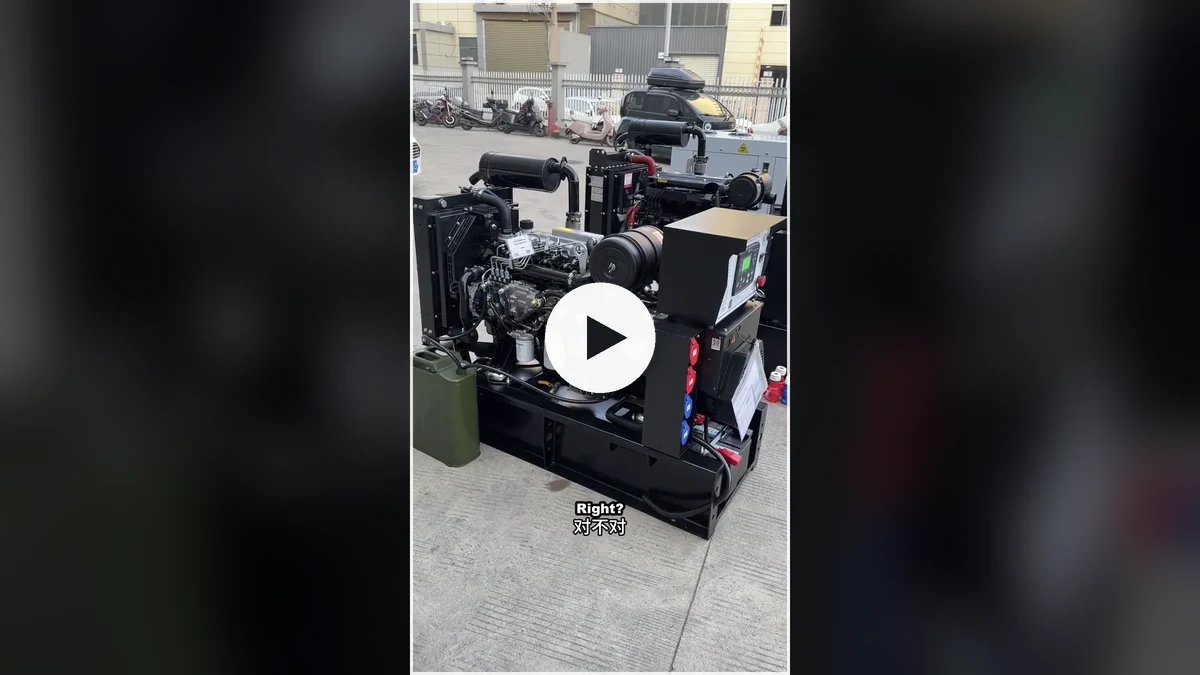
In the same video Sange describes a remote start range for the controller he shows. A remote start distance is a property of a specific controller, its accessory and the site, so the figure for your order comes from the controller maker's document for the exact model and accessory, not from a demonstration. How remote start, electric start and automatic start differ, and where the transfer switch fits, is in the start-mode guide.
Base frame, fuel tank, mounts, canopy, exhaust and cooling
These are the lines most often written as one word, "standard", or left off the quote altogether. Each one is a physical part with a drawing, and each one changes what you receive. The table shows what a complete line looks like and what to send back.
| Part | A complete line states | Send back when the quote says |
|---|---|---|
| Base frame | Frame drawing and revision, welded or formed construction, lifting points, forklift pockets, battery position | "Heavy-duty base" with no drawing |
| Fuel tank | Fitted in the base or not, the capacity the supplier states and how it is measured, level sender, filler and drain arrangement, tank documents | "With tank" and no capacity basis or drawing |
| Anti-vibration mounts | Type, number and position between the engine and alternator feet and the frame, and whether further isolation under the frame is by others | "Mounts included" with no type |
| Canopy | Canopy drawing, panel material and coating, acoustic lining, doors and locks, and any sound figure with its measurement distance and method | "Silent canopy" as the only description |
| Exhaust | Flexible bellows, silencer type and position, rain cap, what ships loose and what the site provides | "Exhaust included" with no scope |
| Cooling | Radiator arrangement and fan drive, guard, coolant type and whether the set ships filled | "Radiator cooling" with nothing else |
| Output and switchgear | Main breaker rating basis and type, sockets and their standard, terminals and cable entry | "Breaker and sockets" with no list |
The open-frame or enclosed choice changes how many of these rows apply, and a canopy brings its own questions about access and service that the open-frame vs enclosed matrix covers. Frame lifting points and forklift pockets also decide how the sets are loaded, which the container loading plan uses as input.
Component comparison sheet for two quotations
Put both quotations on one sheet with one row per part and one column per quote. The rows follow the numbers on the schematic, so the sheet, the drawing and the inspection photographs use the same reference. Fill each cell from the quote and its attached documents only, not from a catalogue, a sales message or an earlier order.
| Row | Field to fill | Quote A | Quote B | Document that supports it | Checked at inspection by |
|---|---|---|---|---|---|
| 0 | Rating category, kW and kVA, voltage, frequency, phase, conditions | Genset rating sheet, revision | Genset nameplate | ||
| 1 | Engine maker, exact model, speed, fuel system | Engine maker's data sheet, revision | Engine nameplate and serial number | ||
| 2 | Alternator maker, exact model, frame, insulation class, IP code, regulator | Alternator maker's rating sheet, revision | Alternator nameplate and serial number | ||
| 3 | Controller maker and model, configured functions, panel devices | Controller manual or data sheet, panel drawing | Controller label, function test to the agreed list | ||
| 4 | Battery, starter, charger, cables, isolator | Battery data, package list | Battery label and quantity, items present | ||
| 5 | Cooling arrangement | Drawing or data sheet | Visible arrangement | ||
| 6 | Exhaust items supplied | Drawing, scope note | Items present, loose items listed | ||
| 7 | Base frame and fuel tank | Frame and tank drawings, revision | Frame against drawing, tank fitted or not | ||
| 8 | Anti-vibration mounts | Drawing or data sheet | Type and number present | ||
| 9 | Canopy | Canopy drawing, coating data, sound data if quoted | Canopy against drawing | ||
| 10 | Output breaker, sockets, terminals | Panel drawing, single-line diagram | Devices present and labelled |
A hypothetical example of one completed row, to show the level of detail: row 2, Quote A, "Alternator: [maker], model [code], frame [designation], insulation class [letter], IP [code], AVR [make and model]; rating sheet rev. [x] attached". If Quote B reads "brushless alternator, copper winding", row 2 for Quote B is not filled; it goes back to the supplier with the field names from the left column.
Each row ends in one of three states:
- Same build: both quotes name the same maker and model with supporting documents, or the difference is one you accept.
- Priced difference: both quotes are complete, but they name different parts or one quote excludes an item; the difference is real and has to be priced or accepted.
- Not yet comparable: a field is missing, a document is missing, or row 0 differs on rating category, frequency or conditions. The quote goes back to the supplier before any price comparison.
The sheet is complete when every row is filled with a maker, a model and a document, marked excluded or not applicable in writing, or recorded as a deviation you approved. Only then is the price comparison between Quote A and Quote B a comparison of the same thing.
Nameplates, documents and substitutions after award
The completed sheet becomes the reference for inspection. Before shipment, the engine, alternator and genset nameplates and serial numbers are photographed and compared with rows 0 to 2, the controller label with row 3, and the package contents with rows 4 to 10. The pre-shipment inspection checklist explains how to run that check, and the certificate and nameplate match guide covers how certificates, reports and nameplates have to point to the same unit. A visual inspection proves identity and visible condition; performance claims still rest on the maker's documents or an agreed test.
Three points keep the sheet valid after award:
- Substitution only in writing. If a component becomes unavailable, the supplier proposes the replacement with its maker, model and data sheet, explains the difference, and waits for your written approval before building. An "equivalent" without that comparison is not an approval.
- Warranty route per line. The quote states whether warranty claims for the engine, the alternator and the controller go through the genset supplier or the component maker, and which written warranty document applies.
- Destination documents per component. Some markets regulate the engine separately from the set. In the United States, for example, 40 CFR Part 60 Subpart IIII sets standards for specified stationary compression-ignition engines; whether it applies depends on the engine, its use and dates, so the importer and its compliance adviser decide which engine documents the quote must carry. The pre-order document checklist helps build that file.
Send the sheet with your RFQ
Send the empty sheet with your request for quotation, together with the rating category, voltage, frequency, phase, destination market and quantity, and ask each supplier to return it filled with documents attached. For a BEAR quotation, send it through the contact page; Miya handles inquiries, and the written quotation confirms the model, configuration, accessories and documents for each row. A sample unit or a factory visit can be arranged before a production order, so the nameplates can be checked against the sheet on a real unit. The open-frame diesel generator range is the starting point for most component questions, and the 60 kW open-frame diesel generator page shows one example build part by part.