
What the 168F, 170F, 188F and 190F engine codes on Chinese generator spec sheets do and do not tell a buyer, and the fields to demand before comparing quotations.
In this guide7 sections
A 188F engine on a Chinese generator's specification sheet is a family label, not a specification. The code tells you the bore class of a horizontal-shaft single-cylinder engine, and therefore the order of size between a 168F, a 170F, a 188F and a 190F; it does not tell you the maker, the exact displacement, the rated power at a given speed, or whether two suppliers' 188F engines share a single part. The buying decision that follows is simple to state: use the code to sort quotations into size classes, then make each supplier name the engine maker and the full model code with its suffixes, quote displacement and rated power at rated speed from the maker's own document, show you the code on the block, and tie every spare part to that exact variant. The exception is a quotation that already names a maker's full model and attaches its data sheet; there you skip the decoding and go straight to the manual.
This guide is for importers, distributors and parts planners who read Chinese quotations and product cards, not for engine tuners. It stops where the engine meets the alternator: the output rating of the set is checked through the rated versus peak power guide, and sizing through the portable sizing guide.
Start with the marking on the block
Three places carry an engine identity on a Chinese generator, and they do not always agree. The quotation gives a code, often bare. The sticker on the engine shroud gives a brand, a model and sometimes a power figure chosen for the market.
The engine block itself carries a cast or stamped marking, usually near the oil-level sensor or on the crankcase face, placed there by the engine maker. When the three disagree, the block marking is the item to photograph first, because it is the hardest to change after the fact; it is still not proof of power or origin on its own.
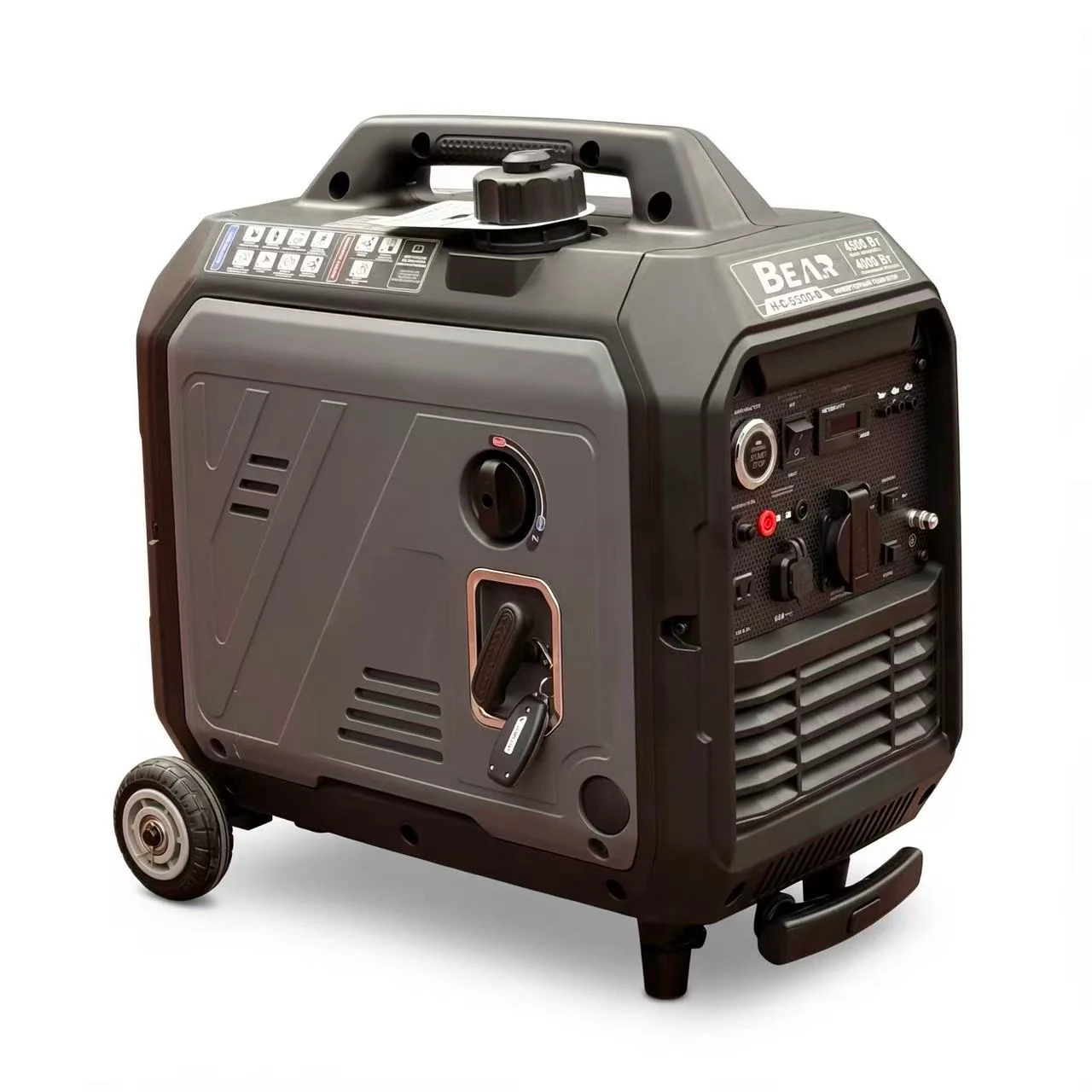
Record three things for every quotation: the code on the block, the brand and model on the sticker, and the engine line of the quotation. If they differ, ask the supplier to reconcile them in writing and to confirm which engine will actually be fitted to the production units, because a generator model can be built with more than one engine over its life. The incoming inspection guide covers how to repeat the check when the goods arrive.
Read the code as a family clue, not a specification
The common gasoline codes used on Chinese generators follow one convention: the number before the F tracks the cylinder bore class, so a higher number usually means a larger engine. A suffix after the F marks a version: 168F-2 is a different engine from 168F, with a different displacement, although both are sold as six-and-a-half horsepower class engines by many brands. That is as far as the code reliably goes. The same code on engines from two makers can carry different displacements, different rated outputs and different power claims, and a trade name such as "GX390 type" is a comparison, not an identity.
| Code as it appears in quotations | What it usually denotes | Published example (one maker, Lifan) | What to ask before relying on it |
|---|---|---|---|
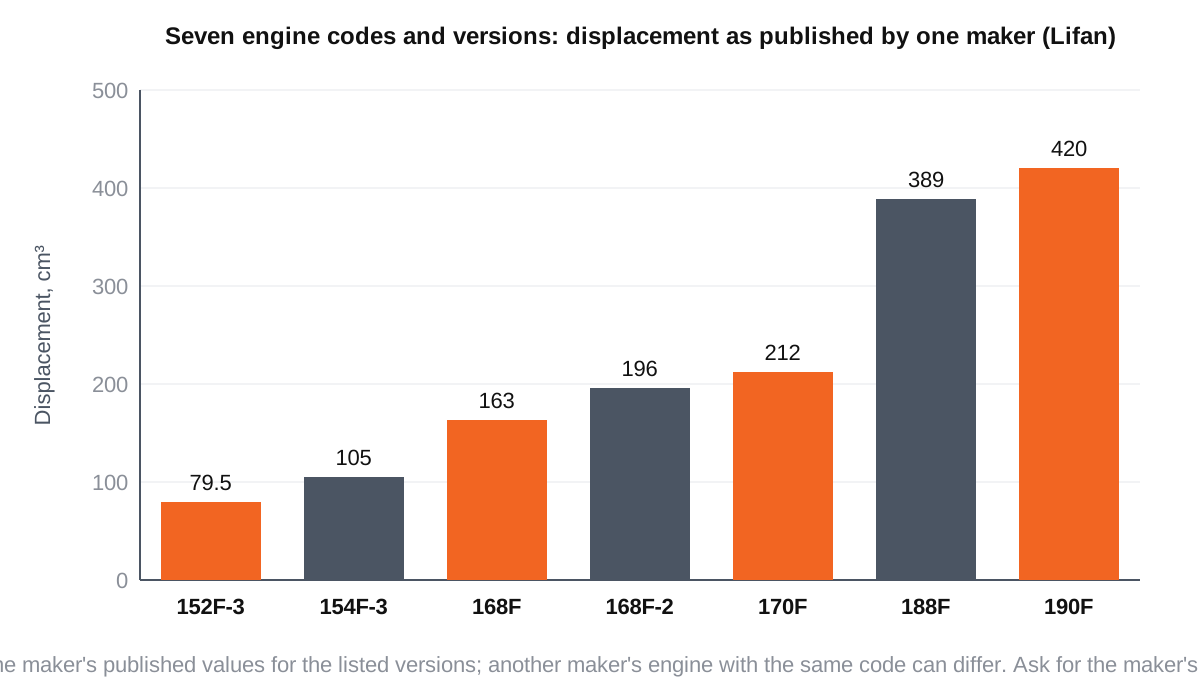
| 152F, 154F, 156F | Smallest horizontal-shaft class, often on 1 kW class sets | Lifan lists 152F-3 at 79.5 ml and 154F-3 at 105 ml | Which version; the suffix changes the displacement |
| 168F, 168F-2 | The 2 to 3 kW class workhorse; 168F-2 is the larger version | 168F 163 ml; 168F-2 196 ml in the same maker's data | Which of the two is fitted; do not accept "168F" alone |
| 170F | A step above 168F-2 | 212 ml in the Lifan B-series data | Whether the quotation's power figure is rated or maximum |
| 173F, 177F, 182F | Intermediate classes on 4 to 6 kW class sets | Maker documents | The maker's own displacement and output; values differ by maker |
| 188F | The 5 kW class engine most often described as a "GX390 type" | 389 ml in Lifan's data | Maker and version; "GX390 type" is a comparison, not a model |
| 190F, 192F | Larger single-cylinder classes on 6 to 8 kW class sets | 190F 420 ml in Lifan's data | Fuel type: 192F is used for both gasoline and diesel engines in makers' listings |
The output classes in the second column are a reading aid for sorting quotations, not a promise about any set. Where the table says "maker documents", the maker's manual or data sheet is the only acceptable source; a figure copied from a marketplace card or a forum post belongs in your notes, not in your contract. The portable manufacturer shortlist names assemblers, not engine makers; the engine maker is a separate identity to request.
Verify displacement and rated power from the maker
Once the family is clear, two numbers decide whether the engine is what you are paying for: displacement and rated power at rated speed. Both must come from the engine maker's document for the exact model code, including suffix, and both come with conditions that are easy to lose in translation.
Power is the number most often misstated. Engine makers publish a maximum power and a rated, or net, power, at a stated speed, and the two are not interchangeable: the sticker on a generator engine may carry the maximum figure, while the engine's work at 3000 rpm in a 50 Hz set or 3600 rpm in a 60 Hz set is governed by the rated figure at that speed. Ask the supplier to quote the maker's term, the value, the unit and the speed, and to attach the page. Horsepower without a speed and a basis is a sales figure.
Fuel type is the other trap. The same number appears in gasoline and diesel engine families, and 192F in particular is used for both in makers' own listings, with quite different engines behind it. If a quotation says 192F, ask which fuel, which maker and which version before anything else; the diesel families carry their own displacements and ratings, and nothing transfers across from the gasoline table above.
Check the engine against the quoted generator output
A buyer with the engine's rated power in hand can ask whether the generator's claimed output is plausible. The engine turns the alternator; the alternator converts shaft power to electrical power with losses; the set's rated output must therefore sit below the engine's rated output at the same speed, by a margin that depends on the alternator and the rating basis. Forum rules of thumb put the engine-to-generator ratio around 1.7 to 1. Treat that as a screening question with assumptions in it, not as a conversion: a set whose claimed output comes too close to the engine's rated power deserves a written explanation of the rating basis, and the rated versus peak power guide shows how to separate the set's rated and maximum figures before you compare them with anything.
Ask the supplier for three documents side by side: the engine maker's rated power at rated speed, the alternator maker's rated output, and the set's own rating declaration with its basis. When the three are consistent, the engine code has done its job; when they are not, the mismatch is the supplier's to explain before the order, not yours to reconcile after delivery.
Plan spare parts only after the variant is confirmed
The clone families behind these codes share many dimensions, which is why a carburettor sold as "188F" often fits several brands' engines and why bolt patterns feel familiar across suppliers. That is a convenience for the aftermarket and a trap for a parts planner. Carburettor jetting, recoil-starter housings, ignition coils, gasket sets and shaft details vary between makers and versions, so "fits all 188F" is a listing claim, not a fitment confirmation.
The safe sequence is short. Confirm the engine maker, the full model code and the version from the block and the maker's document. Request the maker's parts catalogue reference, or the supplier's written cross-reference, for each part you intend to stock: carburettor, recoil starter, ignition coil, gasket set, oil sensor, air filter element and spark plug.
Enter a part into your stock plan only with a part number tied to that variant. The first-order spare-parts kit guide covers quantities and consumables; the oil specification request and the break-in guide cover what the engine maker's manual must tell your customers.
Put the engine identity into the RFQ
The schedule below turns the code into a set of answers a supplier either has or does not have. Attach it to the RFQ, ask for it to be completed per generator model, and compare offers only after every row has a sourced answer or a written "not applicable" with a reason.
| Field | Complete supplier answer | Proof | Who confirms | Reject or query when |
|---|---|---|---|---|
| Fuel and engine type | Gasoline or diesel; single-cylinder horizontal-shaft; cooling | Maker's data sheet | Supplier | Fuel type missing or inconsistent with the code's use |
| Engine maker and full model code | Maker's name and the complete code with prefix and every suffix | Data sheet, parts catalogue, photo of the block marking and sticker | Supplier; engine maker if disputed | A bare "168F", "188F" or "GX390 type" |
| Displacement | Value with unit for that maker and version | Maker's manual or data sheet | Engine maker's document | No source, or a value from a different version |
| Rated power and speed | Value, unit, the maker's term (rated, net, maximum) and the rpm | Maker's document page | Engine maker's document | Horsepower without speed or basis; maximum offered as rated |
| Generator rating | Set rated output, frequency, voltage, rating basis; peak listed separately | Set data sheet and rating declaration | Set supplier; alternator maker | Engine power offered in place of set output |
| Alternator identity | Alternator maker, model and rated output | Alternator data sheet | Alternator maker's document | Unnamed alternator |
| Emissions and destination | Market named; the applicable approval or certificate, or a written statement of what is not certified | Certificate and label details where required | Supplier provides; the destination authority decides applicability | "EPA", "CARB" or "Stage V" asserted without the engine family and document |
| Parts identity | Part numbers for each stocked part, tied to the exact variant | Maker's parts catalogue or written cross-reference | Engine maker or supplier | "Fits 188F" alone |
| Production trace | Engine marking tied to each shipped unit | Production record, inspection photos | Supplier; inspector records | Untraceable or unexplained mismatch |
Emissions deserve one sentence of caution. The United States Environmental Protection Agency's small equipment and tools page and the European Union's Regulation (EU) 2016/1628 apply to engines and markets, never to a family code; whether a given engine is certified for your destination is a document question, and the import compliance guide shows where it sits in the wider paperwork. Generating-set ratings themselves follow the vocabulary of ISO 8528-1, which the International Organization for Standardization describes on its catalogue page; that standard classifies the set, not the engine code.
BEAR quotes open-frame gasoline generators, inverter generators and the wider gasoline range against written specifications, and the written quotation is where the engine maker, model code, displacement and rated power should appear as text. Send Miya the schedule with your model list and destination, and ask for the engine rows to be filled from the maker's documents; a quotation that returns them is one you can compare.
Frequently asked questions
Is a 188F the same engine as a Honda GX390?
No. "GX390 type" describes a family resemblance in layout and dimensions, which is why some parts fit across brands. It does not make a 188F from any maker identical to a Honda engine in displacement, materials, rated power or parts, and it is not a quality or compliance claim.
Which is bigger, a 168F-2 or a 170F?
In Lifan's published data a 170F is 212 ml and a 168F-2 is 196 ml, so the 170F is the larger engine; another maker's figures can differ. The suffix on the 168F matters as much as the family number: Lifan's 168F without a suffix is 163 ml.
Does the engine code tell me anything about emissions compliance?
Nothing. Compliance belongs to a specific engine, maker and market, and is proved by the applicable certificate and label. Ask for the document that covers the exact engine for your destination, and treat a code or a clone lineage as silent on the question.