
What a “100% copper” generator winding claim should mean, where the material matters, and the five fields and checks that verify it before you order.
In this guide7 sections
A "100% copper" line in a generator quotation is a material claim, not a quality grade, and until the supplier names the conductor material of the alternator windings in writing for the exact model, it is unverified. Three materials are in play: copper, aluminum, and copper-clad aluminum, usually shortened to CCA.
The decision is to treat the words as a field. Ask for the declaration and the wire gauge, make the claim checkable through alternator mass on identical models, per-phase resistance with its measurement temperature, and the insulation class with its temperature-rise record, then write the acceptance rule into the order and check it at inspection. The exception is scope: for an inverter generator, or for a set that will run a few dozen hours a year, the winding material rarely decides the purchase, and paying a premium for the word alone is a mistake.
Online, the question "aluminum vs copper windings in generator" gets two kinds of answers: physics lessons that end in "copper is better", and shoppers who conclude that nobody can tell anyway. Both are half right. This guide is for importers, distributors, marketplace sellers and fleet buyers who compare quotations from China and need the half that can be written into an order. The output rating itself is checked through the rated versus peak power guide, and waveform quality through the THD specification request; the winding material validates neither.
Decide what the claim has to prove before you compare prices
Three quotations for the same output class often read differently on this point: one says "100% copper windings", one says nothing, one says "copper-clad aluminum". Before the price gap means anything, you need all three to answer the same question: what is the conductor in the stator and rotor windings of the alternator fitted to the quoted model, and what document says so.
Two inputs frame how much weight the answer deserves. The first is the use case: occasional standby, seasonal use, daily commercial duty near rated load, or rental fleets where units run hard and are serviced by strangers. The second is the architecture: a conventional synchronous alternator with an automatic voltage regulator, or an inverter generator where power electronics sit between the alternator and the sockets. Write both down; the next three sections use them.
Copper, aluminum and CCA: what each one changes
Copper and aluminum are different conductors, and CCA is a composite: an aluminum core with a bonded copper skin. CCA is a legitimate winding material when it is declared as CCA. It is not "100% copper", and a quotation that uses one term for the other has told you something about the supplier's paperwork before you look at the machine.
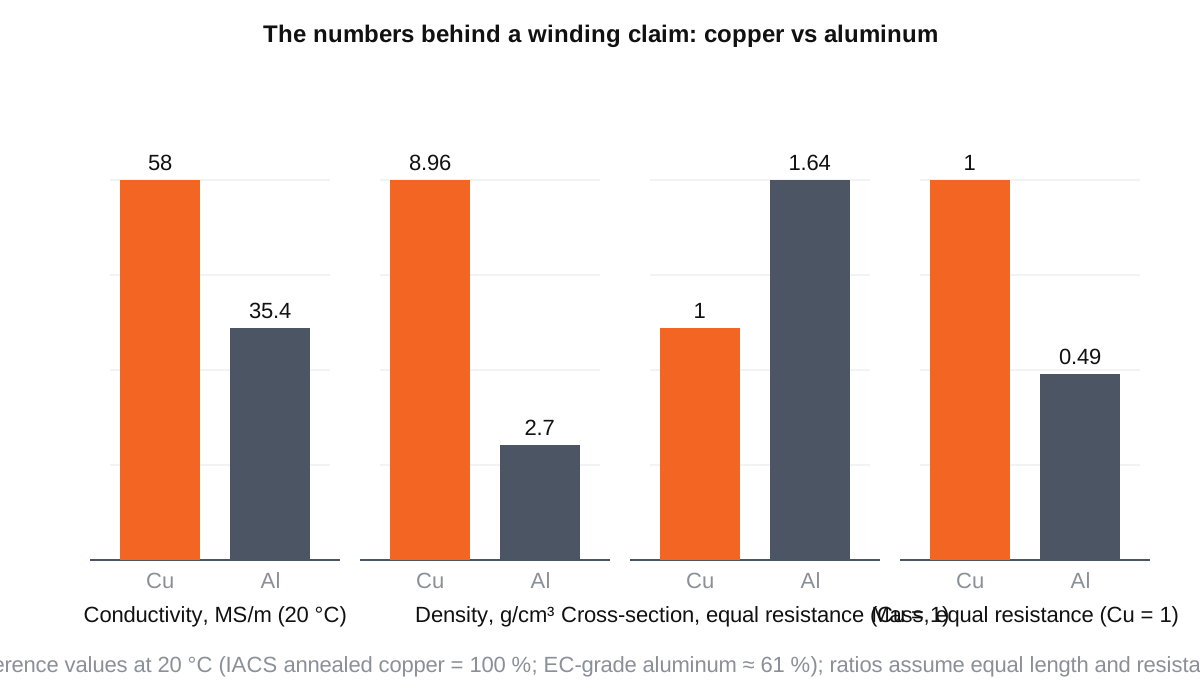
The physics behind the chart is short. For the same length and cross-section, aluminum has about 1.6 times the resistance of copper, so a designer who wants the same resistance from aluminum uses a larger cross-section; that larger conductor still weighs about half as much as the copper one, because aluminum is roughly a third as dense. The Association for Science Education's bulk properties of copper page and the NIST reference tables give the underlying values and their conditions. A winding is not bulk metal, however: slot space, insulation, connections and cooling decide how those constants turn into heat and output in a given alternator.
What the material changes in practice is therefore a list of tendencies, each of which must be confirmed for the model you are buying:
- Resistance and heat for a given slot. An aluminum winding in the same slot space runs at higher resistance, so it runs warmer at the same current unless the design compensates.
- Mass. An aluminum-wound alternator is lighter, which is why mass is a clue on identical models and a trap on different ones.
- Terminations. Joints between aluminum conductors and copper leads need design care, so ask the alternator maker how they are made rather than assuming they fail.
- Repair. Rewinding capability and parts differ by material and by market, which matters to a rental fleet more than to a standby buyer.
Where the winding material matters, and where it does not
In a synchronous alternator with an AVR, the stator winding carries the full load current and the rotor winding carries the excitation current, both for as long as the set runs. A unit that spends long shifts near its rated load, in a hot enclosure, is the case where the resistance and temperature-rise differences above have the most room to show, and where asking for the material, the insulation class and the temperature-rise record earns its time.
In an inverter generator the alternator feeds a rectifier and inverter, often at variable speed, and the electronics set the output. The winding material is still a real design choice, but it is one input among several, and the questions that decide the purchase are in the inverter generator buying guide: output quality, parallel capability, load response and the inverter module's own warranty. Pay for a declared material if you want one; do not expect it to answer those questions.
For occasional standby use, a few dozen hours a year at partial load, the material difference is unlikely to show inside the life of the set, and the money is better spent on the alternator's declared rating and on spare parts. Rental fleets sit at the other end: long hours, hard use, rough service, and a strong case for insisting on the declared material plus the test records. The components quotation guide shows where the alternator line sits inside a full genset quotation.
Five fields instead of a colour
Wire colour proves nothing: enamel and lacquer give copper and aluminum windings the same look, and a photograph of the grille shows even less. The checkable fields are these five. Ask for all of them against the exact alternator model, and treat a mass figure as a cross-check rather than a test.
| Field | Complete supplier answer | Who confirms | Reject when |
|---|---|---|---|
| Alternator identity | Alternator maker and model, configuration and revision, for the quoted generator model | Generator supplier; alternator maker for its data | "Standard alternator", or a data sheet for another model |
| Winding conductor material | Copper, aluminum or CCA, stated in writing, with scope: all stator and rotor winding conductors, or which ones | Alternator maker's declaration passed through the supplier | "Copper coil", "copper wire" or "100% copper" without scope; CCA described as copper |
| Wire gauge | Nominal conductor diameter or cross-section, stating whether bare or over the enamel | Alternator maker | A number without a basis |
| Alternator mass | Mass of the bare alternator for the exact model, with the weighing basis | Supplier's data sheet; inspector's witnessed weighing | A whole-generator mass; a comparison across different frames |
| Per-phase resistance, insulation class, temperature rise, IP | Phase-by-phase resistance with winding temperature and method; the insulation class; the temperature-rise test result with rating and conditions; the IP code and what enclosure it covers | Alternator maker's test record; inspector witnesses only the agreed measurement | A single resistance value with no temperature; a class offered as a measured rise; an IP code read off a grille |
Three of these fields have standards behind them. The rating, temperature rise and insulation class of rotating machines belong to IEC 60034-1, and the IP code of the machine enclosure to IEC 60034-5; neither certifies copper content, they define what the maker's figures mean. Winding wire itself is specified by type, with separate IEC 60317 parts for enamelled round copper wire and enamelled round aluminium wire, so a supplier who claims "IEC 60317 wire" should be asked which part. None of these numbers has a universal pass limit for your purchase; the alternator maker's document for the model sets the values, and your job is to obtain that document and tie it to the unit.
Verify before the order and at inspection
Verification has two moments, and the evidence at each is different in kind. Before the order you collect declarations and documents; at inspection you collect observations tied to a serial number. Keep the two apart in your file, because a declaration that is later contradicted by an observation is a contract matter, while an observation with no declaration behind it is just a photo.
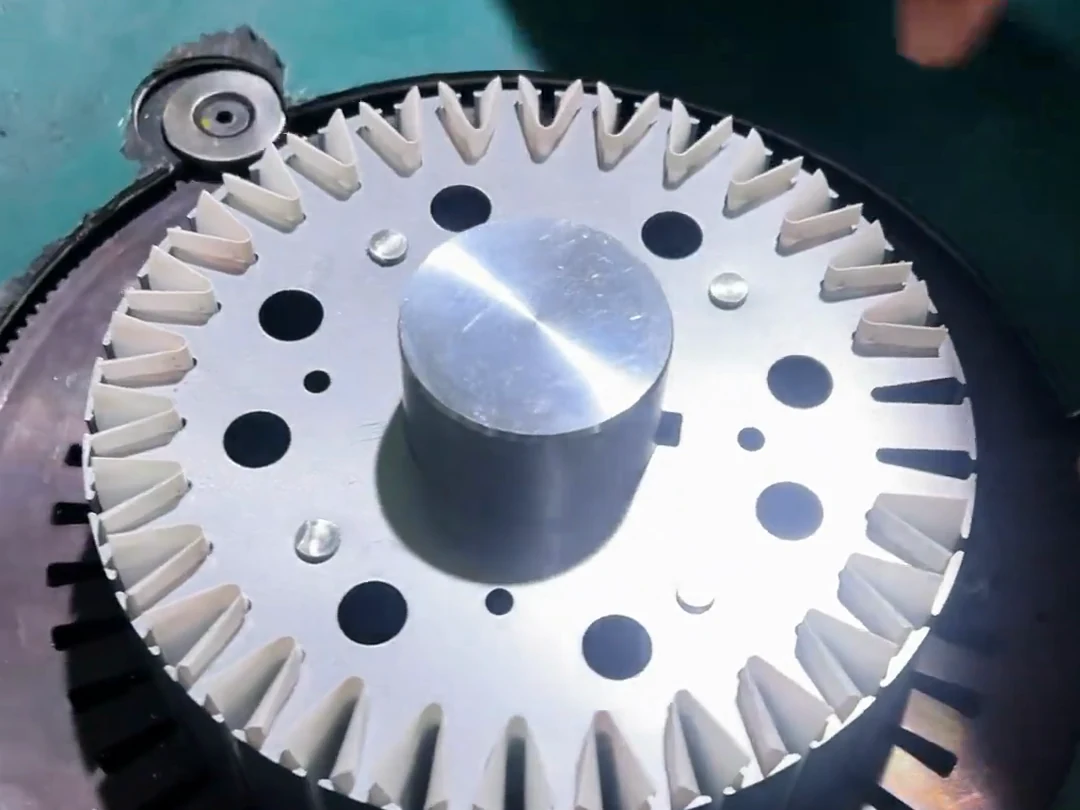
Before the order, four steps are enough. Obtain the signed material declaration for the exact alternator model and attach it to the quotation. Obtain the alternator data sheet with mass, insulation class and IP, and the temperature-rise and resistance records for the model or its documented family.
If a sample unit is approved under the first-article approval guide, agree then whether a winding end-turn photograph or a cut sample from a production winding will be part of the evidence, who takes it, and what it costs; destructive checks are not something to spring on a supplier at the factory gate. Compare alternator mass only between the same alternator model in the same configuration, and record the weighing basis.
At inspection, the pre-shipment inspection checklist carries the generic steps; for the winding claim, the inspector records the alternator plate, photographs the agreed end-turn view if the terminal box or end cover is opened under the agreed scope, witnesses the per-phase resistance measurement with the winding temperature noted, and weighs a bare alternator if that was agreed. The inspector records; the alternator maker's document sets the acceptance values; the supplier explains any gap. A factory audit can add context on how the supplier controls incoming alternators, but it does not replace the model-specific declaration. The test-report red flags guide explains how to tie any report to the unit it claims to describe.
Write the acceptance rule into the RFQ and the contract
The rule below turns the five fields into a decision. It is deliberately strict about undeclared CCA and deliberately relaxed about CCA that is declared and accepted, because the risk is in the mismatch, not in the material.
| Decision | Condition |
|---|---|
| Accept for comparison | Exact alternator identity, explicit material declaration with scope, wire gauge with basis, and comparable mass and electrical or thermal evidence for the model |
| Clarify before order | Missing test conditions; "copper" without scope; a report whose model scope is unclear; a mass comparison that is not like-for-like |
| Reject or hold | Undisclosed CCA or mixed construction where copper was specified; contradiction between contract and declaration; refusal to name the material; records tied to a different model with no technical justification |
| Complete | Contract, declaration, evidence and the inspected unit agree on identity and material, and every agreed check has a record; any check that could not be done is recorded as an exception and approved by you in writing |
The RFQ sentence that produces usable answers is specific: "State the winding conductor material of the stator and rotor windings of the alternator fitted to model X as copper, aluminum or CCA, name the alternator maker and model, attach the maker's declaration and data sheet, and state the per-phase resistance with its measurement temperature." A supplier who answers that sentence has a controlled bill of materials; one who answers "100% copper, don't worry" has a sales script.
BEAR quotes open-frame gasoline generators, inverter generators and the wider gasoline range against written specifications, and the written quotation is the document that fixes the model, the configuration and the papers that travel with it. Send Miya the sentence above with your model list and duty, and ask for the alternator fields in the same order; a quotation that returns them is a quotation you can compare.
Frequently asked questions
Is copper-clad aluminum a fraud?
No. CCA is a recognised conductor with its own specifications; the problem arises only when it is sold as "100% copper". Ask for the material by name, and if CCA is declared, decide whether it is acceptable for your duty and price it accordingly.
Does a copper winding make the generator more efficient or longer-lived?
Not by itself in any amount you can put in a contract. The material shifts resistance, heat and mass for a given design, but efficiency, temperature rise and life follow from the whole alternator and its duty. Ask for the model's temperature-rise record and insulation class instead of a percentage.
Can I tell the material from the weight?
Only on two units of the same alternator model and configuration, weighed bare on the same basis, and even then mass is a cross-check rather than proof. Across different frames, ratings or canopies the comparison is meaningless.