
Choose the engine speed class from duty hours, site and service, not the price gap; write rpm, poles, frequency and ratings into the RFQ and check the plates.
In this guide7 sections
The speed class of a generator set should follow the duty, not the price gap between two offers. A 1500 rpm set at 50 Hz, which is the same machine class as an 1800 rpm set at 60 Hz, is the usual starting point when the set will run many hours a year or carry a site's prime load; a 3000 rpm set (3600 rpm at 60 Hz) is the usual starting point for standby, portable and seasonal duty. The forum question "1800 rpm vs 3600 rpm generator" is the 60 Hz version of the same decision. The exception is the small power classes, roughly below the size where liquid-cooled four-pole sets are built at all: there the 3000 rpm air-cooled set is the only configuration on offer, and the decision moves to rating, cooling and service instead.
That rule of thumb only tells you where to start. The rest of this guide turns the decision into six fields that every bidder must return, so that a quotation for a 3000 rpm set and a quotation for a 1500 rpm set can be compared on the same basis, and then shows where to find those fields on the plates of the set that arrives. Sizing the load belongs to the industrial sizing guide and the portable sizing guide; the rating categories themselves belong to the prime, standby and continuous ratings guide.
Decide the duty first
Write down three numbers before you look at any rpm: the hours the set will run in a year, the longest single run you expect, and the load pattern during that run. A standby set for a shop may run forty hours a year in two-hour pieces. A rental set or a farm set may run a thousand hours a year in ten-hour shifts at steady load. Those two buyers are not choosing between the same machines, and a quotation cannot be judged until the bidder knows which one you are.
| Duty input | What to write in the RFQ | Why it matters for the speed decision |
|---|---|---|
| Hours per year | Your estimate, with the basis (outage history, shift plan, rental calendar) | Service intervals and oil capacity are quoted per engine; the annual hours turn them into a cost and a downtime figure |
| Longest run | Hours without a stop, and how often | Air-cooled sets carry maker-stated run limits; ask for the document rather than assuming a class rule |
| Load pattern | Steady, cyclic or motor-starting; share of time near rated load | Decides whether a prime or a standby rating applies and which speed class the maker will quote for it |
| Site | Noise limit at the boundary, indoor or outdoor, access for service | Noise and service access are quoted per configuration, not per speed |
The rating category is a separate field from the speed, and the two are often confused in quotations. Ask the bidder to state the duty category and the rating basis in writing, then ask for the speed at which that rating applies. A standby figure quoted for a 3000 rpm set is not comparable with a prime figure quoted for a 1500 rpm set, whatever the kilowatts say.
What 1500 and 3000 actually mean
For a conventional synchronous alternator, the output frequency is fixed by the engine speed and the number of magnetic poles: frequency equals poles times speed divided by 120. A two-pole alternator must turn at 3000 rpm to produce 50 Hz and at 3600 rpm for 60 Hz; a four-pole alternator produces the same frequencies at 1500 and 1800 rpm. Six-pole machines at 1000 and 1200 rpm exist in larger sets. The Engineering ToolBox gives the relationship and the standard pairings.
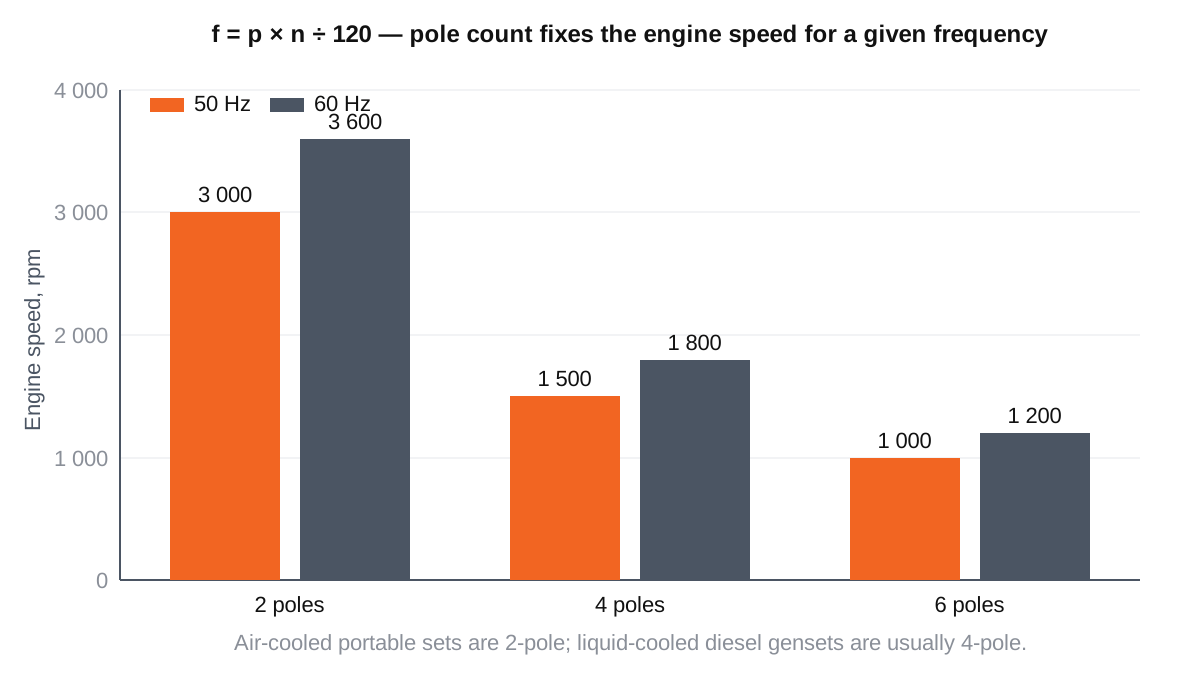
Two consequences follow for a buyer. First, "1500 or 3000" is really "four-pole or two-pole", and the alternator's pole count is a field you can ask for and read on its plate. Second, a set is not switched from 50 Hz to 60 Hz by turning a screw: the engine speed, the alternator's rating at the new speed, the controller settings and the quoted outputs all change, and some combinations are not offered at all.
If you buy for a 60 Hz market, ask for written confirmation of the exact set configured for 60 Hz, with its ratings at 1800 or 3600 rpm, rather than a 50 Hz data sheet with a note. The certificate, model and nameplate matching guide covers how the paperwork must follow that configuration.
What changes with speed, and what only seems to
The forum summary says that a 1500 rpm engine turns half as often, so it wears half as fast, runs cooler and quieter, and lasts for decades. Each half of that sentence contains a real engineering tendency and an overstatement.
Fewer revolutions per hour of running is a fact of arithmetic. Service life, however, depends on the specific engine, its load, its maintenance and its environment, and no maker publishes a life figure that applies to a whole speed class. Treat every life-hours claim as a question to the engine maker's documents, not as a property of the number 1500.
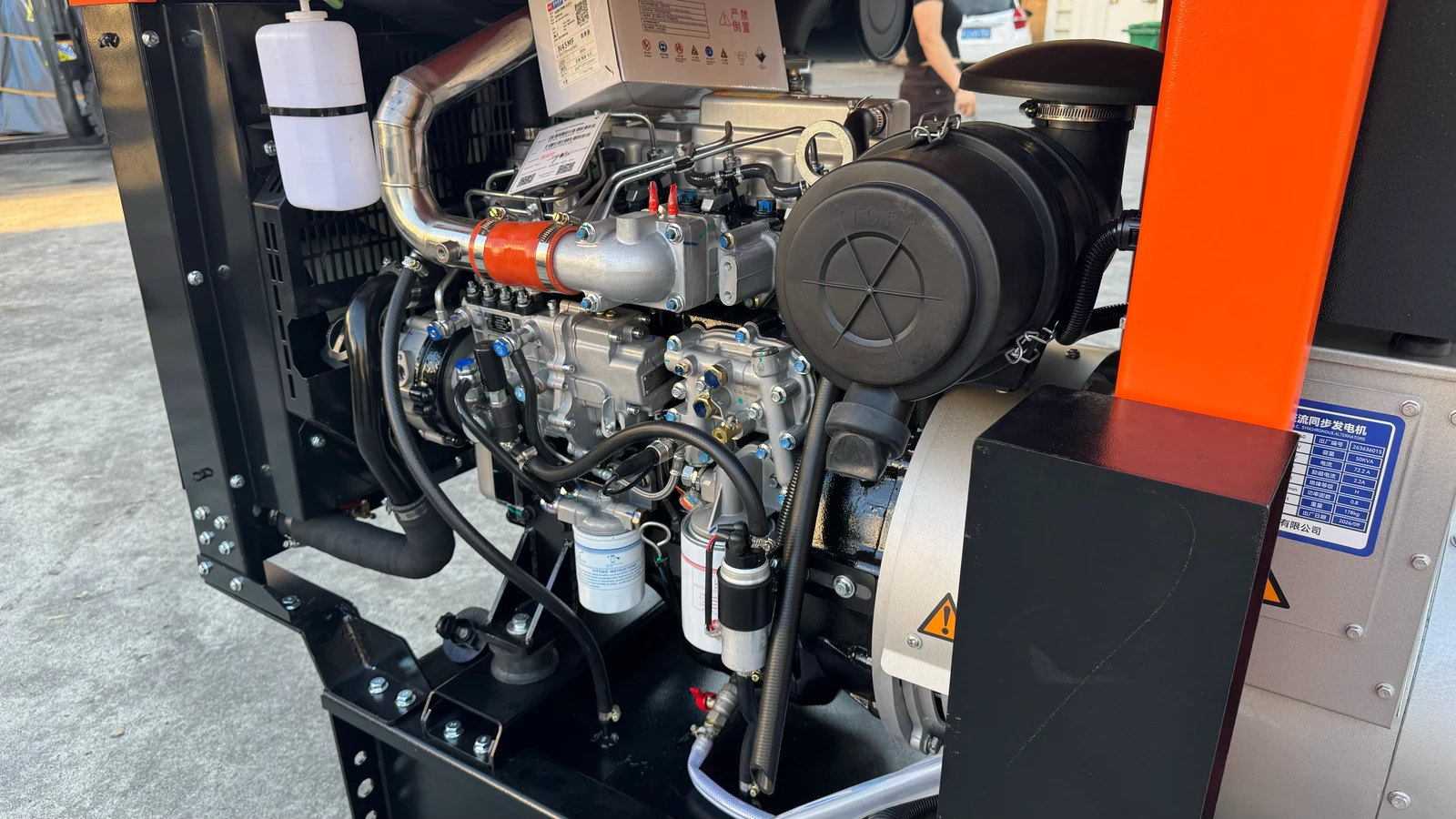
The differences that do belong in your comparison are the ones a bidder can document for the exact model.
| Field | Ask for | What the answer usually shows | What not to assume |
|---|---|---|---|
| Cooling and engine type | Air-cooled or liquid-cooled; cylinders; aspiration | 3000 rpm sets below the small diesel classes are air-cooled; 1500 rpm sets are liquid-cooled with a radiator | Cooling type is not a run-time permit; the maker's manual is |
| Service interval and oil capacity | The engine manual's schedule in hours and months, and the sump capacity | A larger four-pole set carries more oil and often longer intervals, which lowers cost per running hour | Intervals from a different engine family, or a class average |
| Noise | Sound pressure or power at a stated distance and load, with the test method, for the offered configuration | Enclosed 1500 rpm sets are often quieter than open 3000 rpm sets, but the canopy and exhaust decide more than the speed | "1500 rpm is quieter" as a rule; see the noise check guide and the canopy specification |
| Fuel | Consumption at stated load steps, at the rated speed | Comparable only at the same load and rating basis; the fuel consumption quotation guide gives the fields | A single litres-per-hour figure without the load |
| Mass and footprint | Dry mass, dimensions, lifting points, with and without canopy | Four-pole sets of the same output are heavier and larger | That the heavier set is the better one |
| Price and parts | Price at the same rating basis and scope; parts list and lead time | The price gap narrows when scope (canopy, ATS, tank, documents) is equalised | That the gap is the price of durability |
Oil and filter schedules deserve one more sentence because they are where the annual hours from the first section meet the speed decision. Ask for the maker's schedule for the exact engine and multiply it by your hours; the maintenance schedule guide explains how to turn that into a consumables plan. For the gasoline-versus-diesel question, which is a different decision from speed, use the fuel-type comparison.
Put the speed into the RFQ before you compare prices
Price comparison between a 3000 rpm offer and a 1500 rpm offer is meaningful only when both bidders have answered the same six questions. Send them as fields, not as a question about "which rpm you recommend".
| RFQ field | Complete answer | Proof | Who confirms |
|---|---|---|---|
| Duty and rating category | Standby, prime or continuous, with the standard or document the rating follows | Rating declaration on the set data sheet | Set supplier |
| Frequency | 50 or 60 Hz for the offered configuration; one value, not "50/60" | Set data sheet and set plate | Set supplier; you confirm the destination |
| Engine rated speed | rpm at the offered frequency and duty, for the named engine model | Engine data sheet and engine plate | Engine maker's document; supplier provides |
| Alternator poles and rated speed | Pole count and the alternator's rated speed at that frequency | Alternator data sheet and plate | Alternator maker's document; supplier provides |
| Prime and standby output at that speed | Both figures, units, power factor, frequency, speed and the rating conditions | Set rating sheet | Set supplier |
| Cooling, service interval, oil capacity | Type, schedule in hours and months, sump capacity | Engine manual for the exact model | Engine maker's document |
Reject an answer that gives a speed inferred from the frequency, a rating without a category, or "50/60 Hz" without two configurations priced separately. The MOQ and quotation guide shows how these fields sit inside the rest of a quotation request.
Verify the fields on the plates
The set that arrives carries at least two plates and often three: the engine maker's plate, the alternator maker's plate and the set builder's plate. The speed fields are spread across them, and the engine plate does not carry the complete-set rating. The annotated photo below shows where the fields sit on one engine plate; the values are blurred because they belong to that one engine and not to any model you are buying.
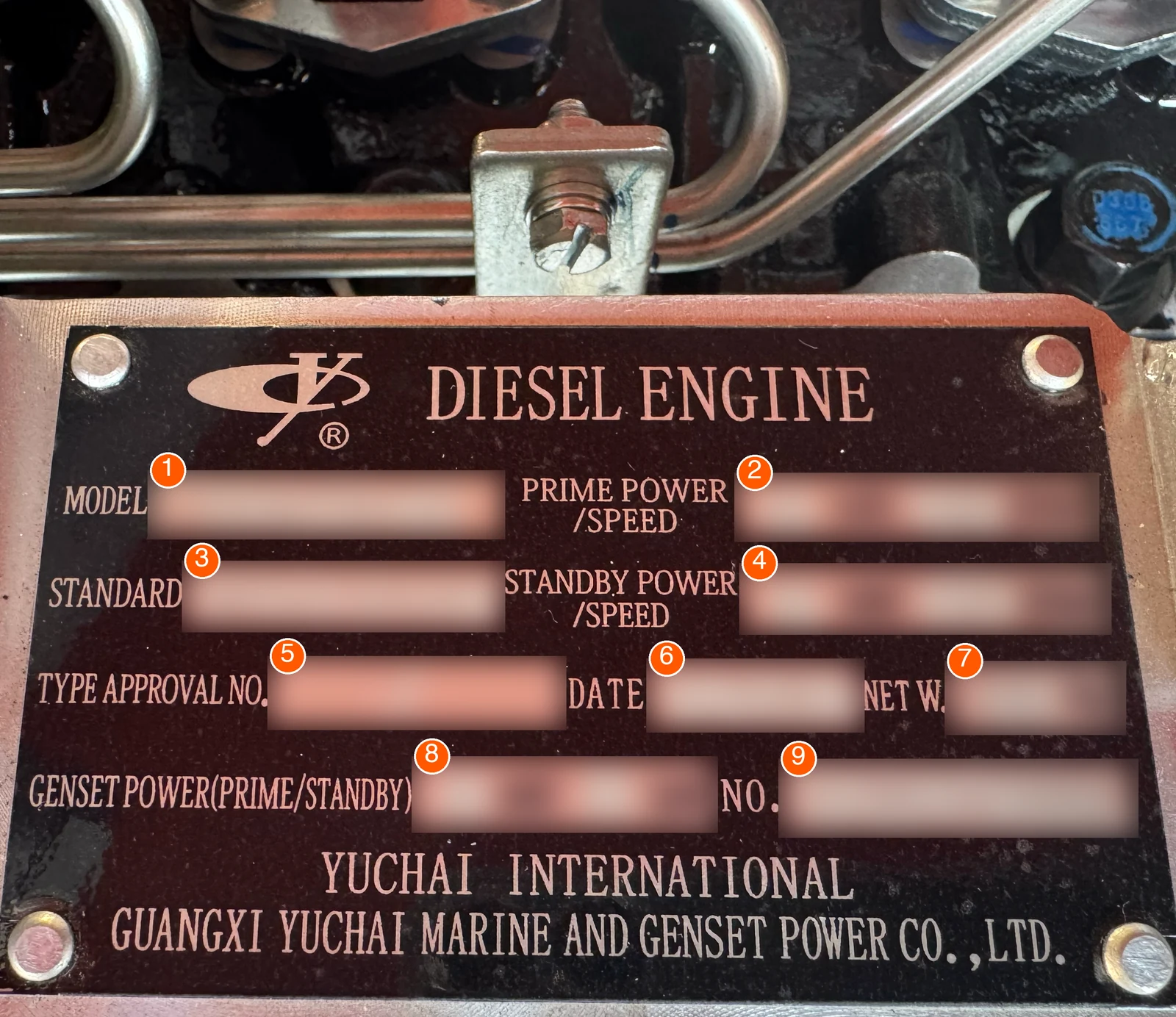
| Callout | Field on the plate | What to compare it with |
|---|---|---|
| 1 | Engine model | The engine model named in the quotation and the engine data sheet |
| 2 | Prime power and speed | The rpm you specified and the engine's prime output at it |
| 3 | Standard the rating follows | The rating basis declared in the quotation |
| 4 | Standby power and speed | The standby figure, at the same speed |
| 5 | Type approval number | Emissions or type-approval paperwork, where your market requires it |
| 6 | Manufacturing date | The production record and the warranty start event |
| 7 | Net mass of the engine | Lifting and transport documents |
| 8 | Genset power, prime and standby | The complete-set rating sheet, which is the figure you bought |
| 9 | Engine serial number | The packing list and the warranty record |
Photograph all plates at pre-shipment inspection and again at delivery, and reconcile model and serial against the quotation before signing for the goods. Where a plate value and a document disagree, the supplier explains and corrects the document; a third-party inspector records the discrepancy but does not resolve it.
Compare the offers on one sheet
Put one offer per row and the fields below as columns, and mark each cell confirmed, not applicable or open. Do not fill an open cell with an assumption, and do not compare prices while a cell in the rating or speed columns is open.
| Column | Confirmed when |
|---|---|
| Duty and annual hours | Your figures acknowledged in the quotation |
| Frequency and configuration | One frequency, one configuration, one price |
| Engine model, rated speed | Data sheet and plate agree |
| Alternator model, poles, rated speed | Data sheet and plate agree |
| Prime and standby output at that speed | Rating sheet states category, conditions, units |
| Cooling type | Documented for the model |
| Service interval and oil capacity | Exact engine manual quoted |
| Noise, fuel, mass evidence | Stated with conditions, or marked unclaimed |
| Price at equal scope | Canopy, tank, ATS, documents equalised |
| Parts and support | Parts list and route named |
| Plates reconciled | Photos on file, no open discrepancy |
BEAR builds liquid-cooled diesel generator sets to order alongside its open-frame and silent diesel ranges and its gasoline generators. The written quotation is the document that fixes model, configuration, accessories and documents for an order, and it is where the six speed fields should appear. Send Miya your duty figures, destination frequency and the sheet above, and the quotation will return the fields in the same order.
Frequently asked questions
Can a 3000 rpm set run all day?
There is no answer for the class. Ask for the maker's declared duty, the rating that applies at that speed, and any run-time or rest-period statement in the engine manual for the exact model; if the quotation cannot point to the document, treat the question as open.
Can I buy a 50 Hz set and switch it to 60 Hz later?
Not by changing the speed alone. The alternator rating, controller settings and output figures all belong to one configured frequency; ask for the 60 Hz configuration as a separate quotation with its own plates and documents.
Is a 1500 rpm set always quieter?
No. Speed is one input to noise; the enclosure, exhaust silencer, cooling fan and load matter at least as much. Compare sound figures measured at the same distance and load with the method stated, and read the canopy specification before the rpm.