
Four outcomes for a stated outage profile and load list: station only, generator only, both as one system or neither, with the request fields for each.
In this guide9 sections
A battery portable power station and a fuel generator are chosen by four inputs the buyer already controls, not by the traits each camp advertises: how long and how often the supply is lost, which loads must run together and which of them are motors, where the source has to sit, and whether the battery can be recharged or the tank refilled before the stored energy or the fuel runs out. Short outages with quiet, indoor, electronic loads point to a station; long or frequent outages with motor loads and an outdoor position point to a generator; quiet hours inside a long outage usually call for both, with the generator charging the station; and a load list that neither product's documents can carry is not a product question but a reason to redesign the requirement. The one input that overrides the others is location: when the power has to be produced inside a building, the generator leaves the decision before any figure is compared, because an engine is never run in an enclosed space.
This guide is written for importers, distributors, rental fleets and private-label buyers who source both product lines and must send a request for quotation (RFQ) a factory can answer line by line, and for prepared end buyers planning one specific site. It is not a brand or model comparison; it states no runtime, noise, charging or battery-life figure for any product; and it contains no installation, wiring or safety procedure. BEAR supplies both product lines, so nothing below favours either of them. Where a source is to be connected to premises wiring, a licensed electrician designs the arrangement and the authority having jurisdiction confirms what applies.
Place the use in one of four outcomes
Read the matrix with your inputs in hand, not with product traits. Each row is an outcome; a row applies only when every condition in it holds for the stated use, and if any input is still unknown the decision is not complete and the next four sections say what to record first.
| Outcome | Outage and recharge profile | Loads and motor starts | Site, noise and fuel | What still has to be confirmed |
|---|---|---|---|---|
| Station only | Outage energy fits the usable stored energy of one exact model, and mains, solar or vehicle recharge is reachable before the next event | Every running and starting demand sits inside the model's documented continuous and surge output, with duration | Source must or may run indoors, in quiet hours, or where fuel cannot be stored | Usable energy under the stated load, surge duration, charging inputs, the model's indoor-use instructions |
| Generator only | Outage lasts longer than any practical battery, and fuel can be stored and resupplied for the whole event | Motor loads or sustained heavy loads that the exact generator model is documented to start and carry | An outdoor position with exhaust clearance is available and the noise condition at that position is acceptable | Rated and maximum output with duration, starting behaviour for the named motors, fuel consumption at the stated load point, noise conditions |
| Both as one system | A long or repeated outage that also contains quiet hours or indoor-only periods | Heavy loads run on the generator; quiet-hour loads fit the station; the station is recharged from the generator during its run window | Generator outdoors, station indoors, both positions available | Written pairing confirmation: generator outlet, station charging input and limits, charging while supplying, supplied cable, operating instructions |
| Neither without redesign | Days without any recharge or resupply, or an outage profile nobody can state | A start demand or a simultaneous load that no offered model is documented to carry | A site where no source may run, or a noise condition no model meets | Return to the load list, the operating plan and the site before requesting any model |
"Neither" is a legitimate result, not a failure of the method. It usually means a load list that was never checked for simultaneity, a motor whose start demand was guessed, or an operating plan that assumed recharge would somehow appear. A site that needs continuous or recurring off-grid supply rather than outage cover is a different task; the off-grid cabin power plan organises that one.
Record the outage profile and the operating window
Write down how long a typical outage lasts, how long the longest expected one lasts, how often they occur, how many hours the loads must run together, which interruptions are acceptable, and when during an event the buyer can reach mains, sunlight, a vehicle or a fuel supply. Those entries, with units, decide whether stored energy can bridge the event or a fuel source is needed; a station and a generator cannot be compared until they exist.
Two units carry the comparison and are routinely confused. Energy, in watt-hours (Wh), is what a station stores and what an outage consumes over its duration; power, in watts (W), is what the loads draw at a moment and what either product must deliver at that moment. The U.S. Energy Information Administration's explainer on measuring electricity is a short, neutral reference for the two.
A generator has no stored electrical energy to compare: it converts fuel while it runs, so its "energy" is the fuel on site and the consumption at the load point the buyer states. A rated Wh figure on a station is not appliance runtime, and a runtime figure on a generator is not comparable until tank, load point and claim source sit together, as the runtime guide sets out.
| Field | What to record | What it changes |
|---|---|---|
| Location and market | Country or region, voltage and frequency at the site | Which documents and configurations apply |
| Typical outage | Duration in hours, with the time of day | Energy needed per event |
| Longest expected outage | Duration in hours or days, and how it was estimated | Whether stored energy alone can ever cover it |
| Frequency | Events per month or per season | Maintenance and operating burden; battery cycling or engine hours |
| Hours loads must run together | The simultaneous period, not the sum of appliance hours | Peak power and the energy of the peak period |
| Acceptable interruptions | Which loads may pause, and for how long | Whether a bridge source suffices |
| Recharge or refuel window | When mains, sun, a vehicle or fuel delivery is reachable during an event | Station as bridge or as source; generator fuel plan |
| Operator | Trained staff, an unattended site, or a household | Start method, refuelling, maintenance capacity |
A hypothetical example: a small shop that loses mains for an hour or two several times a month, keeps tills, lighting and a router running and has mains back before the next event has written a station profile; the same shop with a walk-in cooler and a seasonal week-long outage has written a generator profile, possibly with a station for the evening hours. The example measures nothing; it shows which fields move the row.
Build the load list with the motor starts marked
List every load that must run during the event with its running demand, and for each motor or compressor add the starting demand and how long it lasts; then compare both with the continuous and surge figures in the documents of the exact model offered, not in a family brochure. A supplier's "peak" figure without duration, conditions and model identity is not a comparable value for either product.
| Field | Where it comes from | Why it matters |
|---|---|---|
| Load name, quantity, exact model | Nameplate, manual or the customer's inventory | Identifies the source of the start-demand figure |
| Voltage and frequency | Nameplate | Must match the output of the source and the site |
| Running demand (W or VA) | Nameplate, or a measurement by a qualified person | Sums into the simultaneous power |
| Starting demand and duration | Motor or appliance maker, or a measured start | Decides the surge requirement |
| Duty cycle and priority | The customer's operating plan | Decides which loads may pause and which are critical |
| Simultaneity | The operating plan, not a wish | Decides the peak the source must carry |
What the documents must show differs by product. For a station: the continuous AC output, the surge output with its duration, and any limit per socket. For a generator: the rated and the maximum output with the duration and conditions of the maximum, and the starting behaviour for the named motor if the maker publishes it.
Neither "a station cannot start a motor" nor "a generator starts any motor" is a safe generalisation; a refrigerator compressor, a pump or an air conditioner starts according to its own motor, and where that load is critical the equipment maker's confirmation for the exact pairing is the acceptance basis. The wording of generator labels is covered in the starting watts versus running watts guide; when the load list adds up to more than a portable set, the load-list sizing method takes over.
Can the generator run where the power is needed?
Only outdoors. A fuel generator is never operated inside a house, garage, basement, tent or any other enclosed or partly enclosed space, and an open door or window does not make it acceptable; the U.S. Consumer Product Safety Commission's guidance on generators gives carbon monoxide from engine exhaust as the reason and directs outdoor-only use. A battery station has no engine exhaust while it supplies loads and may be used indoors within its maker's instructions and any local requirement for the room, the charging arrangement and storage. That is why the site is settled before any output figure is compared: an indoor-only requirement removes the generator from the matrix, and no workaround belongs in the request.
Three more site inputs belong on the record before a model is requested. Quiet hours: if the site or its neighbours impose a period when an engine may not run, the generator either stops in that period, which creates the "both" outcome, or is ruled out; a noise claim is comparable only as a package of quantity, distance, load, method and configuration, which the quiet generator noise check explains how to request. Fuel storage: where fuel may be kept on the site, in what container and quantity, and who approves it, are questions for the site owner and the local authority, not for the supplier.
Operating conditions: the generator's manual states them, and the buyer records whether the site offers them. Whether the generator should be an inverter set or an open-frame set is a separate choice made after the generator outcome is reached; the inverter generator buying guide covers it.
Decide whether recharge or refuelling closes the gap
List every way energy can be put back into the system during the outage profile, with its real availability at the site, and compare that list with the event length. If no recharge and no fuel resupply exists for days, a station is a finite bridge, not a source; a generator likewise stops when the fuel does, so both products need a stated energy plan and neither is "unlimited backup".
| Means | What the supplier must state for the exact model | What the buyer records about the site |
|---|---|---|
| AC mains | Charging input and its limits; whether the station can charge and supply at the same time | When mains returns relative to the event length |
| Solar | Compatible panel type and connector, input voltage and current limits, charging behaviour | Panel area, orientation, season, whether panels are part of the order |
| Vehicle | Compatible adapter and input limit | Whether a vehicle is on site during the event and may run there |
| Generator outlet | Which outlet and setting the maker approves for charging, and the limits that apply | Whether the generator can run during the event (see the system section) |
| Fuel resupply | Fuel type, consumption at the stated load point, tank capacity | Fuel on site, storage approval, delivery during a regional outage |
Maintenance capacity is part of the same decision. A generator asks for engine service on a schedule, consumables, and attention to fuel that ages in storage; a station asks for a state-of-charge and temperature regime in storage and loses capacity with calendar time and cycling. Neither product is maintenance-free, and no shelf-life, cycle-life or service-interval figure is universal: the maintenance schedule and consumables guide shows how to bind intervals to the named model and manual, and the off-season storage guide gives the fuel and site fields for an idle generator. A buyer who cannot provide either regime should write that limitation into the profile; it moves the row.
When both products form one system
The combined outcome works when the generator supplies the heavy or long-duration loads and recharges the station during its run window, while the station carries the quiet-hour or indoor loads with the engine off. It counts as an outcome only after both makers, or the supplier on their behalf, have confirmed the pairing in writing for the exact models; "compatible with most stations" is not a confirmation.
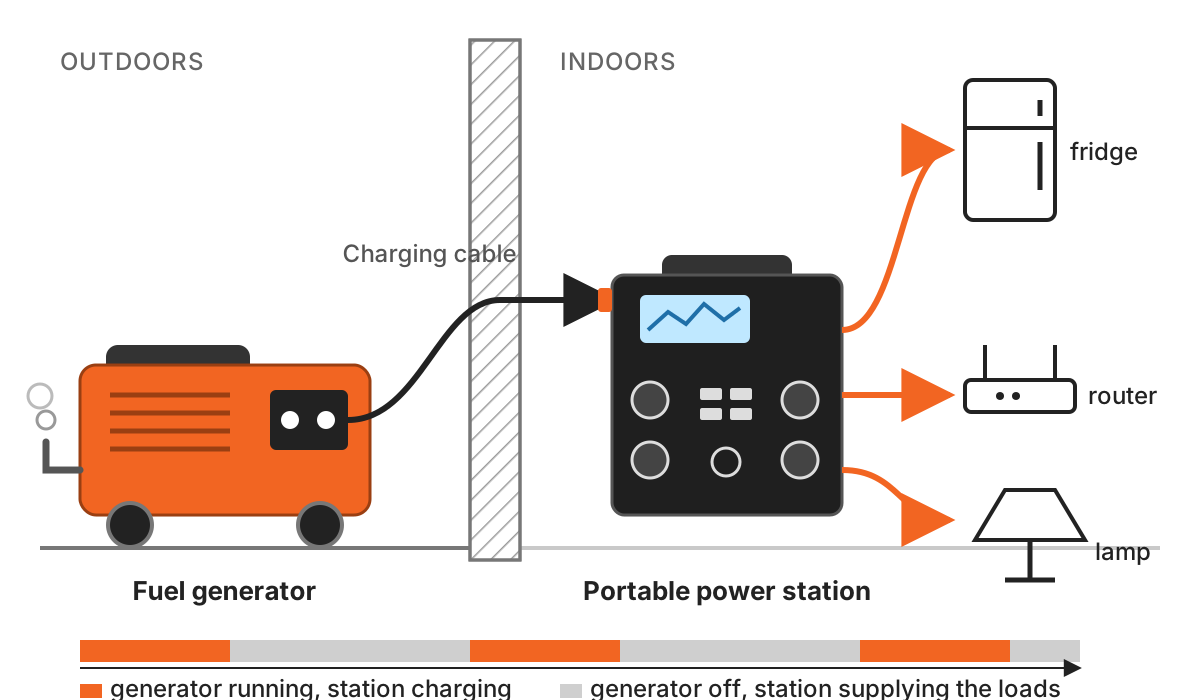
Six fields make the confirmation checkable: the generator model and the outlet and setting used for charging; the station model, its charging input type and the input limits; whether the station may charge and supply loads at the same time, and with which restriction; the cable or accessory that is supplied, and by whom; the operating instructions for the pair, including what the station does when fully charged and what the generator does at low fuel; and the duty expected of each product over the event, so that fuel and maintenance are planned for the generator's real run window rather than for the whole outage. A transfer arrangement or an uninterruptible supply built into premises wiring is a different system with its own design responsibility: in the United States, optional standby systems fall under NEC Article 702, as the North Carolina Office of State Fire Marshal's overview summarises, and the adopted edition and local amendments are confirmed by the licensed electrician and the authority having jurisdiction, not by this guide.
Compare operating burden and lifecycle cost on the same basis
Compare the two outcomes over the same service period and the same duty profile, with every assumption written next to the figure; purchase price alone decides nothing, and a figure without its assumptions is not comparable. The table lists what belongs in the comparison; the values come from the supplier's documents for the exact models and from the buyer's own site.
| Item | Generator side | Station side | Assumption to disclose |
|---|---|---|---|
| Energy per event | Fuel at the stated load point and run window | Charging energy and any charging losses the maker states | Event length, load profile, run window |
| Scheduled service | Engine service items and intervals from the manual | Inspection, firmware and storage regime from the manual | Hours or cycles per year |
| Storage between events | Fuel ageing, stabilising or draining; battery for electric start | State of charge and temperature during storage | Idle months per year |
| Capacity loss and replacement | Engine wear by hours | Battery calendar and cycle ageing; replacement path | Expected service period |
| Accessories | Cables, parallel kit, wheel kit, cover | Panels, adapters, expansion batteries, cables | Which are in the order |
| Transport and documents | Market compliance evidence | Lithium battery transport documents and packaging | Destination market, mode of transport |
| Staff time | Refuelling, starting, service | Recharging, monitoring, storage upkeep | Operator type from the profile |
Hypothetical example: a rental fleet hiring sources out for short events with electronic loads, recharged between hires, is weighted towards the station side's charging and storage regime; the same fleet serving construction sites with motor loads for whole days is weighted towards fuel, service hours and transport. No figure is assigned to either side.
Request fields for whichever product follows
Send one line per field and accept only answers tied to the exact model, configuration and document revision; a brochure that mixes variants, a category average or an "up to" value without conditions is returned, not filed. The two tables cover the product the matrix selected; the system fields are added when the outcome is "both".
Station request fields:
| Field | A complete answer looks like | Send back if |
|---|---|---|
| Model, variant, document revision | Full designation, market version, dated datasheet and manual | A series name, or a document for another variant |
| Battery chemistry and energy | Chemistry, rated and usable energy in Wh with the basis | Nominal and usable energy not distinguished |
| Continuous and surge AC output | W, the surge duration, and any limit per socket, with test conditions | A surge figure without duration |
| Output voltage, frequency, sockets | Values and socket types matching the site and market | Output that does not match the recorded site |
| Charging inputs | Each input type with its limits and the accessories required | "Solar ready" or "fast charge" without limits |
| Charging while supplying | Allowed or not, with the restriction | Not stated |
| Operating and storage conditions | Temperature and storage instructions from the manual | Missing, or copied from another product |
| Indoor use | The maker's instructions for the room and the charging arrangement | A general assurance |
| Safety and transport documents | The battery or cell test report with its standard and scope, the UN 38.3 test summary, the conformity documents for the destination market | A certificate for another model or market |
| Warranty and service | Terms, and where service is performed | Not stated |
Generator request fields:
| Field | A complete answer looks like | Send back if |
|---|---|---|
| Model, variant, document revision | Full designation, market version, dated datasheet and manual | A series name, or a document for another variant |
| Engine and fuel | Engine identity, fuel type and grade from the manual | Fuel not stated |
| Rated and maximum output | Both values, with the duration and conditions of the maximum | A single "peak watts" headline |
| Voltage, frequency, phase | Values matching the site and market | Mismatch with the recorded site |
| Outlets and protection | Outlet types and the protection fitted, with any limit per outlet | Outlets unspecified |
| Fuel capacity and consumption | Tank capacity, and consumption or runtime at a stated load point | Runtime without a load point |
| Starting the named motors | The maker's statement for the named loads, or a documented test | "Starts any motor" |
| Start method | Recoil, electric or remote; battery supplied or not | Not stated |
| Noise | Quantity, distance, load, method and configuration | A number without conditions |
| Maintenance schedule | Intervals and consumables from the manual | Universal intervals |
| Emissions and compliance evidence | The document for the destination market, naming standard, scope and model | A logo without a document |
| Warranty and service | Terms, and where service is performed | Not stated |
Both-system fields are the six confirmation fields from the system section, answered in one written statement that names both models and the supplied components. Document references should be asked for by scope and jurisdiction rather than assumed: in the United States, ANSI/PGMA G300-2023 is a consensus standard for specified classes of portable generators with its own exclusions (PGMA publication), UL 2201 addresses carbon monoxide testing and shutoff for the spark-ignited portable generators it covers (UL Standards & Engagement), and exhaust emissions for covered small spark-ignition engines fall under 40 CFR Part 1054 (U.S. EPA). For a station, IEC 62133-2 covers the safety of portable sealed secondary lithium cells and batteries, not the complete product (IEC Webstore), and shipment of lithium batteries follows the UN 38.3 test summary and, in the United States, 49 CFR 173.185 (PHMSA; eCFR).
None of these references is proof of certification, and none applies automatically to a given model, fuel, frequency or market; the supplier names the standard, edition, certificate and scope, and the importer or the local compliance party establishes what the destination requires. The freight forwarder confirms transport classification and packaging.
The request is complete when every field is answered, supported by a document tied to the quoted configuration, or explicitly marked unavailable with an agreed disposition; nothing is left as a verbal assurance. For an incomplete reply, return a numbered list rather than a long message: "Field 3 is stated without duration; please restate the surge figure with its duration and test conditions." "The datasheet revision differs from the quoted variant; please send the revision for configuration [code]." "Charging from a generator outlet is not addressed; please confirm or exclude it in writing for both models."
Send the request
Send the completed record sheet, the load list and the chosen outcome through the contact page, naming the destination market and the quantity. A BEAR written quotation confirms the model, configuration, accessories and documents for the exact product offered, from the portable power station range or the gasoline inverter generator range, and a sample unit or a factory visit can be arranged before a production order so that the pairing or the motor start can be checked with your own loads.