
Split a diesel genset exhaust between factory and installer: silencer, flexible bellows, flanges, rain cap, supports, and who proves each item.
In this guide8 sections
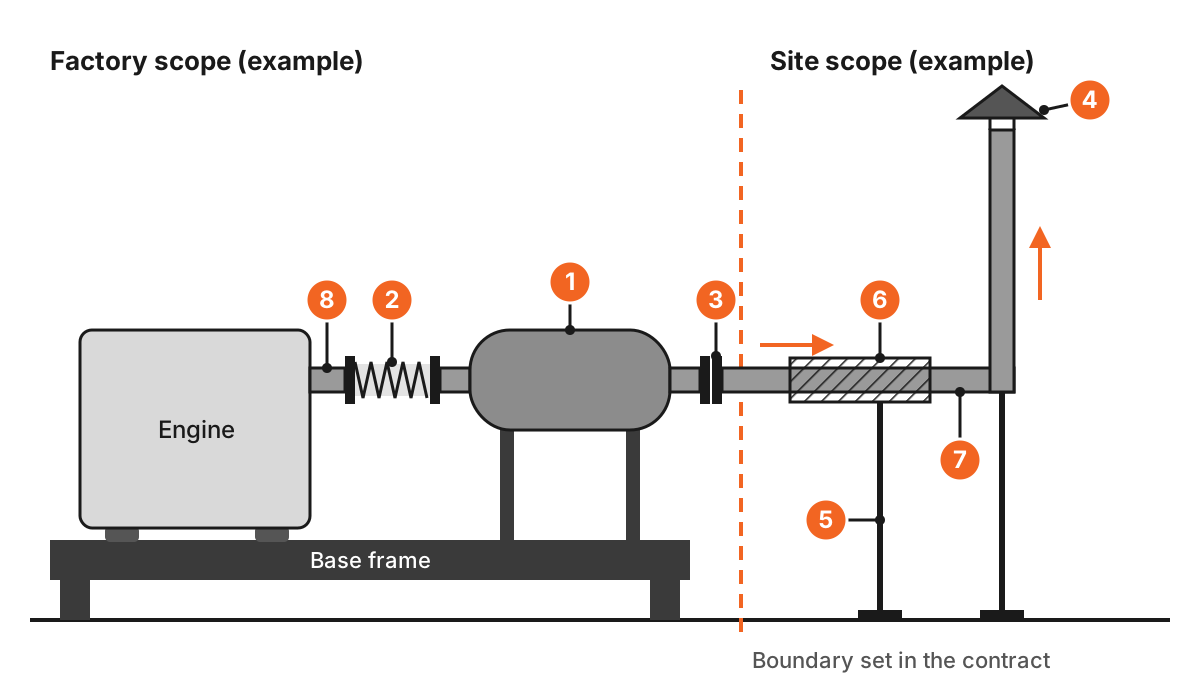
Before you compare diesel genset quotations, write the exhaust system as a list of items with an owner for each: the silencer, the flexible bellows, the flanges and gaskets on both sides of every joint, the rain cap, the pipe supports, any insulation or heat shield, and the external piping. Mark every item as supplied by the genset factory, supplied by the installer, or excluded, and attach the document that identifies it. This works once the engine model is fixed in the quotation. The one item the factory cannot close from its side is the back-pressure check of the finished site piping: the engine maker sets the limit for the exact engine, and the installer or site designer compares the real piping against it.
This guide is for importers, distributors, rental fleets and contractors buying diesel generator sets from a factory. It covers scope, records and acceptance evidence. It does not cover exhaust routing, termination height or distance, indoor installation or carbon-monoxide protection; those follow the engine maker's installation documents and the local code, applied by the installer. Portable generators with an exhaust-extension kit are a different task, and their placement and CO record is covered in the generator placement and clearance record.
Split the exhaust scope before you compare quotations
A line that reads "muffler included" tells you that one item exists. It does not say which silencer, where it sits, whether the bellows and mating flanges come with it, or where the factory's delivery stops. Two quotations with the same phrase can differ by several exhaust items, and the difference surfaces on site when the installer finds a missing flange or a pipe with nothing to hold it. There is no universal factory package; the split is a contract decision and has to be written per order.
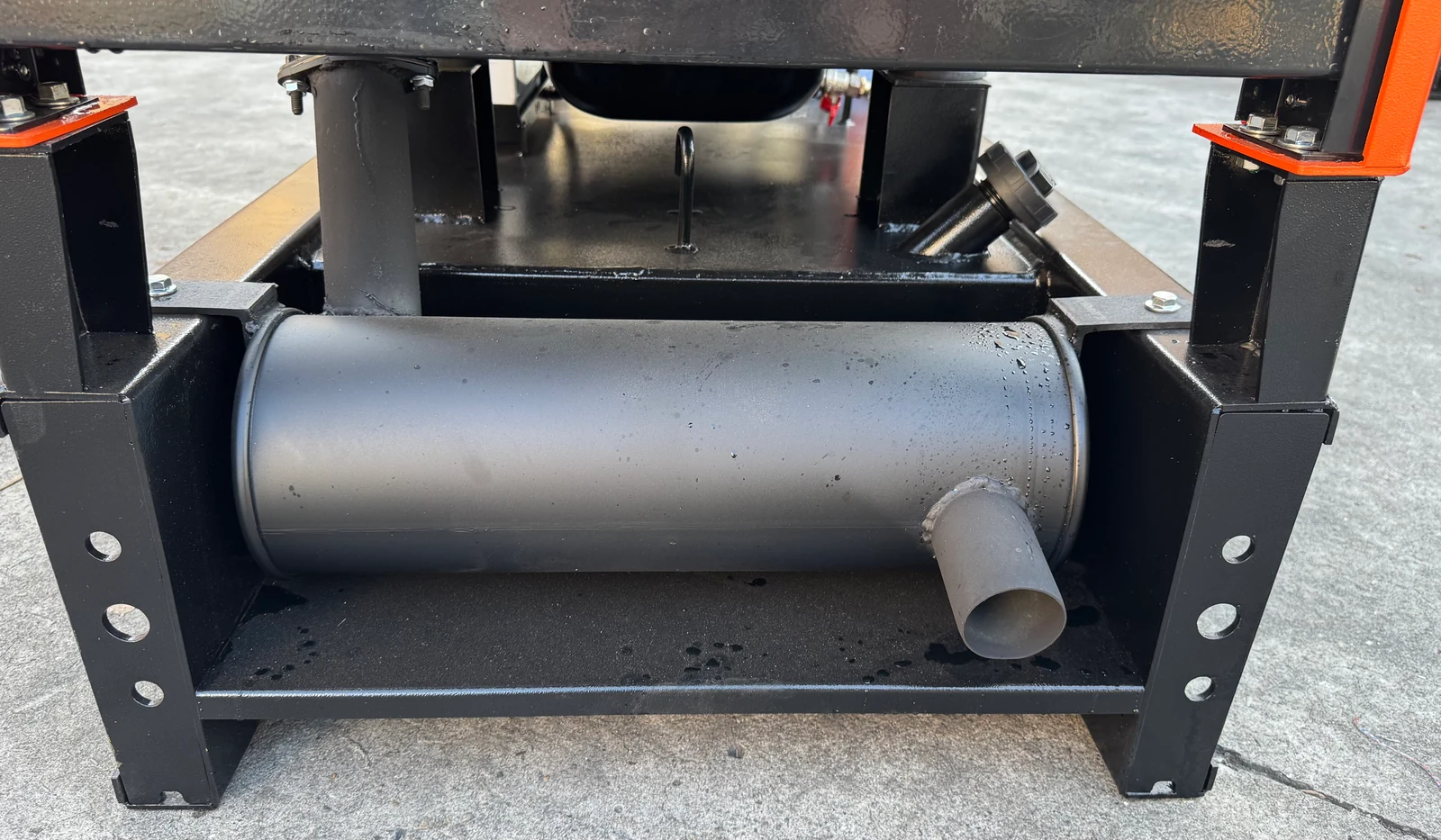
The build type moves the boundary. On an enclosed set the silencer usually sits inside or on the canopy; on an open-frame set it may sit on the roof frame, in the base frame, or ship loose for the site. The open-frame versus enclosed guide covers that choice. The table below assumes it has been made.
| # | Item | Mark one | A complete supplier answer | Proof and who confirms | Send back if |
|---|---|---|---|---|---|
| 1 | Silencer | factory / installer / excluded | Construction and any grade name as the supplier defines it; position on the set; inlet and outlet connection; any attenuation or pressure-loss data with its method | Quotation line and datasheet; the silencer maker confirms its own data | Only "muffler included", or a grade name with no definition |
| 2 | Flexible bellows | factory / installer / excluded | Size, length, material, end connections and rated temperature as stated by its maker; position on the drawing | Drawing and component datasheet; the component maker confirms its ratings | No identifiable part or no connection details |
| 3 | Flanges and gaskets | factory / installer / excluded | Which joints come with their mating flange; flange standard or drilling as stated; gasket type and count | BOM and drawing; the supplier confirms | "Flanges included" with no joints named |
| 4 | Rain cap | factory / installer / excluded | Supplied or not; connection and material as stated | BOM and drawing; the site designer confirms it suits the site | Responsibility left blank |
| 5 | Pipe supports | factory / installer / excluded | Which supports, if any, are included and where supply ends | Drawing; the site designer designs site supports | An arrangement that leaves pipe weight on the bellows or engine |
| 6 | Insulation or heat shield | factory / installer / excluded | Whether supplied; which section it covers; material and temperature information as stated | Datasheet; the site designer confirms site-side protection | "Insulated" with no section named |
| 7 | External piping and termination | factory / installer / excluded | Where factory scope ends and who designs the site piping | Interface drawing with revision; installer or site designer named | "By others" with no named party |
| 8 | Engine back-pressure limit | supplier names the engine; site designer uses the limit | Exact engine model and configuration, plus the title and revision of the engine maker's document that gives the limit | Engine maker's installation or application data; the site designer records the comparison | A generic value, or a value taken from another engine |
Fill it in twice: once from the supplier's quotation and once from the installer's offer. An item that neither offer covers, or that both claim, is the gap to close before the order is signed.
What a silencer line in the quotation must identify
A silencer line is complete when someone else could identify the part, see where it is fitted and know what data, if any, stands behind its performance. Construction and grade names alone do not get you there.
Silencers are usually described as reactive (chambers and passages that reflect sound), absorptive (sound-absorbing packing) or a combination of both. That tells you how the part works, not how much it reduces noise on your set. Grade names such as "industrial", "residential" or "critical" are supplier terminology unless the offer defines them; ask for the definition in writing or read the word as a label.
- Construction as stated by the silencer maker, and the grade name with its definition if one is used.
- Position: inside the canopy, on the roof frame, in the base frame, or shipped loose for site installation.
- Inlet and outlet: size, connection type and outlet direction.
- Attenuation data, if offered: the figure, the method and the test set-up. ISO 7235 describes laboratory measurement of ducted silencers, covering insertion loss, flow noise and pressure loss, and notes that laboratory results can differ from those in a real installation. A figure without its method cannot be compared with another.
- Pressure-loss data, if the silencer maker publishes it; the site designer needs it for the back-pressure comparison.
- The maker and part number of a bought-in silencer, so its datasheet can be traced.
On a silent set the silencer is one contributor to the noise result, not the result itself. A noise figure for the complete set comes with its own distance and method; the noise check guide shows how to read a dB claim with its conditions, and the test report red flags guide covers reports that leave the conditions out.
The flexible bellows: why the joint has to move, and what it must not do
The engine moves on its mounts, and the exhaust pipe grows as it heats. A flexible bellows, also called a flexible exhaust connector or flexible exhaust pipe, sits between the engine outlet and the rest of the system and takes up that relative movement within the limits its maker states. It is not a pipe support.
Engine makers' exhaust-system installation guides say this plainly: the weight of the piping and silencer should not be carried by the engine, the turbocharger or the flexible connection. For your order, the installation documents for the quoted engine govern.
Record these fields for the bellows:
- Included or not, and on which side of the boundary it falls.
- Size, length, material and end connections as stated by the component maker.
- Rated temperature and permitted movement, taken from the component datasheet. Neither can be judged from appearance.
- Position on the drawing: which flanges it sits between and where the genset-side scope ends.
- Any protective sleeve or wrap, and whether it is part of the supplied item.
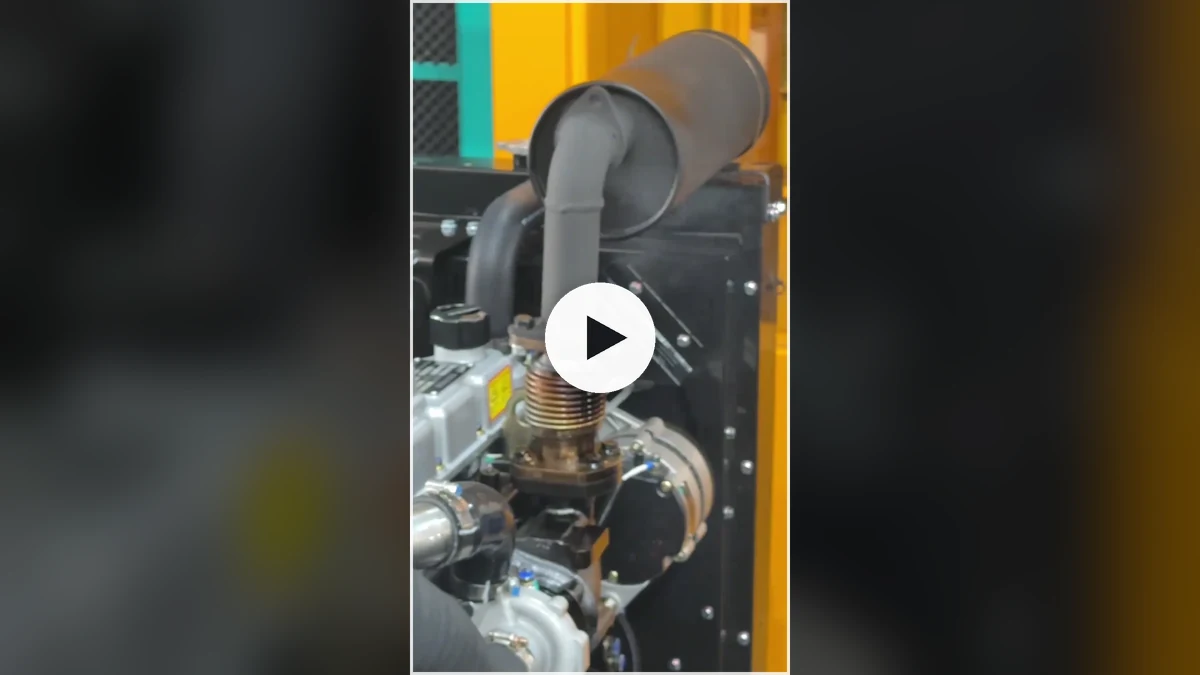
Heat tint shows that metal has been hot. It does not show the bellows' rated temperature, that its movement stays within limits, that the joint is leak-tight or that back-pressure is acceptable. Those answers come from the datasheet, the drawing and, where the contract asks for it, a measurement.
Flanges, rain cap, supports and insulation
These items go missing because each one sits on the boundary between two parties. The record should say which side supplies each item and which document shows it.
- Flanges and gaskets. Every joint has two sides. Name the joints that come with their mating flange, the flange standard or drilling as the supplier states it, and the gasket type and count. The word "flange" on its own implies neither a flange standard nor a gasket.
- Rain cap. Record whether it is supplied and how it connects. Whether a rain cap is the right termination for the site is the site designer's decision under the local code, not a factory default.
- Supports. The factory may supply brackets for the section mounted on the genset. Supports for the site piping are designed by the installer or site designer, who accounts for weight and thermal movement. The bellows does not count as one of them.
- Insulation and heat shield. Record which sections are covered, the material and any temperature information as stated. Protection on the site side belongs to the site designer.
Parts that travel loose, such as a separate silencer, a rain cap or a bellows kit, should appear on the packing list and carry shipping marks, so they are not lost between factory and site. The container loading plan guide covers the packed-shipment data the forwarder needs.
Who sets the back-pressure limit, and who checks the piping against it?
The engine maker sets the allowable exhaust back-pressure for the exact engine, rating and configuration. The installer or site designer checks the finished site piping against that limit. The genset supplier's part is to name the engine precisely and provide the genset-side data the check needs.
Engine makers' application manuals tell designers to keep back-pressure within the rating of the specific engine, and they publish that limit per engine model and rating. A number copied from another engine, another rating or a portable generator manual is not evidence for your set.
| Party | Provides | Does not provide |
|---|---|---|
| Engine maker | The allowable limit for the exact engine and configuration, in an identified document and revision | A verdict on your site piping |
| Genset supplier | Engine model and configuration, the genset-side outlet connection, silencer and bellows identity, and any pressure-loss data the component makers publish | The site piping calculation, unless the contract assigns it |
| Installer or site designer | The site piping design, the comparison with the engine limit, and a measurement at commissioning where the project requires one | The engine limit itself |
| Buyer | The record that ties these documents to one configuration and revision | Engineering judgement on any of the above |
If a revised quotation changes the engine, the silencer or the outlet connection, the comparison has to be redone. Keep the document revisions in the record so that a change cannot pass unnoticed.
What to record at inspection and after the first run
Inspect the delivered exhaust items against the accepted quotation, BOM and drawing revision, then record what is seen on the first run. A visual check records an observation; it does not replace a leak test, a back-pressure measurement or an acoustic test where the contract requires one.
| Check | What to record | Who confirms | Not acceptable |
|---|---|---|---|
| Delivered scope | Each item against the accepted BOM and drawing revision, with any substitution listed | Buyer or third-party inspector; the supplier resolves differences | Missing items or unlisted substitutions |
| Identity | Silencer and bellows markings matched to their datasheets | Inspector; supplier | Parts that cannot be matched to a document |
| Condition | Dents, damaged bellows convolutions, missing gaskets, damaged insulation | Inspector; the supplier for factory-side defects | Damage noted but not closed |
| Contact with canopy or frame | Any contact or rubbing between exhaust parts and the canopy, frame or cables while running | Supplier for the genset side; installer for the site side | Contact left unresolved |
| Leak observation | The agreed check, its method and the result | The commissioning party defined in the project | "Passed" with no method |
| Back-pressure | Measured value, operating condition, measuring point and the engine limit it was compared with, where required | Installer or commissioning party | A pass with no reference to the engine limit |
| Evidence pack | Accepted revisions, inspection record, component datasheets, engine data, site design record | The buyer compiles; each party signs its own part | A required field with neither a document nor a "not offered" note |
The factory-side rows fit into a factory acceptance test or a pre-shipment inspection; see the FAT scope guide and the pre-shipment inspection checklist. The site rows belong to commissioning.
Standards that come up, and what they do not prove
| Document | Scope | What it does not prove |
|---|---|---|
| ISO 8528-5 | Design and performance criteria for generating sets that combine a reciprocating internal combustion engine and an AC generator | That a site exhaust design meets the engine's back-pressure limit |
| ISO 8528-6 | Test methods for characterising the complete generating set | Silencer attenuation or acceptance of the site piping |
| ISO 7235 | Laboratory measurement of ducted silencers: insertion loss, flow noise, pressure loss | Performance in your installation |
| Engine maker's installation or application documents | Engine-specific exhaust requirements, including the back-pressure limit | Anything about a different engine |
| Local building, fire, environmental and noise rules | Site requirements in one jurisdiction | Anything outside it; the installer confirms them with the local authority |
Cite the edition named in your contract. Vehicle, RV and portable-generator installation instructions describe other products, and their dimensions or values do not transfer to an industrial set.
Send the exhaust scope with your RFQ
Send the scope table with the generator model you are considering, the build type (open-frame or enclosed), the destination and, if one is appointed, the name of your installer or site designer. The documents-before-order guide lists the other files to collect at the same stage.
For a BEAR quotation, send it through the contact page; Miya is the inquiry contact. The written quotation confirms the model, configuration, accessories and documents, so the exhaust items it includes can be read in one place. The open-frame diesel generator range and the silent diesel generator range show the build types the table applies to, and a sample unit or a factory visit can be arranged before a production order.