
Plan the generator in a spray drone trailer setup: carrier and weight, open frame or canopy, placement, mounting, fuel, exhaust, outputs and who confirms what.
In this guide9 sections
In a spray drone trailer setup, the generator brings engine heat, exhaust, noise and vibration onto the rig, so decide where it goes before the tanks and racks are fixed. Choose the carrier and its weight budget first, then the build of the set (open frame or canopy), then a position where hot air and exhaust leave the rig and the fuel filler and service side stay reachable. The generator supplier answers for the set, the trailer builder for the installation and the electrician for the wiring. The one hard limit is an enclosed trailer: an engine-driven generator is not run inside a closed body, and any enclosed arrangement has to be engineered for that exact set, by the builder working to the supplier's air, exhaust and installation data.
This guide is for operators, dealers and rig builders who are equipping a trailer, a pickup or a flatbed for spray-drone field work. It covers the generator as one part of the rig. How large the set must be for your chargers is a separate calculation, set out in the sizing guide for spray drone charging. Tank and mixing design, pesticide rules and trailer purchase are outside its scope.
Choose the carrier and fix the weight budget first
The carrier decides almost everything about the generator: how much it may weigh, how tall it may be, where air can reach it and who has to stand beside it. Three carriers appear again and again in rig tours, and each asks something different of the set.
| Carrier | What it gives the rig | What it asks of the generator |
|---|---|---|
| Enclosed cargo trailer | Shelter for chargers, batteries and tools | The set cannot simply run inside; exhaust, heat and air must be engineered, or the set runs outside the body |
| Open deck trailer | Free air and easy access from every side | Weather, dust and spray drift reach the set, and its noise reaches the crew |
| Pickup bed or flatbed skid | One vehicle and quick moves between fields | A tight footprint and height; the cab and tailgate limit air paths and access |
List everything the rig carries when it is ready to work: water or mix in the tanks, fuel, chargers, batteries, the generator and the crew's gear. For the generator, ask for a wet, ready-to-run weight and for a statement of what that weight includes, such as oil, coolant, a full base tank and the options quoted. A dry or shipping weight understates what the axle carries.
Whether the total is acceptable is not a generator question. The permitted payload, axle load and tongue load come from the vehicle and trailer documents and their rating labels. The terms and the rules differ by country, so the documents of your own vehicle and local law decide.
Open frame or canopy: what changes on a vehicle
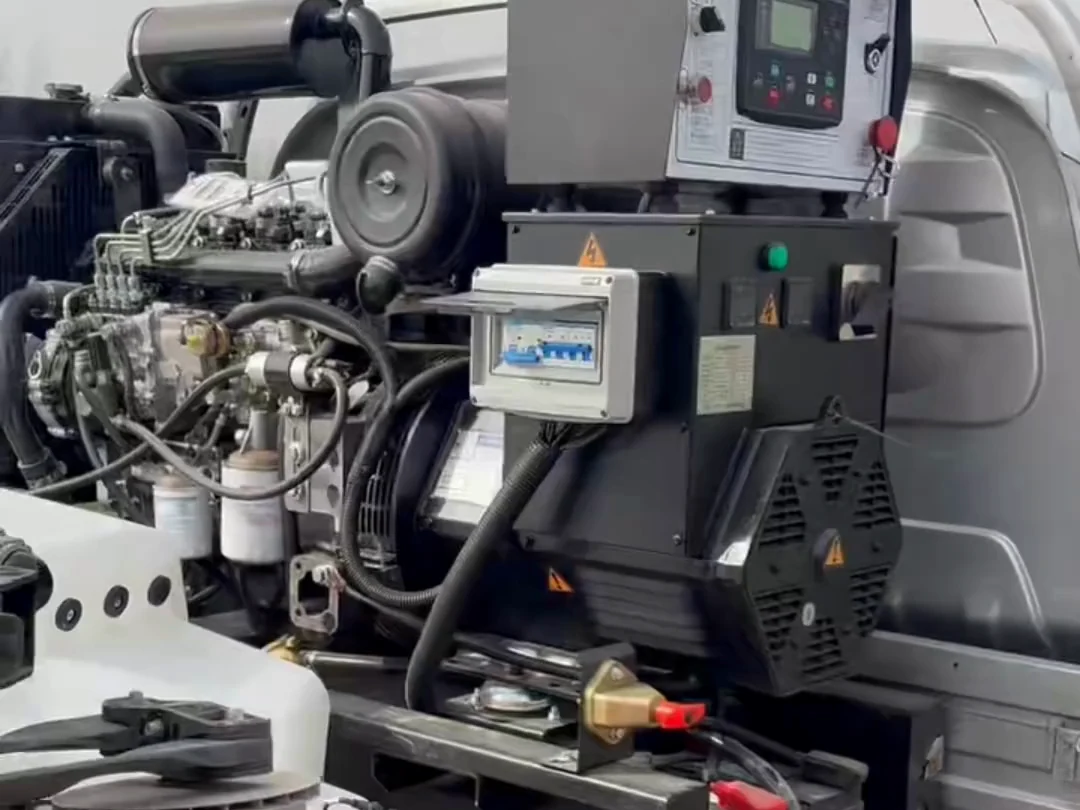
Compare the two builds on the outline drawing of the exact model, not on appearance. An open-frame set leaves the engine, alternator and control box exposed. Air reaches it freely, and so do rain, dust and spray drift. Every service point is in view, and nothing damps the sound.
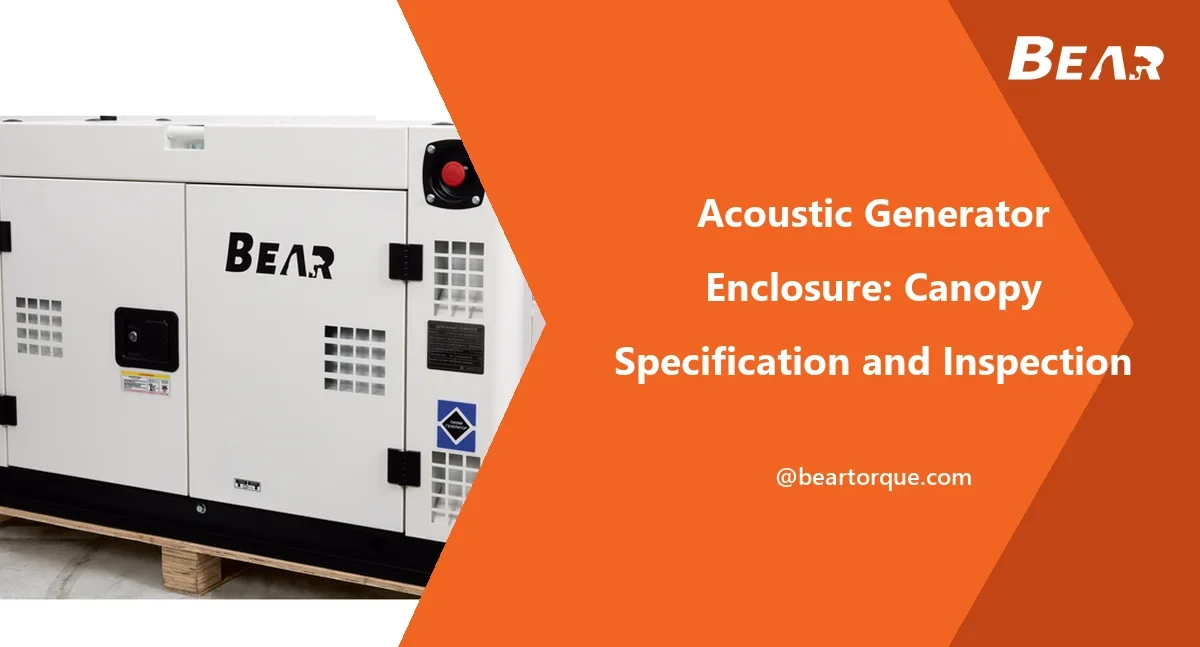
A canopy set adds weather protection and sound attenuation. It also adds weight and height, and it gives the set a defined air path that the installation must keep clear. The open-frame and enclosed comparison covers the general choice, and the canopy specification guide lists what to ask about panels, doors and lining.
A canopy does not make a set suitable for a closed trailer. The canopy takes cooling air in at one place and pushes it out at another, and both openings still need free outside air. Height matters wherever the set stands under a rack, a cover or an engineered compartment: a canopy that fits on paper may not fit once the set stands on its mounts.
Place the power block in the layout
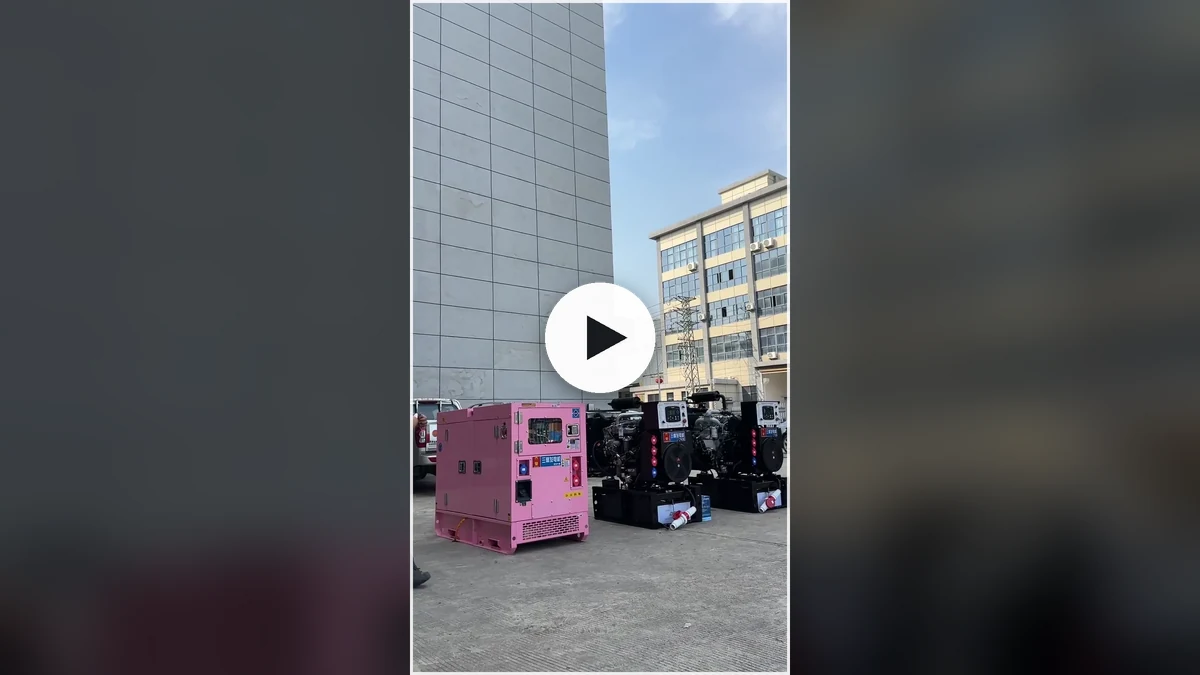
Put the generator where its hot air and exhaust leave the rig without crossing the places where people stand, batteries charge, chemicals are mixed or the drone lands. Then check that the fuel filler and the service side can still be reached with everything else installed. Four rules follow from that:
- Hot air and exhaust point outboard, because chargers and batteries need cool air and nobody should breathe exhaust.
- The cooling-air intake stays clear of walls, tanks and the hot-air outlet of any other machine.
- The fuel filler is reachable from outside the deck, without climbing over equipment and away from the exhaust.
- Chargers, batteries and cables stay out of the hot-air stream and off the walkway.
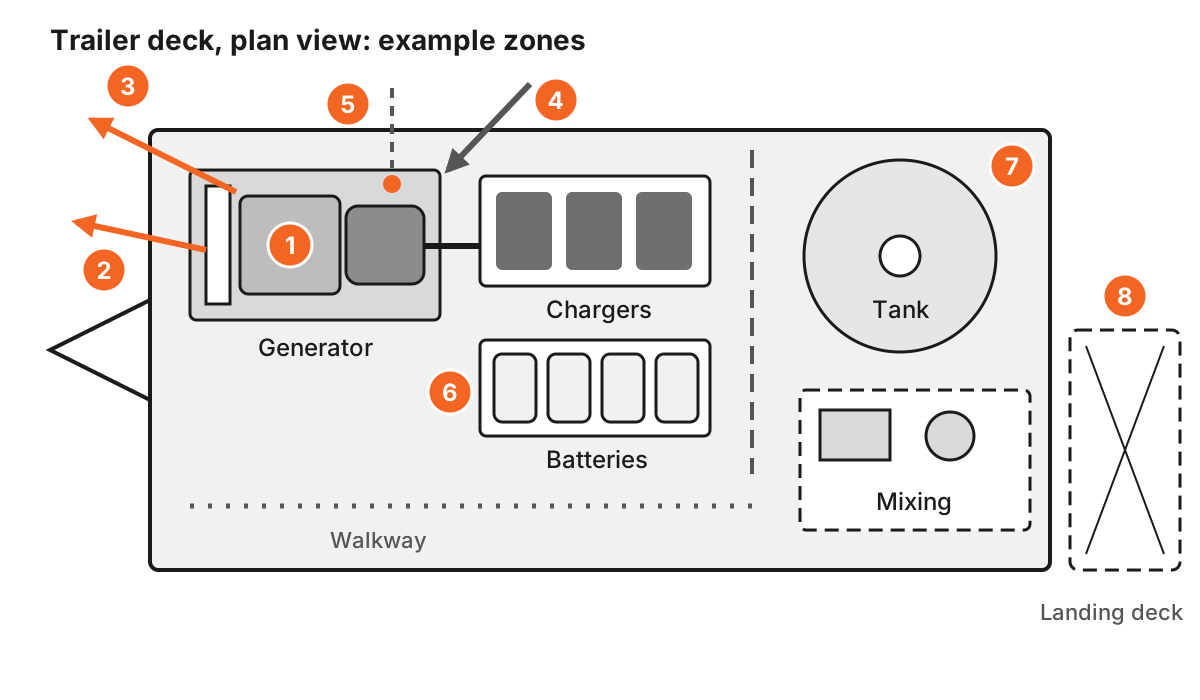
| # | Zone or direction | Why it sits there |
|---|---|---|
| 1 | Generator set | At one end, so its air and exhaust have a free edge of the deck |
| 2 | Hot cooling air | Leaves over the front of the deck, away from chargers and crew |
| 3 | Exhaust | Leaves at the front corner, pointing away from the filler, the crew and the landing deck |
| 4 | Cooling-air intake | Faces open air on the long side, not a tank or a wall |
| 5 | Fuel filler | Reachable from the ground on the long side, away from the exhaust end |
| 6 | Chargers and battery rack | Shaded, next to the outputs, outside the hot-air stream |
| 7 | Tank and mixing area | At the other end from the generator and its fuel, set apart from the charging zone |
| 8 | Landing deck | Clear of exhaust, cables and the walkway |
The positions on your rig depend on the body, the set and the fields you work. Purdue Extension's guide to spray-drone operations treats generator and battery placement, shade and heat as part of field setup, and Sprayers 101 describes the components of a drone tender. Both are useful for the rest of the rig; neither replaces the drawings of your own equipment.
Mounting: base frame, hole pattern and vibration
The generator supplier provides the base frame and its mounting-hole pattern; the trailer or body builder designs the structure that receives it. Ask for an outline drawing that shows the base footprint, the hole positions, the forklift pockets and the lifting points. Give that drawing to the builder before any cross-member is welded.
Inside the set, the engine and alternator normally sit on anti-vibration mounts above the base frame. Whether the base then needs further isolation from the deck depends on the set and the vehicle, and the supplier should state what it requires or allows. The base frame guide lists the frame fields to request.
A strap thrown over a canopy is not a mounting. How the set is restrained on the road follows the vehicle and trailer documents and local law, and the builder is the party who turns the supplier's hole pattern into a fixing.
Fuel on a moving rig: tank, filler and refuelling
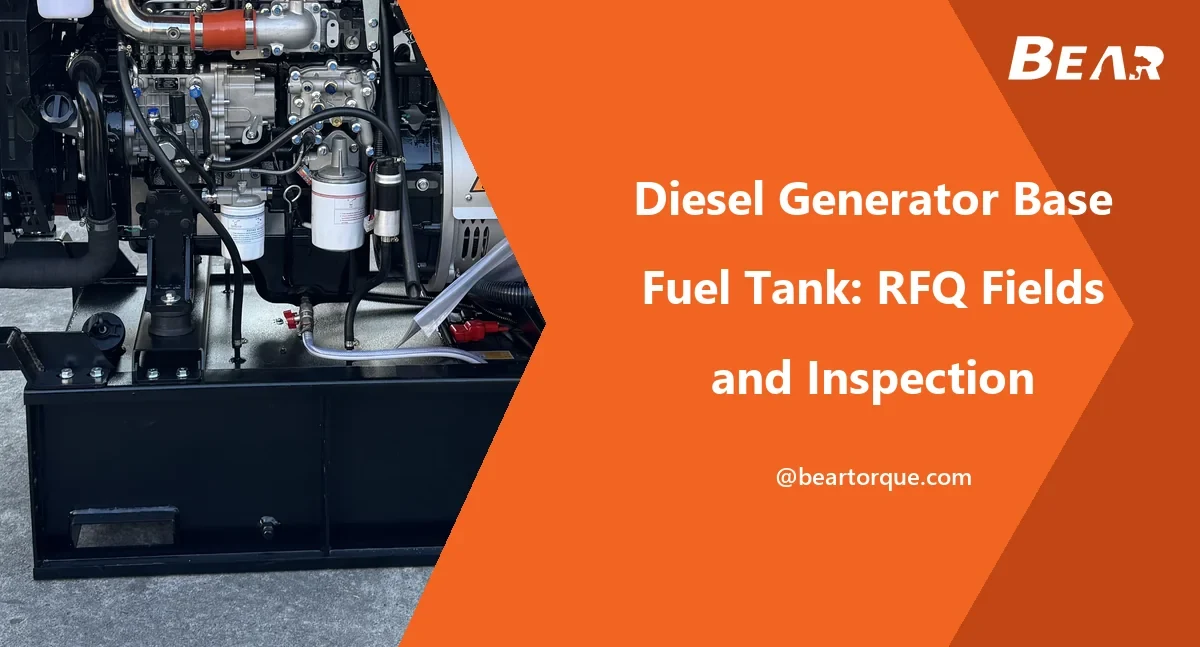
Decide first whether the set carries its own base tank or draws from a separate tank on the rig. A base tank keeps the fuel system inside the supplier's scope. A separate tank adds lines, fittings and a responsibility that someone has to own.
On a vehicle, fuel moves. Ask whether the base tank has internal baffles, where the filler and the level gauge sit, and how the level is read from the operating side. The base fuel tank guide lists the tank fields, and the fuel consumption guide shows how to turn a stated consumption into a day's fuel plan.
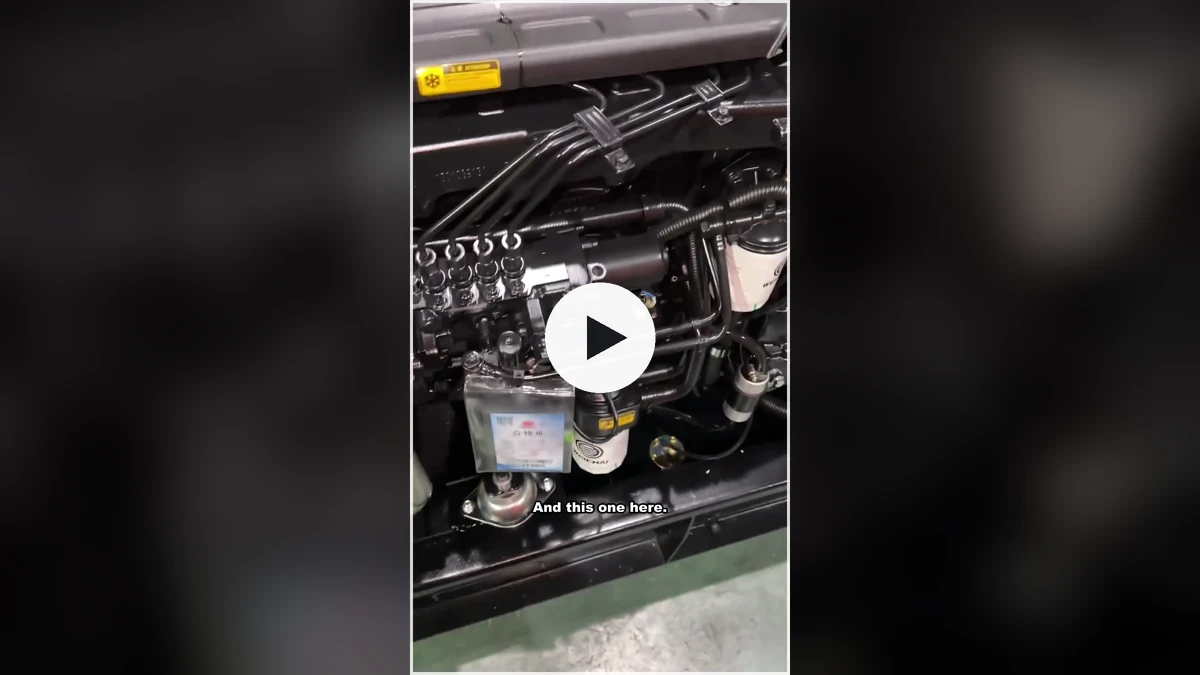
Refuelling is an operating routine, not a layout detail. Decide where it happens and how it is kept apart from charging batteries; whether the set has to be stopped first is answered by its manual. The equipment instructions and local rules govern that routine.
Exhaust and cooling air
Treat the exhaust outlet and the cooling-air path as features of the exact set, read from its drawing, not as distances to guess. The drawing shows where air enters, where hot air leaves and which way the exhaust points. The layout has to keep all three clear and aimed away from people, chargers, batteries, the mixing area and the landing deck.
An engine-driven generator is not run inside a closed trailer body. Open doors or a roof vent do not turn a cargo box into an engine room, and engine exhaust is dangerous in any confined space. If the rig is an enclosed trailer, there are two workable options. Run the set outside the body, or have the builder engineer a compartment for that set, separated from the space where people work and with its own air inlet, air outlet and exhaust routing, to the limits the supplier states.
The parts between the engine and the outlet (flexible section, silencer, flanges, rain cap and supports) are covered in the exhaust guide. On a rig, the question to settle with the builder is simpler: which way the outlet points when the trailer is parked for work.
Outputs, chargers and cable routes
Give the electrician two documents: the charger maker's input requirements and the generator supplier's socket schedule. From those the electrician designs the connection, the protection and the earthing under the local code. None of that is improvised on the deck.
Chargers shed heat of their own. Place them in shade and moving air, out of the generator's hot-air stream and away from the mixing area, and follow the operating environment in the charger manual. Route the cables where nobody walks, drives or sprays.
A set with its outputs, breaker and battery switch on one face makes the layout easier. Turn that face toward the charging zone and the other sides stay free for air and service. The generator outlets guide shows how to write the socket schedule.
Dust, spray drift and service access
Field dust, spray drift and fertiliser reach the radiator, the air filter and the electrical parts of any set that works beside a mixing station. Ask the supplier what finish the base frame and canopy carry and what the alternator and control box are protected against. Ask also what the manual says about cleaning the radiator and replacing the air filter in dusty work.
Then check the layout against the service list. The dipstick, oil filter, fuel filter, air filter, coolant filler and oil drain all need to be reachable with the rig fully fitted out. A set whose air filter faces the tank wall will not be serviced on time. The maintenance schedule guide shows the list to request.
Who answers what
Every open question on a rig has one party that can answer it. The table assigns each decision to that party and names the document that proves the answer.
| Decision | Who owns the answer | Proof |
|---|---|---|
| Set model, outline, wet weight, lifting points, air and exhaust directions, tank, outputs, service points | Generator supplier | Data sheet, outline drawing, manual |
| Position on the rig, support structure, access to filler and service side, air and exhaust routing through the body | Trailer or body builder | Layout and installation drawings |
| Payload, axle and tongue load, towing limits | Vehicle and trailer documents | Rating labels and manuals |
| Connection, protection, earthing, cable routes | Qualified electrician | Drawings and test records required locally |
| Chargers, work sequence, refuelling routine, site conditions | Operator | Charger manuals and the operating plan |
| Road, fuel, pesticide and workplace rules | Authority with jurisdiction | Current local rules and product labels |
Send the generator supplier the fields below for the exact model, and treat a field as answered only when a drawing or document comes back.
| Field to send | Complete answer |
|---|---|
| Outline and mounting | Drawing with overall size, base footprint and mounting-hole pattern |
| Weight | Wet weight with its inclusions, and lifting points |
| Air and exhaust | Intake side, hot-air outlet side, exhaust direction and any installation limits |
| Fuel | Base tank or none, stated volume, baffles, filler and gauge position |
| Outputs | Socket schedule with voltage, phase and breaker protection |
| Start | Start method, and remote start if the crew needs it |
| Build | Open frame or canopy, with size and weight for the quoted build |
| Vibration | Mounts fitted and what the supplier requires under the base |
| Finish | Coating of base frame and canopy; stated protection of alternator and control box |
| Service | Position of service points and the interval list |
To request a quotation from BEAR, send the carrier type, the space available for the set, the charger list and outputs you need, the build you prefer and the quantity through the inquiry page. The written quotation confirms the model, configuration, accessories and documents, and a sample unit or a factory visit can be arranged before a production order. The current ranges are on the open-frame diesel generator page and the silent diesel generator page.